

 Anteprima in scala reale
 Invia
Invia Condividi
 Dettagli opera
 Guida
Guida

 Scarica
 Simili
 Radiografia
 Slideshow
 Domande e risposte
 Statistiche
Il Conservatorio


"Il Conservatorio" di Édouard Manet: un affresco luminoso e raffinato che cattura l'intimità della vita borghese parigina del XIX secolo, simbolo dell'impressionismo francese. Scopri il suo stile innovativo e la sua storia!
 Espandi i dettagli
Esplora l'arte rivoluzionaria di Édouard Manet (1832-1883), una figura chiave nella transizione dal Realismo all'Impressionismo. Scopri i suoi capolavori controversi come 'Le Déjeuner sur l'herbe' & 'Olympia', e la sua influenza duratura sull'arte moderna.
Giclée / Stampe d'arte
Stampa giclée o su tela di qualità museale, con produzione rapida e diverse opzioni di finitura. ( Acquista il dipinto realizzato a mano Passa all'immagine digitale)




P118B €10

P118H €10

P118W €10

P438Z €10

P508JH €12

P508YH €12

P805H €10

P805Z €10

P919BZ €10

P919G €10

P919XJ €10

P959ZH €10

P968JZ €12

W106C €8

W218G €10

W218JH €8

W218Y €10

W307PJ €10

W316G €10

W316PJ €8

W316Y €10

W398PJ €8

W4111J €10

W500HY €15

W500JH €15

W692G €12

W849H €8

W940BG €15

W953PJ €8




Formato standard
su misura
CM
INCH
Scegli tra le nostre dimensioni predefinite, che rispettano le proporzioni originali dell'opera d'arte.
Loading sizes...

larghezza
altezza
Inserisci la larghezza e l'altezza desiderate, per adattarle alla tua cornice o alla tua parete. Una stampa può essere solo ritagliata, mai resa più grande dell'immagine originale; pertanto, un formato con una forma differente comporterà la perdita di una parte dell'opera. Ti invieremo un mockup digitale da approvare prima di procedere con la stampa. L'immagine mostrata in questa pagina non rappresenta il ritaglio reale — solo il mockup lo mostra.
Consegna in tutto il mondo () in 2 settimane invece delle normali 4/5 settimane. (8 Novembre)

Spedizione espressa gratuita in tutto il mondo

Tela in lino di alta qualità

Assicurazione completa sulla spedizione

Garanzia di rimborso dei dazi doganali

Garanzia di fedeltà cromatica assoluta

Politica di reso entro 100 giorni (solo per difetti di fabbricazione)

Garanzia di rimborso al 100%

Offerta per acquisti multipli
 L'opzione vetro è disponibile solo per dimensioni inferiori a 110 cm

Il Conservatorio
Giclée / Stampe d'arte
Dimensioni riproduzione
-


Prezzo finale calcolato
€ 62
The Conservatory
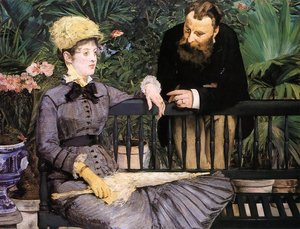
“The Conservatory” by Édouard Manet is a captivating oil on canvas painting created in 1879. This work exemplifies the artist’s unique blend of Realism and Impressionism, showcasing his ability to capture modern life with elegance and simplicity. It's a scene frozen in time—a Parisian conservatory bathed in soft light, inhabited by two figures engaged in an intimate conversation that speaks volumes about their relationship.The Painting and Its Context
Manet’s decision to depict this domestic interior wasn’t merely aesthetic; it reflected the broader artistic currents of his era. He sought to portray a slice of bourgeois life—a world increasingly concerned with social decorum and subtle nuances of emotion—without resorting to idealized representations. The painting was exhibited in the 1879 Paris Salon, where it provoked considerable debate among critics and viewers alike. Some lauded Manet’s masterful handling of light and color, recognizing his contribution to Impressionism's burgeoning influence; others questioned his stylistic choices, arguing that they strayed too far from traditional academic conventions. Nevertheless, “The Conservatory” stands as a pivotal moment in art history—a testament to Manet’s unwavering commitment to portraying the complexities of human experience with unflinching honesty.The Composition
The painting depicts two figures seated on a bench within a lush garden setting, surrounded by potted plants and flowers. The man and woman are engaged in conversation, their faces turned towards each other. Jules Guillemet and his wife, Mme Guillemet, were Manet’s friends and owners of a clothing shop—a connection that adds another layer of significance to the scene. In the background, several other people can be seen standing or sitting on benches, adding depth to the composition. A vase placed near the left side of the painting serves as a decorative element, subtly enhancing the overall atmosphere. Manet’s meticulous attention to detail—particularly in capturing the textures of fabric and foliage—demonstrates his mastery of technique and reinforces the impression of immediacy and spontaneity.Artistic Style
Manet's style in “The Conservatory” is characterized by his use of bold brushstrokes and vivid colors, typical of Impressionist techniques. Unlike academic painters who prioritized precise rendering and meticulous detail, Manet embraced a looser approach—allowing for visible marks of the brush to convey movement and luminosity. He skillfully blended pigments on canvas, creating an ethereal effect that captures the fleeting beauty of natural light. The overall composition is well-balanced, with the two main figures as the focal point while still allowing for other elements to create interest. This deliberate asymmetry contributes to the painting’s dynamism and invites contemplation about the unspoken tensions beneath the surface of their interaction.Historical Significance
Édouard Manet was a pivotal figure in the transition from Realism to Impressionism. His early masterpieces, such as “The Luncheon on the Grass” and “Olympia,” caused controversy but were later praised by progressive artists. These works challenged prevailing artistic conventions and paved the way for new aesthetic sensibilities—a legacy that continues to inspire artists today. "The Conservatory" embodies this spirit of innovation—representing a decisive break from tradition while simultaneously upholding Manet’s unwavering commitment to portraying human emotion with sensitivity and nuance. It remains an enduring symbol of modern art's ambition to capture the essence of life as it unfolds in everyday moments. ## Relevance at TopImpressionists At TopImpressionists, we offer high-quality, handmade oil painting reproductions of “The Conservatory” and other notable works by Édouard Manet. Our team of skilled artists ensures that each reproduction captures the essence and beauty of the original piece—preserving its luminosity and textural richness for generations to come. Explore a stunning selection of prints and canvases designed to elevate your interior décor and bring the timeless elegance of Impressionism into your home.Domande e risposte
Dove posso acquistare una riproduzione dipinta a mano di "Il Conservatorio" di Édouard Manet?
Le riproduzioni dipinte a mano di "Il Conservatorio" di Édouard Manet sono disponibili su questo sito web: una riproduzione a olio dipinta a mano su tela di lino, ordinabili tramite la pagina Riproduzione dipinta a mano.
Quando e con quali materiali è stata realizzata "Il Conservatorio"?
"Il Conservatorio" è stata realizzata nel 1879 con la tecnica Acrilico su tela.
Quale stato d'animo esprime "Il Conservatorio" di Édouard Manet all'interno di Impressionism?
L'emozione Serenità di "Il Conservatorio" accompagna il suo stile Impressionism.
Opere simili



Biografia dell'artista
vitae e carriera
Édouard Manet, pittore modernista francese, nacque il 23 gennaio 1832 a Parigi. Contrariamente alle sue radici aristocratiche e a un percorso navale predeterminato, Manet emerse come un audace pittore modernista francese le cui tele catturavano la vivacità della vita del XIX secolo. È ampiamente acclamato per il suo ruolo nel pionierismo dell'impressionismo, guidando l’arte dalle rappresentazioni realistiche a territori inesplorati.opere notevoli
Le prime opere capolavoro di Manet, Il pranzo sull'erba (Le déjeuner sur l’herbe) (1863) e Olimpia (1865), furono radicali, sfidando le norme artistiche e provocando indignazione tra i tradizionalisti. Queste opere provocatorie ottennero l'approvazione dei colleghi più lungimiranti, seminando i semi dell’impressionismo. * Il pranzo sull'erba (Le déjeuner sur l’herbe) (1863) - un dipinto che ha scatenato controversie sia da parte della critica che dell'Accademia di Belle Arti. * Olimpia (1865) - un'opera che ha causato grande scompiglio a causa della sua rappresentazione di una donna bianca nuda, accompagnata da una serva nera.musei e collezioni
Le opere di Manet si possono trovare in vari musei in tutto il mondo, tra cui: * Musée d’Orsay (Parigi, Francia) - sede di una vasta collezione dei dipinti di Manet, tra cui Olimpia. * Museo di Belle Arti (Boston, Stati Uniti) - presenta il Ritratto di Victorine Meurent, un'opera degna di nota nel suo percorso artistico.eredità e influenza
Lo stile innovativo di Manet, caratterizzato da pennellate ampie e veloci, illuminazione in studio e profondità limitata, è stato una grande influenza sui pittori futuri. La sua eredità può essere vista nelle opere di numerosi artisti che hanno seguito le sue orme.- Impressionismo: il suo lavoro pionieristico in questo stile lo ha reso un nome familiare tra gli appassionati d'arte.
- Realismo: il suo rifiuto degli approcci realistici tradizionali ha aperto la strada a una nuova generazione di artisti.
- Arte moderna: i contributi di Manet all’evoluzione dell’arte moderna sono innegabili, consolidando il suo posto nella storia dell'arte.
ulteriore lettura ed esplorazione
* Scopri di più sulla vita e sulle opere di Édouard Manet su TopImpressionists. * Esplora la collezione del Musée d’Orsay, che presenta una vasta gamma di dipinti di Manet, tra cui Olimpia, su TopImpressionists's pagina del museo.
Édouard Manet
1832 - 1883 , Francia
Dettagli rapidi
- Artisti Influenti:
- Caravaggio
- Diego Velázquez
- Gustave Courbet
- Artisti Influenzati:
- Claude Monet
- Pierre-Auguste Renoir
- Edgar Degas
- Data Di Nascita: 23 gennaio 1832
- Luogo Di Nascita: Parigi, Francia
- Movimento Artistico: Impressionismo, Realismo
- Nazionalità: Francese
- Nome Completo: Édouard Manet
- Opere Notevoli:
- Le Déjeuner sur l'herbe
- Olympia
- Madame Manet a Bellevue
- Ritratto di Mery Laurent
Articoli correlati

Luce e Materia: La Profondità della Texture nell'Olio su Tela Impressionista
Scopri il legame tra luce e materia nell'Impressionismo, dai maestri ai dettagli tecnici. Immergiti nella bellezza della pittura ad olio.
Esplora le opere d'arte organizzate per temi, stili e caratteristiche.


