A Portrait of Unease: Egon Schiele’s “Eduard Kosmack”
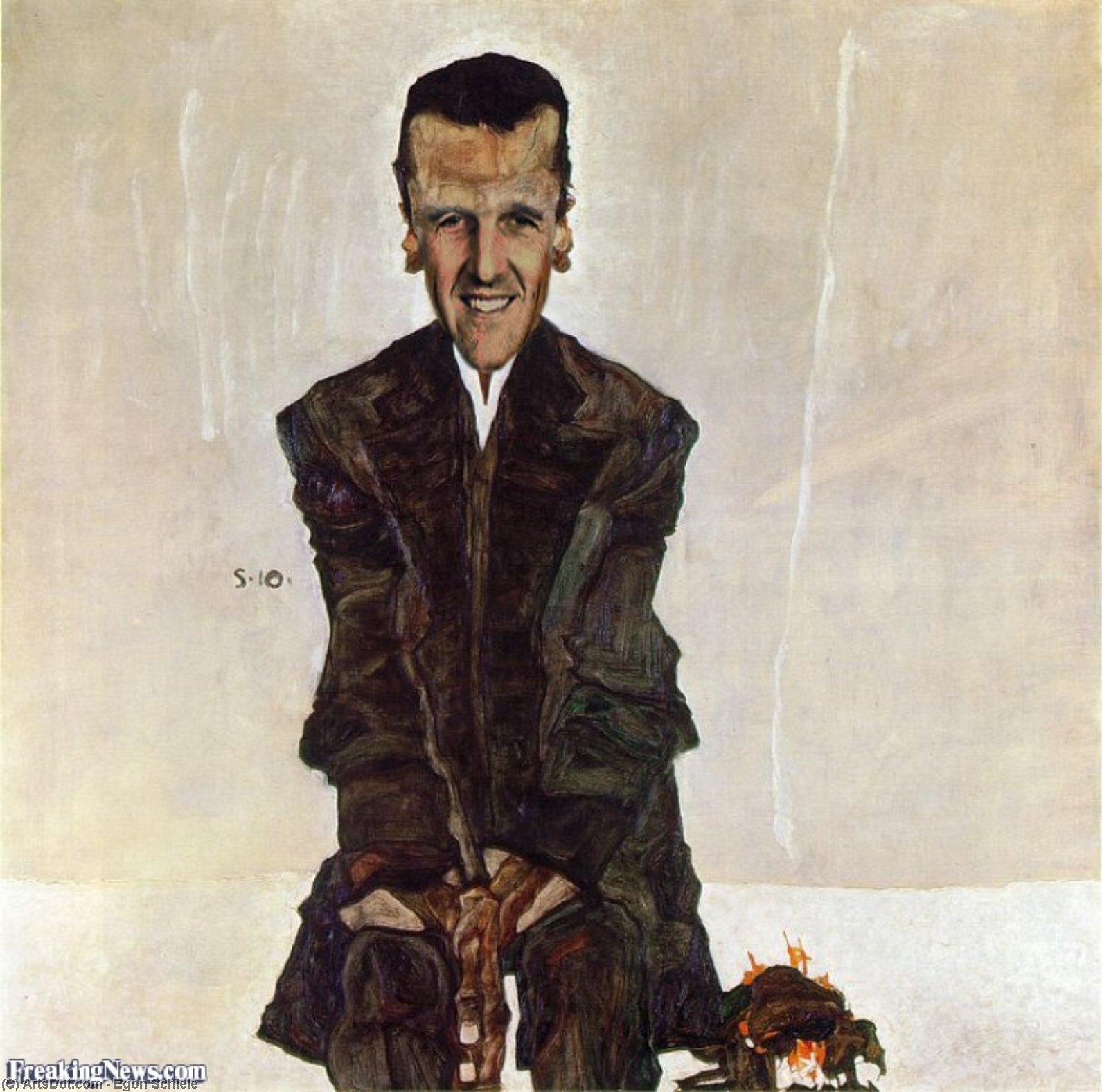
Egon Schiele's 1910 portrait of Eduard Kosmack is not merely a depiction of a man; it’s an excavation of the psyche, rendered with a raw intensity that defines the burgeoning Expressionist movement. Kosmack, a publisher who supported Schiele during a challenging period in his career, becomes less a specific individual and more a vessel for exploring themes of anxiety, introspection, and the unsettling nature of modern existence. The painting’s power lies not in its flattering representation, but in its unflinching honesty – a quality that both captivated and disturbed audiences of its time, and continues to resonate today.
The Language of Distortion: Style and Technique
Schiele abandons the traditional pursuit of realistic likeness, instead employing a visual language built on distortion and expressive line. The figure of Kosmack is not smoothly modeled or idealized; rather, he appears almost contorted, his limbs angular and his features subtly exaggerated. This deliberate departure from academic convention reflects Schiele’s rejection of societal norms and his desire to convey inner emotional states over superficial appearances. The brushwork itself is crucial – loose, visible strokes build up a textured surface, creating a sense of restless energy. Impasto, the thick application of paint, further emphasizes this tactile quality, inviting the viewer to not just *see* the portrait but almost *feel* its emotional weight. The muted palette of browns, grays, and ochres contributes to the somber mood, reinforcing the feeling of psychological depth. The flattened perspective adds to the sense of claustrophobia, drawing the viewer into Kosmack’s internal world.
Vienna 1910: A Crucible of Artistic Innovation
To understand “Eduard Kosmack” fully, one must consider its historical context. Vienna at the turn of the century was a hotbed of artistic and intellectual ferment. The established order was crumbling, giving rise to new ideas about psychology, sexuality, and the human condition. Figures like Sigmund Freud were challenging conventional understandings of the mind, and artists like Gustav Klimt – who served as a mentor to Schiele – were pushing the boundaries of representation. Schiele’s work emerged from this environment, reflecting the anxieties and uncertainties of a rapidly changing world. His willingness to confront taboo subjects, particularly those related to sexuality and mortality, made him a controversial figure, even leading to his brief imprisonment on charges of obscenity. However, it was precisely this uncompromising vision that established him as a pivotal voice in modern art.
Symbolism and the Gaze: Unraveling the Portrait’s Meaning
The power of “Eduard Kosmack” extends beyond its stylistic innovations to its subtle yet potent symbolism. Kosmack's unsettling smile, coupled with his intense, unwavering gaze, suggests a complex inner life – perhaps one marked by anxiety or hidden desires. The way he holds his hands, bony and clasped tightly, speaks to a sense of restraint or even repression. While the painting doesn’t offer easy answers, it invites us to contemplate the complexities of human emotion and the masks we wear to navigate the world. The very act of portraiture itself becomes a form of psychological inquiry, as Schiele attempts to capture not just Kosmack's physical appearance but also his inner essence. The work is a testament to Schiele’s belief that art should be an expression of subjective experience, rather than a mere imitation of reality.
Additional Research:
- Eduard Kosmack1910
- Egon Schiele
- Egon Schiele Art Centrum
- Leopold Museum
- Death and the Maiden (Schiele)


 Acquista stampa
 Invia
Invia Condividi
 Dettagli opera

 Scarica
 Simili
 Radiografia
 Slideshow

 Scopri di più






































 L'opzione vetro è disponibile solo per dimensioni inferiori a 110 cm