

Shown: · With its frame:
 Anteprima in scala reale
 Invia
Invia Condividi
 Dettagli opera
 Guida
Guida

 Scarica
 Simili
 Radiografia
 Slideshow
 Q&A
Q&A Statistiche

€ 239
Riproduzione a olio fatta a mano
Olio su tela dipinto a mano nelle tue dimensioni e con la tua cornice, realizzato su ordinazione dai nostri artisti. ( Passa alle stampe Passa all'immagine digitale)
Size
·Formato standard
su misura
CM
INCH
Scegli tra le nostre dimensioni predefinite, che rispettano le proporzioni originali dell'opera d'arte.
Loading sizes...

larghezza
altezza
Inserisci la larghezza e l'altezza desiderate, per adattarle alla tua cornice o alla tua parete. Trattandosi di un'opera dipinta a mano, in caso di dimensioni con un formato differente, l'artista può estendere leggermente il dipinto oltre i bordi dell'immagine o ritagliare una piccola parte — la scelta spetta a te. Ti invieremo un mockup digitale da approvare prima che la realizzazione abbia inizio. L'immagine mostrata in questa pagina non rappresenta il risultato finale — solo il mockup lo fa.
 Scopri di più
Finish
·
White €1

Blurside €1

Extended €1

P118B €10

P118H €10

P118W €10

P438Z €10

P508JH €12

P508YH €12

P805H €10

P805Z €10

P919BZ €10

P919G €10

P919XJ €10

P959ZH €10

P968JZ €12

W106C €8

W218G €10

W218JH €8

W218Y €10

W307PJ €10

W316G €10

W316PJ €8

W316Y €10

W398PJ €8

W4111J €10

W500HY €15

W500JH €15

W692G €12

W849H €8

W940BG €15

W953PJ €8

H24-GOLD €30

H24-SILVER €30

H36-GOLD €45

H36-SILVER €45
Shipped in a protective tube, ready for your own framer.
Above 105 cm the frame is shipped as a kit for a professional framer — read the details.
Extras
optionalWhat do the extras include?
Examples of what can be changed: Replace face with customer photo; Add pet (e.g., replace cat with dog); Include hidden message in background; Change background landscape or elements.
After order, TopImpressionists.com team will email client for instructions and provide a mockup preview
After order, TopImpressionists.com team will email client for instructions and provide a mockup preview
Consegna in tutto il mondo () in 3/4 settimane anziché nelle normali 5 settimane. (2 Novembre). Nessun compromesso sulla qualità.
Vernice protettiva
Didascalia
Dettagli della targhetta in bronzo inciso
This elegant plaque features the artist's name and the title of the artwork, finely engraved for a timeless presentation.
It is made from bronze with a refined, elegant finish. The text is precisely laser-engraved for a sharp and permanent result. Measuring 9x2 cm, the plaque is compact yet easy to read. It's built to be durable and scratch-resistant, offering a professional, museum-quality look. Mounting is simple thanks to the included adhesive backing.
Dettagli della targhetta in acrilico trasparente
The plaque includes essential engraved details such as the artist's name, the title of the artwork, the date it was created, the type of media used-like oil on canvas or watercolor-a brief description of the piece, and a QR code that links to the complete artwork information.
It is crafted from clear acrylic, offering a sleek, modern appearance. The text is UV-engraved in black to ensure strong visual contrast. With a size of 10x15 cm, it ensures optimal readability. It comes equipped with two metal hooks for secure wall mounting. The plaque is designed to be weather-resistant, making it suitable for various environments, and it includes interactive features that work seamlessly with smartphone scanning.
Dettagli della targhetta in acrilico nero
This elegant plaque includes engraved information such as the artist's name, the title of the artwork, the date it was created, the type of media used (like oil on canvas or watercolor), a short description of the artwork, and a QR code for quick access to more information.
The plaque itself is made from refined black acrylic with a premium finish. The text is laser-engraved in white for high contrast and readability. Its size is 10x15 cm, designed to be easy to read. It comes with two metal hooks for professional mounting. The design is sleek and fits any interior style. It is also weather-resistant and durable, with built-in digital integration for mobile compatibility.
L'opzione vetro è disponibile solo per dimensioni inferiori a 110 cm
 L'opzione vetro è disponibile solo per dimensioni inferiori a 110 cm
- Spedizione espressa gratuita in tutto il mondo
- Tela in lino di alta qualità
- Assicurazione completa sulla spedizione
- Garanzia di rimborso dei dazi doganali
- Garanzia di fedeltà cromatica assoluta
- Politica di reso entro 100 giorni (solo per difetti di fabbricazione)
- Garanzia di rimborso al 100%
- Offerta per acquisti multipli


Descrizione del reperto
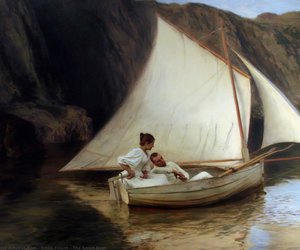
A tender moment of French Realism unfolds in Maternal Tenderness by Émile Friant as a mother cradles her child amidst a serene field, inviting you to bring this evocative 1906 masterpiece into your private collection.
Biografia dell'artista
Scopri le opere realistiche di Émile Friant (1863-1932), un artista francese celebre per ritratti evocativi, scene di vita quotidiana e soggetti patriottici come 'La Toussaint'. Esplora la sua carriera artistica e l'influenza nel panorama artistico del primo Novecento.
About the painting
A Moment Frozen in Time: The Soul of Maternal Tenderness
In the quietude of a sun-drenched field, Émile Friant captures a scene that transcends mere observation, inviting the viewer into a sanctuary of pure emotion. Maternal Tenderness, painted in 1906, is far more than a depiction of a woman and her child; it is a profound meditation on the sanctity of the maternal bond. As the eye wanders through the lush, verdant grass, one encounters a mother cradling her infant with an intimacy that feels both private and universal. The soft light of the French countryside bathes the subjects in a warm, nostalgic glow, while the presence of two loyal dogs resting nearby adds a layer of domestic peace and companionship. This is a world where time seems to slow down, allowing the viewer to breathe in the serene atmosphere of a summer afternoon.
The composition is masterfully orchestrated to draw the heart toward the center of the frame. The woman, dressed in the simple, elegant attire of the era with a delicate bonnet framing her face, serves as the emotional anchor of the piece. Every brushstroke contributes to the sense of weight and warmth in the child's small form against her embrace. A subtle detail, such as the handbag resting on the ground, grounds this ethereal moment in the reality of everyday life, suggesting that this profound connection is found not in grand gestures, but in the quiet, unadorned intervals of our daily existence.
The Mastery of French Realism
As a pivotal figure in the transition between 19th-century realism and the dawn of modernism, Émile Friant utilized his technical prowess to elevate genre painting to new heights of psychological depth. Through the medium of oil on canvas, Friant employs a meticulous technique that honors the traditions of French Realism while infusing them with a soft, almost impressionistic light. His ability to render textures—the roughness of the earth, the softness of a child's skin, and the gentle movement of the surrounding trees—demonstrates a scientific precision learned from his early training, yet it is always subservient to the emotional truth of the scene.
For the discerning collector or interior designer, this painting offers a sophisticated balance of detail and atmosphere. The palette, rich with natural greens, earthy tones, and soft highlights, makes it an exquisite centerpiece for a room designed for contemplation and comfort. It does not merely decorate a wall; it transforms a space, bringing with it a sense of historical weight and a calming, pastoral elegance. To possess a reproduction of this work is to invite the timeless grace of the Belle Époque into the modern home, serving as a constant reminder of the beauty found in life's most tender connections.
Domande e risposte
Émile Friant, autore di "Maternal Tenderness", è conosciuto con altri nomi?
Altri nomi registrati per Émile Friant, autore di "Maternal Tenderness", includono Emile Friant.
Qual è la tonalità dominante di "Maternal Tenderness" di Émile Friant?
"Maternal Tenderness" tende verso una tonalità Green to Violet Spectrum.
In quale stanza si consiglia di esporre "Maternal Tenderness" di Émile Friant?
Una riproduzione di "Maternal Tenderness" si adatta perfettamente a un/una Bedroom.
Quick facts and art quiz
About Émile Friant

Émile Friant
1863 - 1932, Francia
Biografia dell'artista
A Life Rooted in Realism: The World of Émile Friant
Émile Friant, born in Dieuze, Lorraine (France), on April 16, 1863, stands as a significant figure within the landscape of French realism—a movement that sought to depict the world with unflinching honesty and meticulous detail. His artistic journey unfolded against the backdrop of transformative historical events, notably the Franco-Prussian War, which profoundly impacted his formative years and instilled in him a deep appreciation for the complexities of identity and displacement. The family’s relocation to Nancy following the annexation by Prussia fostered an awareness of societal shifts that would undoubtedly inform Friant's artistic sensibilities. Early musical inclinations—a passion nurtured by his father—were swiftly superseded by an irresistible pull toward visual arts, guided initially by Louis-Théodore Devilly in Nancy. Devilly’s pedagogical approach championed direct observation and painstaking rendering—principles that became central to Friant’s distinctive style: a realism imbued with palpable emotion and astute psychological insight. A pivotal moment arrived when Friant gained admittance to the École des Beaux-Arts in Paris, securing him access to influential artistic circles and cementing his commitment to mastering academic techniques alongside exploring personal expression. Though initially grappling with the constraints of the atelier system—a tradition prioritizing formal training—Friant quickly recognized the value of experimentation and sought inspiration from diverse sources. His formative years coincided with the burgeoning Impressionist movement, spearheaded by Claude Monet and Pierre-Auguste Renoir, whose revolutionary use of light and color challenged prevailing artistic conventions. Friant absorbed these innovations while simultaneously cultivating his own unique vision—a synthesis that would characterize his oeuvre throughout his career. The École des Beaux-Arts provided him with invaluable connections to fellow artists and critics, fostering a collaborative environment conducive to intellectual exchange and artistic growth.Parisian Training and Early Salon Successes
Friant’s Parisian education solidified his understanding of artistic history and propelled him toward ambitious goals—namely, achieving recognition within the prestigious Salon system. Alexandre Cabanel, a celebrated academic painter known for his monumental portraits of dignitaries and historical figures, served as Friant’s mentor, imparting invaluable skills in anatomical accuracy and compositional balance. However, Friant yearned to transcend Cabanel’s stylistic conservatism—a desire fueled by an innate inclination toward capturing the subtleties of human emotion and psychological states. This impulse led him back to Nancy, where he continued his artistic pursuits while actively participating in local exhibitions—demonstrating a commitment to both tradition and innovation. The Salon presented Friant with a crucial platform for showcasing his talent and garnering critical acclaim; it was here that he honed his craft and cultivated enduring friendships with prominent actors Ernest Coquelin and Benoit Coquelin, relationships that yielded compelling portrait commissions—a hallmark of his artistic identity. A decisive breakthrough arrived in 1886 when Friant secured a grant from the Salon—allowing him to embark on a transformative journey to Holland. This immersive experience exposed him to the monumental canvases of Dutch Masters—particularly Rembrandt and Frans Hals—who championed dramatic lighting and unflinching realism. The influence of these artists resonated deeply within Friant’s artistic consciousness, shaping his technique and informing his aesthetic sensibilities. He meticulously studied the nuances of chiaroscuro—the interplay between light and shadow—and embraced a compositional style that prioritized clarity and expressive force. Returning to Paris with renewed vigor, Friant continued to refine his skills while actively engaging in the vibrant artistic milieu of the Belle Époque—a period characterized by optimism, technological advancement, and cultural dynamism. ## Mature Works: Portraits, Genre Scenes, and North African Influences Friant’s mature artistic output is distinguished by a remarkable sensitivity to human psychology and an unwavering dedication to portraying everyday life with meticulous detail. He achieved particular renown for his portraits—capturing not merely physical likeness but also the inner character and emotional state of his subjects—a feat accomplished through painstaking observation and masterful rendering. Among his most celebrated canvases are depictions of Nancy’s social elite—individuals rendered with profound empathy and psychological insight—reflecting Friant's conviction that art should illuminate the complexities of human experience. Furthermore, he excelled in genre scenes—capturing moments of domestic tranquility and social interaction—demonstrating a talent for conveying atmosphere and emotion through subtle visual cues. A pivotal influence emerged from his travels to Algeria and Tunisia—experiences that broadened his artistic horizons and infused his landscapes with vibrant color palettes inspired by the exotic beauty of North Africa. Friant’s canvases bear witness to this fascination—depicting scenes of Berber villages, desert vistas, and bustling marketplaces—all rendered with remarkable precision and imbued with a palpable sense of place. His meticulous attention to detail—evident in every brushstroke—underscores his commitment to representing the world as he perceived it—a testament to his artistic integrity and intellectual curiosity. Notably, Friant’s stylistic evolution mirrored broader trends within French painting—particularly the embrace of Impressionism and Neo-Impressionism—reflecting a willingness to adapt to changing aesthetic sensibilities while maintaining steadfast adherence to fundamental principles. ## Legacy and Recognition Émile Friant died in Paris on June 9, 1932, marking the culmination of a distinguished artistic career—one characterized by unwavering dedication to realism and profound empathy for human subjects. His work garnered considerable acclaim during his lifetime—receiving numerous awards at prestigious salons and securing membership in the Institut de France—the highest honor bestowed upon artists in France. Friant’s legacy resides primarily in his contribution to French painting—particularly his pioneering exploration of genre scenes and portraits—which continue to inspire admiration for their beauty, psychological depth, and unwavering fidelity to observation. He stands as a pivotal figure bridging the gap between academic tradition and Impressionist innovation—a testament to his artistic versatility and enduring relevance within the history of art. His canvases exemplify the power of visual representation to convey emotion and illuminate human experience—a legacy that resonates powerfully with audiences today.Quick facts about Émile Friant
- Artistic Movement Or Style: Realismo
- Artists Or Movements Influenced By This Artist: ['Arte del primo Novecento']
- Artists Who Influenced This Artist:
- Louis-Théodore Devilly
- Alexandre Cabanel
- Date Of Birth: 1863
- Date Of Death: 1932
- Full Name: Émile Friant
- Nationality: Francese
- Notable Artworks:
- La Toussaint
- Autoritratto
- I Giovani
- Place Of Birth: Dieuze, Francia
Opere simili


Esplora le opere d'arte organizzate per temi, stili e caratteristiche.



Émile Friant
Maternal Tenderness
() ·
With its frame: · Hand-painted in oil on linen
Total