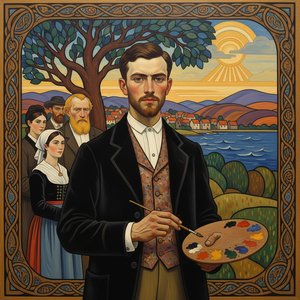
Blue Trees: A Symphony of Color and Symbolism
Paul Gauguin’s Blue Trees stands as a cornerstone of Post-Impressionist art—a bold declaration against the prevailing artistic conventions of its time and an enduring testament to Gauguin’s singular vision.
Painted in 1888 during his formative years in Tahiti, this oil on canvas masterpiece transcends mere representation; it embodies a profound exploration of spirituality and primal beauty. Measuring 92 x 73 cm and currently residing within The Ordrupgaard Collection in Copenhagen, The Ordrupgaard Collection, it immediately captivates the viewer with its audacious palette—dominating blues juxtaposed against a warm sunset glow.
Composition and Style: Cloisonnism’s Influence
Gauguin’s compositional approach reflects the stylistic principles of Cloisonnism, a technique championed by artists like Henri Matisse. Characterized by flattened planes delineated by thick black outlines—a deliberate rejection of Impressionistic realism—the painting prioritizes expressive color and simplified forms. This stylistic choice lends an almost sculptural quality to the scene, emphasizing the monumental presence of the trees against the expansive sky.
Significance Within Post-Impressionism: Beyond Observation
Unlike Impressionists who sought to capture fleeting moments of light and atmosphere, Gauguin aimed to convey inner emotions and psychological states. Blue Trees isn’t simply a depiction of Tahiti’s landscape; it's an attempt to distill its essence—to communicate the artist’s spiritual connection with nature and his yearning for transcendence.
Color Palette and Emotional Resonance
The masterful use of color is paramount to Gauguin’s artistic achievement. The vibrant blues—ranging from deep indigo to cerulean—evoke feelings of serenity, contemplation, and perhaps even melancholy. Simultaneously, the yellows and oranges of the sunset convey warmth, optimism, and a sense of vitality. These contrasting hues create a dynamic interplay that mirrors the complexities of human experience.
Legacy: Inspiration for Modern Art
Gauguin’s groundbreaking style profoundly impacted subsequent generations of artists—most notably Pablo Picasso and Henri Matisse—who embraced his bold experimentation with color and form. Blue Trees remains an iconic symbol of Post-Impressionism’s rebellious spirit—a reminder that art can serve as a conduit for profound emotional expression and spiritual contemplation.
For more information on Gauguin's artistic journey and his enduring influence, visit https://TopImpressionists.com.



 Acquista stampa
 Invia
Invia Condividi
 Dettagli opera

 Scarica
 Simili
 Radiografia
 Slideshow
 Scopri di più






































 L'opzione vetro è disponibile solo per dimensioni inferiori a 110 cm