Atelier — Spedizione gratuita in tutto il mondo — Consegna in 2–6 settimane
Lista dei desideri Carrello
Acquista stampa Acquista stampaAcquista download Acquista download InviaInvia
Dettagli operaDettagli opera Aggiungi ai preferiti Aggiungi ai preferiti ScaricaScarica SimiliSimili RadiografiaRadiografia SlideshowSlideshow

Dead nature

Explore Georges Braque's masterful still lifes—featuring serene landscapes and subtle color palettes—in *The Poetry of Things*, a London exhibition celebrating his enduring legacy beyond Cubism.

Esplora la vita e l'arte di Georges Braque (1882-1963), una figura chiave della pittura del XX secolo. Pioniere del Cubismo insieme a Picasso, noto per il Fauvismo, il collage e forme geometriche innovative. Scopri la sua eredità su TopImpressionists!

Riproduzione a olio fatta a mano

Olio su tela dipinto a mano nelle tue dimensioni e con la tua cornice, realizzato su ordinazione dai nostri artisti.

P118B $10
P118H $10
P118W $10
P438Z $10
P508JH $12
P508YH $12
P805H $10
P805Z $10
P919BZ $10
P919G $10
P919XJ $10
P959ZH $10
P968JZ $12
W106C $8
W218G $10
W218JH $8
W218Y $10
W307PJ $10
W316G $10
W316PJ $8
W316Y $10
W398PJ $8
W4111J $10
W500HY $15
W500JH $15
W692G $12
W849H $8
W940BG $15
W953PJ $8

Standard
custom
CM
INCH

Scegli tra le nostre dimensioni predefinite, che rispettano le proporzioni originali dell'opera d'arte.

larghezza
altezza

È possibile inserire dimensioni personalizzate per adattare l'opera a una cornice o a uno spazio specifico. Se la dimensione selezionata non corrisponde alle proporzioni dell'immagine originale, provvederemo a ritagliare l'opera o a estendere il dipinto con elementi aggiuntivi dipinti a mano. Un mockup digitale ti sarà inviato per approvazione prima dell'inizio della produzione.
Si prega di notare che l'anteprima a schermo non riflette il ritaglio o l'estensione effettivi. Solo il mockup mostrerà accuratamente la composizione finale.
Sebbene siano disponibili dimensioni personalizzate, consigliamo di selezionare una dimensione dall'elenco predefinito per preservare le proporzioni originali.

Esempi di modifiche possibili: sostituire il volto con una foto del cliente; aggiungere un animale domestico (ad esempio, sostituire un gatto con un cane); inserire un messaggio nascosto sullo sfondo; modificare il paesaggio o gli elementi dello sfondo.
Dopo l'ordine, il team di TopImpressionists.com invierà un'e-mail al cliente per le istruzioni e fornirà un'anteprima del mockup

Consegna in tutto il mondo () in 3/4 settimane anziché nelle normali 5 settimane. (22 Luglio). Nessun compromesso sulla qualità.

why_choose_icon
Spedizione espressa gratuita in tutto il mondo
why_choose_icon
Tela in lino di alta qualità
why_choose_icon
Assicurazione completa sulla spedizione
why_choose_icon
Garanzia di rimborso dei dazi doganali
why_choose_icon
Garanzia di fedeltà cromatica
why_choose_icon
Politica di reso entro 60 giorni (solo per difetti)
why_choose_icon
Garanzia di rimborso al 100%
why_choose_icon
Sconto per acquisti multipli

Prezzo totale

-

reproduction

Dead nature

Tecnica di riproduzione

Dimensioni riproduzione

-

Prezzo totale finale

-

Informazioni rapide

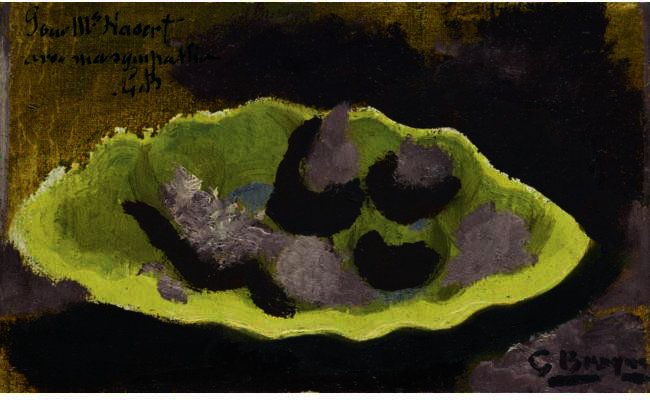
  • Notable elements or techniques: Bowl with greenish-yellow color; Black dots
  • Subject or theme: Still life
  • Influences: Paul Cézanne
  • Artistic style: Analytical Cubism
  • Medium: Painting
  • Movement: Cubism

Descrizione dell'opera

Georges Braque: A Quiet Revolution in Still Life

The painting “Dead Nature,” by Georges Braque—a deceptively understated work from 1930—represents more than just a depiction of fruit and glass; it embodies the core tenets of Cubism’s radical reimagining of visual perception. Exhibited at Bernard Jacobson Gallery, alongside other masterful pieces from Braque's oeuvre, this artwork speaks volumes about his artistic philosophy and its enduring legacy within modern art history.

The Genesis of Cubist Vision

Born in Argenteuil, France, in 1882, Georges Braque’s formative years instilled in him a profound appreciation for form and structure—a sensibility that would propel him to the forefront of the avant-garde movement. Initially pursuing a career as a house painter alongside his father, he swiftly recognized the limitations of traditional artistic representation and sought new ways to capture reality. His encounter with Pablo Picasso at Académie Humbert in Paris proved pivotal, sparking an intellectual collaboration that irrevocably altered the course of art. Together, they dismantled conventional perspective and compositional conventions, prioritizing simultaneous viewpoints—a technique central to Cubism’s revolutionary approach.

Analyzing “Dead Nature”: Form and Texture

“Dead Nature” exemplifies Braque's meticulous attention to detail and his masterful manipulation of texture. The painting showcases a simple arrangement: a ceramic bowl containing greenish-yellow fruit juxtaposed with a glass vessel reflecting ambient light. However, the brilliance lies not in its apparent simplicity but in the fragmented representation of each element. Geometric planes—primarily cubes and cylinders—intersect and overlap, disrupting any illusion of depth or spatial coherence. The artist’s use of muted earthy tones—particularly ochre and umber—creates a harmonious balance against the vibrant yellow hue of the fruit bowl. Furthermore, Braque skillfully employs glazing techniques to achieve remarkable luminosity and textural variation, capturing the subtle sheen of glass and the velvety surface of the fruit.

Historical Context: Embracing Fragmentation

Cubism emerged in Paris during the early 1920s as a reaction against Impressionism’s focus on fleeting impressions of light and color. Artists like Picasso and Braque sought to depict objects from multiple perspectives simultaneously, reflecting the influence of Cezanne's explorations into geometric abstraction. This stylistic innovation wasn’t merely an aesthetic experiment; it mirrored broader intellectual currents—particularly Einstein’s theory of relativity—which challenged Newtonian conceptions of space and time. “Dead Nature” stands as a testament to this transformative period in art history, demonstrating Braque’s unwavering commitment to pushing the boundaries of artistic expression.

Symbolism Beyond Representation

While seemingly objective in its depiction of inanimate objects, "Dead Nature" carries subtle symbolic resonances. The bowl itself—often associated with containment and reflection—represents both the materiality of existence and the artist's attempt to capture a moment frozen in time. The black dots scattered throughout the composition serve as visual anchors, disrupting the flatness of the surface and emphasizing Braque’s preoccupation with geometric abstraction. They invite contemplation on the nature of perception and challenge viewers to consider alternative ways of seeing—a core principle of Cubist thought.

Emotional Resonance: Quiet Contemplation

Despite its intellectual rigor, “Dead Nature” possesses a remarkable emotional depth. The subdued palette and meticulous rendering convey a sense of stillness and contemplative observation—mirroring Braque’s own artistic temperament. It's an artwork that invites viewers to slow down, to appreciate the beauty of simplicity, and to engage in a dialogue with the fundamental questions posed by modern art. Like many of Braque’s paintings, it speaks not just to the eye but also to the soul—a testament to his enduring ability to capture profound truths about human experience within the framework of geometric abstraction.

Biografia dell'artista

**primi anni di vita e formazione**

Georges Braque, un illustre pittore francese, collageur, disegnatore, stampatore e scultore, nacque il 13 maggio 1882 ad Argenteuil, Val-d'Oise. È cresciuto a Le Havre e inizialmente si è formato per diventare pittore di facciate e decoratore come suo padre e nonno. Tuttavia, le inclinazioni artistiche di Braque lo hanno portato a studiare pittura all’École des Beaux-Arts a Le Havre dal 1897 al 1899.

**evoluzione artistica e fauvismo**

Nel 1902, dopo aver completato il suo apprendistato con un decoratore a Parigi, Braque ha frequentato l'Académie Humbert fino al 1904. Questo periodo ha segnato la sua introduzione al fauvismo, uno stile caratterizzato da colori vivaci e risposte emotive. Influenzato dalle opere di Henri Matisse e André Derain, Braque ha adottato un approccio fauvista, come si può vedere nel suo dipinto La Pazienza (fauvismo, olio su tela).

**contributo al cubismo**

La collaborazione di Braque con Pablo Picasso dal 1908 al 1912 ha portato allo sviluppo del cubismo. Le loro opere cubiste analitiche, come Georges Braque: La Pazienza e Pablo Picasso: Clarinet(cubismo analitico, olio su tela), sono oggi considerate pietre miliari della storia dell'arte.

**eredità e opere notevoli**

* Le Case all’Éstaque: una testimonianza dell'uso innovativo di geometria e prospettiva simultanea da parte di Braque. * La Pazienza(fauvismo, olio su tela): dimostra lo stile fauvista di Braque. * Clarinet(cubismo analitico, olio su tela): un'opera cubista collaborativa con Picasso.

**musei e collezioni**

* Musée d’Orsay: presenta una vasta collezione di arte impressionista e post-impressionista, inclusi lavori di Braque. * Musée de l’Orangerie: espone una vasta gamma di opere d'arte, inclusi quelle di Braque e altri artisti notevoli. **Lo stile innovativo di Georges Braque e la sua collaborazione con Pablo Picasso continuano a ispirare artisti e appassionati d'arte.**

Georges Braque

Georges Braque

1882 - 1963 , Francia

Dati rapidi

  • Artisti Influenti:
    • Henri Matisse
    • André Derain
    • Paul Cézanne
  • Artisti Influenzati: ['Pablo Picasso']
  • Data Di Nascita: 13 maggio 1882
  • Luogo Di Nascita: Argenteuil, Francia
  • Movimento Artistico: Cubismo, Fauvismo
  • Nazionalità: Francese
  • Nome Completo: Georges Braque
  • Opere Notevoli:
    • Case a L'Estaque
    • La Pazienza (fauvista)
    • Chitarra, Frutta e Brocca
    • Natura morta con Bass
Esplora opere d'arte organizzate per temi, stili e caratteristiche.
© TopImpressionists.com — Tutti i diritti riservati  ·  100% Dipinto a mano · Soddisfazione garantita · Spedizione gratuita in tutto il mondo
VISA MASTERCARD