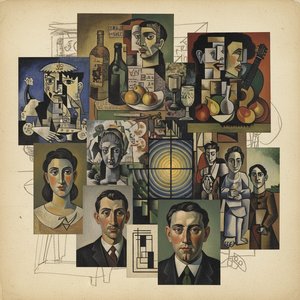
Still Life with Lemons – A Cubist Exploration of Form and Color
Georges Braque’s “Still Life with Lemons,” painted in 1910, stands as a cornerstone of Cubism, representing not merely an observation of the natural world but a radical reimagining of how it could be depicted. This deceptively simple composition—six lemons arranged on a wooden tabletop—embodies the core tenets of Picasso and Braque’s groundbreaking artistic approach.
The Style of Fragmentation
Cubism, born from the collaborative efforts of Picasso and Braque, rejected the illusionistic techniques prevalent in Impressionism and Neoclassicism. Instead of striving to reproduce visual reality faithfully, Cubist painters dissected objects into geometric planes—cubes, cylinders, and cones—presenting multiple perspectives simultaneously on a single canvas. In “Still Life,” this fragmentation is palpable; the lemons are rendered as fractured forms, their surfaces broken down into angular shapes that overlap and intersect.
Technique: Color Palette and Texture
Braque employed a muted color palette dominated by earthy tones—ochre yellows, browns, and greens—reflecting the influence of Cézanne’s exploration of tonal values. However, he skillfully utilized subtle variations in hue to create depth and luminosity. The wooden tabletop is depicted with textured brushstrokes that convey its materiality, adding another layer of visual interest. Careful attention was paid to capturing the interplay between light and shadow, furthering the painting's expressive qualities.
Historical Context: Artistic Revolution
"Still Life with Lemons" emerged during a period of intense artistic experimentation in Paris—the Belle Époque—characterized by a fervent embrace of new ideas and styles. The painting directly responds to Cézanne’s pioneering work in simplifying forms and emphasizing underlying structure, signaling a decisive break from traditional representation. It aligns itself with the broader movement toward abstraction that was reshaping European art.
Symbolism: Beyond Representation
While seemingly devoid of overt narrative content, “Still Life” carries symbolic weight. Lemons, traditionally associated with freshness and vitality—particularly in Mediterranean cultures—represent optimism and renewal. Their arrangement on the tabletop underscores the importance of context and suggests a deliberate consideration of visual relationships. Braque’s artistic choices transcend mere depiction; they invite contemplation about perception and the nature of reality.
Emotional Impact: Quiet Contemplation
Despite its geometric complexity, “Still Life with Lemons” evokes a profound sense of tranquility and introspection. The subdued colors and textured surfaces contribute to an atmosphere of understated elegance—a testament to Braque’s mastery of artistic technique. Viewing this painting inspires a quiet appreciation for the beauty of simplicity and encourages viewers to engage in a meditative exploration of form, color, and texture.



 Anteprima in scala reale
 Passa alla versione dipinta a mano
 Condividi
 Condividi
 Dettagli

 Scarica immagine
 Articoli simili
 Radiografia
 Slideshow
 Leggi tutto






































 L'opzione vetro è disponibile solo per dimensioni inferiori a 110 cm