A Vision of Celestial Harmony: Exploring Tintoretto’s “Paradies”
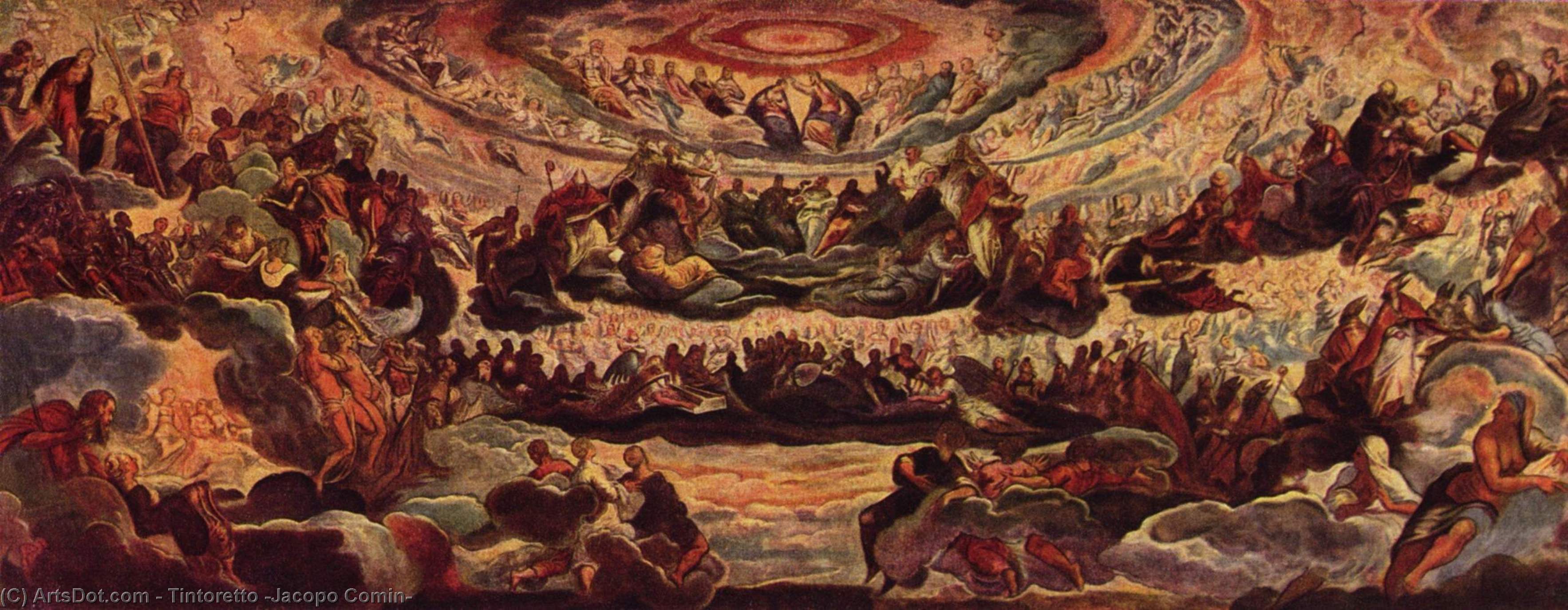
The Venetian painter Jacopo Tintoretto (1518-1594) stands as a titan amongst his contemporaries, a figure whose dramatic compositions and masterful manipulation of light continue to captivate audiences centuries after his death. His masterpiece, "Paradies," completed in 1579, transcends mere representation; it embodies the spirit of the High Renaissance’s waning influence and heralds the triumphant arrival of Baroque grandeur. This monumental canvas – measuring 143 x 362 cm – depicts a breathtaking scene of divine congregation, inviting viewers into an immersive experience that speaks to themes of faith, humanity's aspiration for transcendence, and the sublime beauty of God’s creation.
- Subject Matter: The painting portrays a vibrant gathering of figures—scholars, theologians, musicians, and artists—assembled in what appears to be an idealized paradise. This isn’t simply a pastoral landscape; it's a deliberate staging of theological discourse and contemplation, reflecting the intellectual fervor of the era.
- Style: Tintoretto’s style is undeniably Baroque, characterized by dynamism, theatricality, and an obsession with dramatic lighting effects. Unlike the serene compositions favored by Raphael or Michelangelo, “Paradies” pulsates with energy, conveying a sense of movement that draws the eye across the expansive canvas.
Technique: Mastering Light and Shadow – Tintoretto’s Revolutionary Approach
Tintoretto revolutionized painting technique through his pioneering use of chiaroscuro—the dramatic interplay between light and dark—a cornerstone of Baroque aesthetics. He achieved this astonishing effect not through meticulous blending, but rather by applying paint in successive layers, allowing each subsequent coat to subtly alter the luminosity of its predecessor. This method, combined with a deep understanding of anatomy and perspective, resulted in unparalleled realism within an idealized setting. The artist meticulously studied human musculature, striving for anatomical accuracy that would elevate his figures beyond mere decorative elements. Furthermore, Tintoretto employed aerial perspective—a technique borrowed from Leonardo da Vinci—to create the illusion of depth and atmospheric haze, enhancing the overall grandeur of the scene.
Historical Context: Reformation’s Influence on Artistic Expression
“Paradies” was created during a period marked by significant religious upheaval – the Protestant Reformation. The Catholic Church actively sought to reaffirm its authority and inspire piety through art, commissioning works that conveyed spiritual grandeur and reinforced doctrinal beliefs. Tintoretto's commission likely stemmed from Cardinal Federico Borromeo, a staunch defender of papal orthodoxy, who envisioned “Paradies” as a visual testament to Christian faith and intellectual enlightenment. The painting’s depiction of scholarly debate underscores the importance placed on reason alongside religious devotion—a reflection of the broader cultural landscape of 16th-century Venice.
Symbolism: Celestial Glory and Humanity's Yearning for Divine Perfection
The composition itself is laden with symbolic significance. The figures are positioned around a central altar, symbolizing divine worship and highlighting the importance of faith. Above them stretches an expansive sky filled with radiant light—a visual representation of God’s omnipresence and benevolence. The upward gaze of many participants signifies their aspiration for spiritual transcendence, mirroring the humanist preoccupation with achieving moral virtue and contemplating the mysteries of existence. Ultimately, “Paradies” serves as a powerful reminder of humanity's inherent desire to connect with something greater than oneself—a timeless message conveyed through Tintoretto’s breathtaking artistry.


 Preview
 Switch to hand made Painting
 Invia
Invia Condividi
 Dettagli opera

 Scarica
 Simili
 Radiografia
 Slideshow


 Scopri di più






































 L'opzione vetro è disponibile solo per dimensioni inferiori a 110 cm