
Shown: · With its frame:
 Anteprima in scala reale
 Invia
Invia Condividi
 Dettagli opera
 Guida
Guida

 Scarica
 Simili
 Radiografia
 Slideshow
 Q&A
Q&A Statistiche
- 43.0 x 57.0 cm


€ 239
Riproduzione a olio fatta a mano
Olio su tela dipinto a mano nelle tue dimensioni e con la tua cornice, realizzato su ordinazione dai nostri artisti. ( Passa alle stampe Passa all'immagine digitale)
Quest'opera è protetta da copyright
L'opera d'arte visualizzata in questa pagina è protetta dalle leggi sul diritto d'autore, il che significa che non possiamo legalmente creare o vendere una riproduzione identica. Tale protezione è garantita da accordi internazionali quali la Convenzione di Berna e dalle leggi nazionali, incluse quelle stabilite da Legge sul copyright degli Stati Uniti - Titolo 17. Tutti i diritti riservati. Le immagini presenti su questo sito sono protette da copyright e non possono essere riprodotte o utilizzate senza l'autorizzazione scritta di WahooArt.com o dei rispettivi proprietari del copyright.
Come alternativa rispettosa e legale, offriamo opere d'arte personalizzate e dipinte a mano, ispirate all'originale. I nostri artisti esperti e professionisti studiano con cura lo stile, l'atmosfera e l'essenza artistica dell'opera originale per creare un pezzo nuovo e unico che evochi la stessa emozione, pur rimanendo una creazione originale a pieno titolo.
Questo metodo è pienamente conforme alle normative sul diritto d'autore poiché non prevede la copia o la duplicazione dell'opera protetta. Si tratta invece di una rielaborazione creativa: un nuovo dipinto che trae ispirazione dall'originale, senza tuttavia esserne identico.
 Scopri di più
Size
·Formato standard
su misura
CM
INCH
Scegli tra le nostre dimensioni predefinite, che rispettano le proporzioni originali dell'opera d'arte.
Loading sizes...

larghezza
altezza
Inserisci la larghezza e l'altezza desiderate, per adattarle alla tua cornice o alla tua parete. Trattandosi di un'opera dipinta a mano, in caso di dimensioni con un formato differente, l'artista può estendere leggermente il dipinto oltre i bordi dell'immagine o ritagliare una piccola parte — la scelta spetta a te. Ti invieremo un mockup digitale da approvare prima che la realizzazione abbia inizio. L'immagine mostrata in questa pagina non rappresenta il risultato finale — solo il mockup lo fa.
Finish
·
White €1

Blurside €1

Extended €1

P118B €10

P118H €10

P118W €10

P438Z €10

P508JH €12

P508YH €12

P805H €10

P805Z €10

P919BZ €10

P919G €10

P919XJ €10

P959ZH €10

P968JZ €12

W106C €8

W218G €10

W218JH €8

W218Y €10

W307PJ €10

W316G €10

W316PJ €8

W316Y €10

W398PJ €8

W4111J €10

W500HY €15

W500JH €15

W692G €12

W849H €8

W940BG €15

W953PJ €8

H24-GOLD €30

H24-SILVER €30

H36-GOLD €45

H36-SILVER €45
Shipped in a protective tube, ready for your own framer.
Above 105 cm the frame is shipped as a kit for a professional framer — read the details.
Extras
optionalWhat do the extras include?
Examples of what can be changed: Replace face with customer photo; Add pet (e.g., replace cat with dog); Include hidden message in background; Change background landscape or elements.
After order, TopImpressionists.com team will email client for instructions and provide a mockup preview
After order, TopImpressionists.com team will email client for instructions and provide a mockup preview
Consegna in tutto il mondo () in 3/4 settimane anziché nelle normali 5 settimane. (1 Novembre). Nessun compromesso sulla qualità.
Vernice protettiva
Didascalia
Dettagli della targhetta in bronzo inciso
This elegant plaque features the artist's name and the title of the artwork, finely engraved for a timeless presentation.
It is made from bronze with a refined, elegant finish. The text is precisely laser-engraved for a sharp and permanent result. Measuring 9x2 cm, the plaque is compact yet easy to read. It's built to be durable and scratch-resistant, offering a professional, museum-quality look. Mounting is simple thanks to the included adhesive backing.
Dettagli della targhetta in acrilico trasparente
The plaque includes essential engraved details such as the artist's name, the title of the artwork, the date it was created, the type of media used-like oil on canvas or watercolor-a brief description of the piece, and a QR code that links to the complete artwork information.
It is crafted from clear acrylic, offering a sleek, modern appearance. The text is UV-engraved in black to ensure strong visual contrast. With a size of 10x15 cm, it ensures optimal readability. It comes equipped with two metal hooks for secure wall mounting. The plaque is designed to be weather-resistant, making it suitable for various environments, and it includes interactive features that work seamlessly with smartphone scanning.
Dettagli della targhetta in acrilico nero
This elegant plaque includes engraved information such as the artist's name, the title of the artwork, the date it was created, the type of media used (like oil on canvas or watercolor), a short description of the artwork, and a QR code for quick access to more information.
The plaque itself is made from refined black acrylic with a premium finish. The text is laser-engraved in white for high contrast and readability. Its size is 10x15 cm, designed to be easy to read. It comes with two metal hooks for professional mounting. The design is sleek and fits any interior style. It is also weather-resistant and durable, with built-in digital integration for mobile compatibility.
L'opzione vetro è disponibile solo per dimensioni inferiori a 110 cm
 L'opzione vetro è disponibile solo per dimensioni inferiori a 110 cm
- Spedizione espressa gratuita in tutto il mondo
- Tela in lino di alta qualità
- Assicurazione completa sulla spedizione
- Garanzia di rimborso dei dazi doganali
- Garanzia di fedeltà cromatica assoluta
- Politica di reso entro 100 giorni (solo per difetti di fabbricazione)
- Garanzia di rimborso al 100%
- Offerta per acquisti multipli


Descrizione del reperto
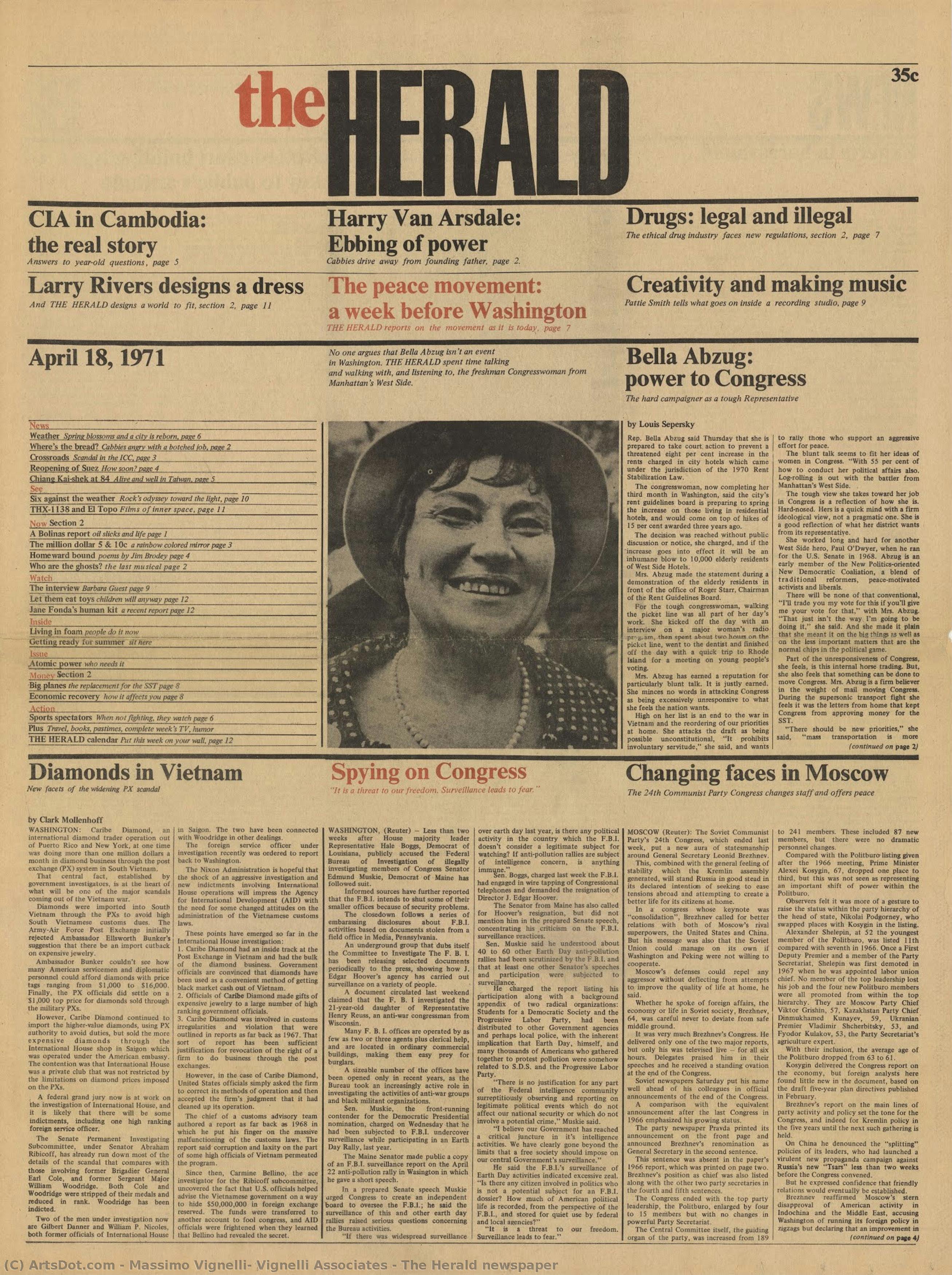
Experience the modernist grid design of The Herald newspaper by Massimo Vignelli (1971), showcasing vintage graphic communication art; discover this iconic piece today.
Biografia dell'artista
Massimo Vignelli (1931-2014): Icona del design italiano, celebre per progetti grafici minimalisti come la mappa della metro di NYC e identità aziendali sofisticate. Scopri il suo contributo alla storia dell'arte contemporanea!
About the painting
The Grid of Modern Communication: Vignelli's The Herald
To encounter this piece is to step directly into the vibrant, structured chaos of mid-century New York journalism. This reproduction of The Herald newspaper from April 1971, conceived by Massimo Vignelli and his associates, is far more than mere ephemera; it is a meticulously designed artifact of visual communication history. It captures a moment when design principles—simplicity, functionality, and rigorous structure—were being aggressively applied to the seemingly unruly medium of print journalism. The very act of presenting this newspaper front page transforms what might be considered disposable media into a profound study in modernist graphic discipline.
A Masterclass in Structured Design
Vignelli’s genius, always rooted in an almost architectural understanding of space, is on full display here. The description notes the structure: a rigid grid of six columns and sixteen modules per column. This underlying skeleton dictates every element—the placement of headlines like "Diamonds in Vietnam," the accompanying portrait of the smiling woman, and the smaller articles detailing everything from spying congress to changing leaves in Moscow. Vignelli’s commitment to using a single typeface, Times Roman, across various weights and sizes, speaks volumes about his belief in universal legibility. It is a powerful testament to the idea that restraint—the disciplined use of negative space and consistent typography—can generate an overwhelming sense of order and sophistication.
Historical Resonance and Materiality
The year 1971 places this work within a fascinating cultural nexus, post-war modernism grappling with the burgeoning media landscape. While the paper itself ultimately folded due to distribution issues, its surviving design remains potent. For the collector or designer, understanding this context is key. This piece speaks to an era obsessed with efficiency and clarity in information transfer. When considering a reproduction for your space, you are not just acquiring art; you are curating a dialogue about how we consume knowledge—a conversation between the fleeting headline and the enduring power of good design.
Symbolism of the Grid
The grid itself functions as the primary symbolic element. In an age where digital information often feels overwhelming, this physical manifestation of order offers a visual anchor. It symbolizes control, but not oppressive control; rather, it suggests that even complex narratives—the confluence of international events and local interest—can be organized into digestible, beautiful patterns. The interplay between the large, arresting photograph and the tightly packed textual modules creates a dynamic tension, mirroring the very energy of a bustling city like New York in that era.
Bringing Modernist Precision Home
For interior design or gallery display, this piece offers an unparalleled opportunity to inject intellectual rigor into a space. It pairs beautifully with minimalist furniture, mid-century modern accents, or any setting that appreciates the clean lines of 20th-century industrial aesthetics. Owning this reproduction is an homage to Massimo Vignelli’s lifelong dedication to elevating the mundane—the daily newspaper—into something enduringly beautiful and intellectually stimulating.
Domande e risposte
A quale stile appartiene "The Herald newspaper"?
Il movimento associato a "The Herald newspaper" di Massimo Vignelli, Vignelli Associates è Modernism. Questa classificazione colloca l'opera tra artisti e opere d'arte correlati.
Qual è l'uso consigliato per una stampa di "The Herald newspaper"?
L'uso consigliato per una stampa di "The Herald newspaper" è Statement.
Qual è la forma di "The Herald newspaper" di Massimo Vignelli, Vignelli Associates e quali sono le sue dimensioni?
Il formato di "The Herald newspaper" è Portrait e l'originale misura 43 x 57 cm. Entrambi sono utili quando si pianifica una riproduzione.
Quick facts and art quiz
About Massimo Vignelli, Vignelli Associates

Massimo Vignelli, Vignelli Associates
1931 - 2014, Italia
Biografia dell'artista
Primi anni e formazione
Massimo Vignelli, rinomato designer italiano, nacque il 10 gennaio 1931 a Milano. Studiò architettura presso il Politecnico di Milano e successivamente all'Università IUAV di Venezia. Fin da giovane, dimostrò un forte interesse per il design, iniziando la sua carriera all'età di 16 anni presso lo studio dei fratelli Castiglioni, dove ebbe l'opportunità di lavorare su una vasta gamma di progetti.
Stile e contributi significativi
Lo stile di Massimo Vignelli si caratterizzava per la semplicità, l'uso di forme geometriche basilari e una palette di colori limitata. Credeva fermamente nel principio del "Design is One", sostenendo che il design fosse un'unica disciplina con applicazioni in diversi settori.
- Heller Rainbow Dinnerware: Un progetto di stoviglie impilabili che esemplifica il suo approccio minimalista e funzionale.
- Tredicesima Triennale di Milano: Un poster che riflette l'uso audace dei colori e delle forme geometriche, diventando un'icona del design italiano.
- Knoll Design (copertina): Una copertina che dimostra la sua capacità di creare immagini visivamente accattivanti per marchi rinomati.
Collaborazioni e associazioni
Nel 1971, Massimo Vignelli co-fondò lo studio Vignelli Associates con sua moglie, Lella Vignelli. Questa collaborazione portò alla creazione di numerosi progetti iconici, tra cui il sistema di segnaletica per la metropolitana di New York City, un esempio emblematico del suo approccio al design orientato alla chiarezza e all'efficacia.
Eredità e impatto
L’influenza di Massimo Vignelli sul design italiano è innegabile. Il suo lavoro è stato esposto in numerosi musei, tra cui il Center for Design Studies presso il Rochester Institute of Technology negli Stati Uniti. Le sue creazioni continuano a ispirare nuove generazioni di designer e artisti in tutto il mondo.
Vignelli, insieme a figure come Paul Rand, Saul Bass, Milton Glaser ed Herb Lubalin, è considerato uno dei maestri del graphic design del XX secolo.
Opere selezionate disponibili su TopImpressionists.com
- Heller Rainbow Dinnerware (vista frontale)
- Tredicesima Triennale di Milano (rosso su rosa)
- Knoll Design (copertina)
Riferimenti
Quick facts about Massimo Vignelli, Vignelli Associates
- Data Di Morte: 27 maggio 2014
- Data Di Nascita: 10 gennaio 1931
- Luogo Di Nascita: Milano, Italia
- Movimento Artistico: Modernismo, Minimalismo
- Nazionalità: Italiana
- Nome Completo: Massimo Vignelli
- Opere Notevoli:
- Heller Rainbow Dinnerware
- Triennale Milano
- Knoll Design (copertina)
Esplora le opere d'arte organizzate per temi, stili e caratteristiche.

![Heller Rainbow Dinnerware
[vista frontale]](/media/artworks/images-thumb/cd/9c/cd9c3f1015cd05d21f20d796279c84cb.jpg)
![Heller The Rainbow Group
[vista frontale]](/media/artworks/images-thumb/bd/a1/bda1d75d48e73957e5def523d2b2fe21.jpg)

![Fort Worth Art Museum Il film italiano: Neorealismo e oltre poster e calendario eventi
[vista frontale]](/media/artworks/images-thumb/9a/f3/9af3622e1fac840c383fbfca8217073b.jpg)

![Knoll Au Louvre
[copertina anteriore]](/media/artworks/images-thumb/2d/58/2d58532dc1c1248432ee69d88c0253d2.jpg)
![Knoll International
[vista frontale]](/media/artworks/images-thumb/3f/ee/3feeb868249b96ea2d449739ed478876.jpg)
![Milano
[vista copertina, piegata]](/media/artworks/images-thumb/d9/d4/d9d4b14c78e469c5d339069b4321c34b.jpg)


![Tredicesima Triennale di Milano
[rosso su rosa]](/media/artworks/images-thumb/d5/7c/d57c0494b16c39484ce82132534f6312.jpg)


![La Casa Bianca
[vista frontale]](/media/artworks/images-thumb/a8/c8/a8c8083505c92320e67caa42c197cd7d.jpg)

![Heller Il Gruppo Arcobaleno
[vista frontale]](/media/artworks/images-thumb/63/ff/63ff27e205bc52fa330b5129aaab17df.jpg)


Massimo Vignelli, Vignelli Associates
The Herald newspaper
() ·
With its frame: · Hand-painted in oil on linen
Total