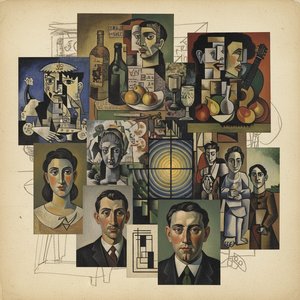
Bather Opening a Cabin: A Surrealist Exploration of Form and Gesture
Pablo Picasso’s “Bather Opening a Cabin,” completed in 1928, stands as a pivotal work within his oeuvre and a cornerstone of Surrealism. More than just a depiction of a seaside scene—a woman ascending steps to access a beach hut—it represents a radical departure from traditional artistic conventions, embodying Picasso's relentless pursuit of innovative visual language.
Style and Technique: Cubist Fragmentation Revisited
Despite its seemingly simple composition, “Bather” is deeply rooted in Picasso’s ongoing experimentation with Cubism. However, unlike the geometric fragmentation characteristic of Analytical Cubism—where objects are dissected into interlocking planes—this piece leans towards Synthetist Cubism. The artist employs flattened color palettes and bold brushstrokes to create a textured surface that emphasizes materiality and gesture. This technique prioritizes conveying emotion and psychological depth over precise representation.
Historical Context: Embracing the Dreamscape
Painted during Picasso’s prolific period in Paris, “Bather” aligns perfectly with the burgeoning Surrealist movement. Influenced by Sigmund Freud's psychoanalytic theories, Surrealists sought to liberate art from rational thought and tap into the subconscious mind. Picasso’s deliberate simplification of form—the stylized horse-headed figure dominating the scene—reflects this fascination with irrationality and dreamlike imagery. The painting captures a moment suspended between reality and fantasy, mirroring the anxieties and desires prevalent in the era.
Symbolism: Keys to Interpretation
The inclusion of a key – prominently positioned on the ground – is laden with symbolic significance. Traditionally representing access, knowledge, and unlocking hidden potential, it suggests that Picasso intended for viewers to contemplate themes of transformation and revelation. The horse-headed figure itself embodies primal instincts and desires, juxtaposed against the serene backdrop of the beach hut—a symbol of domesticity and refuge. These elements intertwine to create a complex visual narrative.
Emotional Impact: A Meditation on Vulnerability
"Bather Opening a Cabin" transcends mere visual observation; it invites contemplation about human vulnerability and the elusive nature of experience. Picasso’s masterful manipulation of color—the vibrant orange against the cool blues—amplifies the emotional resonance of the scene, conveying both serenity and unease. The painting's deliberate distortions serve not to deceive but to heighten our awareness of perception itself, prompting us to question what constitutes “truth” in art and life.



 Anteprima
 Passa alla stampa
 Condividi
 Condividi
 Dettagli

 Scarica immagine
 Articoli simili
 Radiografia
 Slideshow
 Leggi tutto






































 L'opzione vetro è disponibile solo per dimensioni inferiori a 110 cm