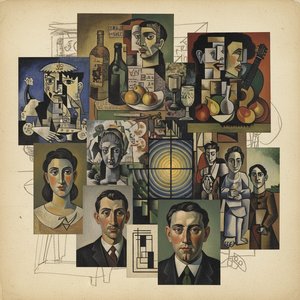
Bust of Woman
The
Bust of Woman, a captivating oil on canvas painting created by the renowned Spanish artist
Pablo Picasso in 1936, is a quintessential example of his surrealist style. This piece, measuring 55 x 46 cm, is part of a series that showcases Picasso’s fascination with the female form and his ability to blend reality with abstract elements.
The Artistic Context
Picasso was known for his innovative approach to art, often experimenting with various styles and techniques throughout his career. The
Bust of Woman is a reflection of his surrealist period, characterized by dream-like imagery and the blurring of lines between reality and fantasy. This style was influenced by the tumultuous political climate of the time, particularly the Spanish Civil War, which had a profound impact on Picasso's work. The artist sought to express inner turmoil and psychological complexity through distorted forms and unsettling juxtapositions—a hallmark of Surrealism’s rebellious spirit.
The Painting's Significance
The
Bust of Woman is not just a portrait; it’s an exploration of the human psyche. The subject, depicted against a pink background and wearing a red shirt, exudes a sense of mystery and intrigue. Picasso deliberately fragmented the woman's face—a technique central to Cubism—creating multiple perspectives simultaneously. This masterful manipulation of visual space invites contemplation on identity and perception. The bold colors – crimson and pastel hues – amplify the emotional resonance of the image, conveying both vulnerability and strength.
Artistic Influences
Picasso’s work was influenced by various artists and movements. His surrealist period was particularly inspired by the works of
Kay Sage, an American Surrealist artist known for her architectural themes. Picasso’s meticulous attention to detail—evident in the rendering of skin texture and drapery folds—also owes a debt to Renaissance masters like Leonardo da Vinci. Furthermore, Dora Maar, Picasso's mistress and muse during this time, profoundly impacted his artistic vision, as seen in pieces like
The Weeping Woman series—a poignant depiction of grief and psychological distress.
Museum Collections
Picasso’s works are housed in numerous museums around the world. The
Musée Cantini in Marseilles, France, is one such institution that specializes in modern art from the first half of the twentieth century. While the
Bust of Woman may not be part of this specific collection, it embodies the spirit of Surrealist art—challenging conventions and delving into the subconscious—a legacy that continues to inspire artists today.
Experience the art of Pablo Picasso through hand-made oil painting reproductions at https://TopImpressionists.com. This article provides a comprehensive look at the
Bust of Woman, highlighting its significance within Picasso’s surrealist period and its place in the broader context of modern art.



 Preview
 Acquista stampa
 Invia
Invia Condividi
 Dettagli opera

 Scarica
 Simili
 Radiografia
 Slideshow


 Scopri di più






































 L'opzione vetro è disponibile solo per dimensioni inferiori a 110 cm