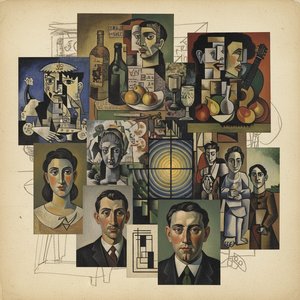
Crouching Woman: A Pioneering Vision of Expressionism
Pablo Picasso’s
Crouching Woman stands as a cornerstone of early 20th-century art, embodying the fervent spirit of Expressionism and marking Picasso’s decisive step toward Cubism. Painted in 1902, this oil on canvas masterpiece transcends mere representation, delving into profound emotional depths—a characteristic that distinguishes it from the prevailing academic traditions of its time. The artwork's muted blue palette and fractured forms immediately signal Picasso’s willingness to challenge conventional artistic conventions, establishing him as a visionary innovator.
The Artistic Context: Modern Art's Bold Experimentation
The burgeoning modernist movement witnessed artists like Vincent van Gogh, Paul Cézanne, and Georges Seurat actively dismantling established artistic paradigms. They sought new ways to convey subjective experience—a quest that Picasso wholeheartedly embraced. Influenced by these trailblazers, he began exploring techniques that prioritized emotion over meticulous detail, paving the way for groundbreaking developments in art history. The prevailing atmosphere of intellectual ferment fueled a desire to break free from stylistic constraints and explore uncharted artistic territories.
Compositional Dynamics: Intimacy Within Distortion
The painting’s arrangement is deceptively simple yet powerfully evocative. Picasso depicts a woman seated on the ground, her head bowed—a posture conveying vulnerability and introspection. The backdrop consists of a tranquil blue wall, punctuated by two vases and a bowl strategically positioned to draw the viewer's gaze inward. This deliberate composition fosters a sense of solitude and contemplation, mirroring the emotional core of the artwork. Picasso’s masterful manipulation of form contributes to this effect, distorting anatomical proportions to heighten expressive intensity.
Expressionism Unleashed: Beyond Literal Representation
Picasso’s embrace of Expressionist principles is palpable in
Crouching Woman's fractured planes and exaggerated contours—a stylistic hallmark of movements like Fauvism and Cubism. Unlike Impressionists who aimed to capture fleeting moments of visual perception, Expressionist artists sought to convey inner feelings and psychological states directly. The painting’s emotional resonance stems from Picasso’s ability to distill complex emotions into simplified forms, reflecting the broader cultural preoccupation with subjectivity during the early 20th century.
Legacy and Influence: Shaping Cubism's Genesis
Crouching Woman represents a pivotal moment in Picasso’s artistic evolution—a precursor to Cubism, which he would later develop collaboratively with Georges Braque. This seminal work laid the groundwork for the revolutionary geometric abstraction that would redefine art aesthetics and profoundly impact subsequent generations of artists. Its enduring influence can be seen in countless artworks produced throughout the 20th century and beyond, cementing Picasso’s position as one of history's most transformative figures.



 Anteprima in scala reale
 Ordina stampa
 Condividi
 Condividi
 Dettagli

 Scarica immagine
 Articoli simili
 Radiografia
 Slideshow

 Leggi tutto






































 L'opzione vetro è disponibile solo per dimensioni inferiori a 110 cm