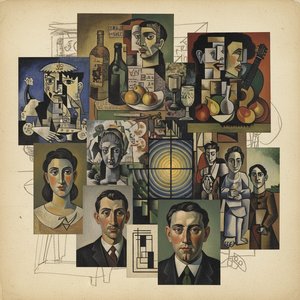
A Revolutionary Portrait: Decoding Picasso’s “Woman with a Fan”
Pablo Picasso's "Woman with a Fan," painted in 1907, stands as an undeniable cornerstone of Cubism—a movement that irrevocably altered the trajectory of modern art. More than just a depiction of a woman seated gracefully before a fan, this artwork embodies a profound conceptual shift away from traditional artistic conventions, inviting viewers to contemplate not merely what is seen but how it’s perceived. Created during Picasso's formative years, it exemplifies his pioneering spirit and foreshadows the groundbreaking innovations that would define his illustrious career.
The Genesis of Cubism: Shattering Perspective
Before delving into the intricacies of “Woman with a Fan,” understanding the intellectual landscape surrounding its creation is crucial. The early 20th century witnessed an explosion of artistic experimentation, fueled by advancements in science and philosophy—particularly Einstein’s theory of relativity—which challenged established notions of space and time. Artists like Picasso responded to these paradigm shifts by rejecting the illusionistic techniques championed by Renaissance masters. Cubism emerged as a reaction against this perspective, advocating for a radically new approach: simultaneous representation of multiple viewpoints within a single image. This technique wasn't merely stylistic; it represented a fundamental reimagining of how artists could convey reality.
Geometric Forms and Fragmented Reality
“Woman with a Fan” brilliantly illustrates Cubist principles. Picasso abandons linear perspective, opting instead for geometric shapes—cubes, cylinders, and cones—to construct the woman’s figure and surroundings. These forms overlap and intersect, creating a disconcerting yet captivating visual experience. The face is dissected into planes, mirroring the fragmented reality that Cubists sought to capture. Notice how Picasso renders the fan itself – it appears as if viewed from several angles simultaneously, emphasizing its materiality and disrupting any sense of unified spatial depth. This deliberate fragmentation isn’t arbitrary; it symbolizes the artist's desire to portray a subject in totality, capturing its essence beyond mere surface appearance.
Symbolism Beneath the Surface: Elegance and Melancholy
Beyond its formal innovations, “Woman with a Fan” resonates with subtle symbolic layers. The woman herself exudes an aura of composure and refinement—a characteristic often associated with Picasso’s exploration of feminine beauty during his Blue Period. However, beneath this veneer of elegance lies an undercurrent of melancholy, reflecting the artist's personal experiences of loss and disillusionment. The fan serves as a visual motif representing both protection from unwelcome intrusions and concealment – perhaps hinting at unspoken emotions or hidden vulnerabilities. Picasso skillfully employs color—primarily muted blues and greens—to reinforce these emotional tones, creating a poignant portrait that transcends mere representation.
A Legacy Enduring Influence
“Woman with a Fan”’s impact extends far beyond its own time, establishing itself as an influential precursor to subsequent artistic movements like Futurism and Surrealism. Its pioneering use of geometric abstraction paved the way for artists to explore new visual languages—challenging conventions and pushing boundaries. Today, reproductions of this masterpiece continue to inspire designers and collectors alike, offering a glimpse into Picasso’s visionary genius and the transformative power of Cubist aesthetics. For a stunning high-quality reproduction, visit



 Anteprima in scala reale
 Ordina stampa
 Condividi
 Condividi
 Dettagli

 Scarica immagine
 Articoli simili
 Radiografia
 Slideshow


 Leggi tutto






































 L'opzione vetro è disponibile solo per dimensioni inferiori a 110 cm