Descrizione dell'opera
Faun, Horse and Bird: A Surrealist Vision by Pablo Picasso
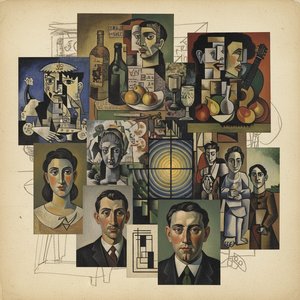
Pablo Picasso's Faun, Horse and Bird (1936) stands as a cornerstone of Surrealist art—a testament to the artist’s ability to transcend rational thought and delve into the subconscious realm. Executed in ink on paper measuring 44 x 54 cm, this painting embodies Picasso’s signature blend of meticulous observation with fantastical imagination, reflecting the anxieties and aspirations of his time amidst the turbulent backdrop of the Spanish Civil War. Its premiere at the Musée Cantini in Marseilles solidified its place within the burgeoning movement dedicated to exploring dreamlike landscapes and symbolic representations.
Contextualizing the Painting: The Surrealist Landscape
The year 1936 wasn’t merely a date on Picasso's calendar; it was a pivotal moment for artistic expression globally. The Musée Cantini, established in Marseilles, served as a beacon for avant-garde art, championing experimentation and challenging conventional aesthetic norms—values perfectly aligned with the Surrealist ethos. Picasso himself had already navigated diverse stylistic periods – from the melancholic Blue Period to the vibrant Rose Period – demonstrating an unparalleled versatility that anticipated the revolutionary spirit of his era. The very act of depicting a serene landscape juxtaposed with mythological figures speaks volumes about the Surrealists’ desire to confront reality through distorted perceptions and hidden meanings.
Artistic Elements and Symbolism: Decoding the Dreamscape
The composition itself is deliberately unsettling yet profoundly beautiful. Picasso presents a faun—a creature from Greek mythology blending human and animal characteristics—positioned beside a horse adorned with a bird perched upon its back. This seemingly simple tableau operates on multiple levels of symbolism. The faun represents primal instinct, fertility, and the untamed wilderness – themes frequently explored by Surrealist artists. Simultaneously, the horse symbolizes strength, nobility, and dominion, while the bird embodies freedom, aspiration, and spiritual transcendence. Scattered throughout the canvas are numerous birds—a deliberate repetition that amplifies the dreamlike atmosphere and underscores the pervasive influence of subconscious imagery. Notably, a clock in the upper right corner introduces an element of temporal constraint, contrasting sharply with the fantastical elements and prompting contemplation on the passage of time and the elusive nature of reality.
Picasso’s Style: A Synthesis of Cubism and Surrealist Influence
Picasso's artistic style during this period was undeniably shaped by Cubism—particularly Analytic Cubism—which had already established itself as a dominant force in European art. However, he skillfully incorporated Surrealist principles into his technique, resulting in an artwork that defies easy categorization. The meticulous hatching lines used to render the horse and bird contribute to a sense of textural depth and realism, grounding the fantastical elements within a tangible framework. Yet, Picasso’s masterful manipulation of perspective and spatial relationships—characteristic of Cubism—further enhances the painting's surreal quality, inviting viewers to question their assumptions about visual representation and embracing the ambiguity inherent in dreamlike visions.
Emotional Impact: Beyond Representation
Ultimately, Faun, Horse and Bird transcends mere depiction; it communicates an emotional resonance that lingers long after viewing. Picasso’s ability to capture the elusive essence of human experience—the interplay between instinct and intellect, reality and fantasy—solidifies his position as one of the most influential artists of the twentieth century. This artwork serves as a powerful reminder that art possesses the capacity to provoke contemplation, inspire wonder, and illuminate the hidden depths of our inner selves. Its enduring appeal lies in its ability to tap into universal themes of mythology, nature, and the human condition—a legacy that continues to captivate audiences worldwide.



 Anteprima in scala reale
 Ordina stampa
 Condividi
 Condividi
 Dettagli

 Scarica immagine
 Articoli simili
 Radiografia
 Slideshow


 Leggi tutto






































 L'opzione vetro è disponibile solo per dimensioni inferiori a 110 cm