Descrizione dell'opera
The Tavern: A Fragmented Reflection of Modern Life
“The Tavern,” painted in 1914 by Pablo Picasso during his pivotal Synthetic Cubist period, isn’t merely a depiction of a Parisian bistro; it's an audacious exploration of perception and memory—a visual manifesto of the anxieties simmering beneath the surface of pre-war Europe. Picasso, alongside Georges Braque, revolutionized artistic representation by rejecting traditional perspective and embracing geometric forms derived from fragmented images. This stylistic choice wasn’t simply aesthetic; it mirrored the fracturing experience of a society grappling with impending conflict.
## Description of the Scene: Chaos Embraced
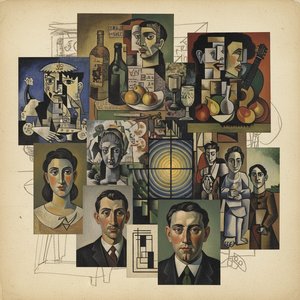
The canvas presents a bustling bar scene bathed in muted tones—primarily browns and ochres—creating an atmosphere of subdued intensity. At its core is a man seated at the table, surrounded by figures whose forms are deliberately distorted and simplified. Two forks lie prominently on the tabletop, one positioned centrally and another angled slightly to the right, symbolizing perhaps the duality of experience – order versus disorder. A knife rests on the left side, anchoring the composition while simultaneously contributing to its unsettling dynamism. Beneath the man’s gaze is a bowl containing fruit—a subtle nod to still life traditions juxtaposed against Cubist principles. Three books are scattered across the surface, each serving as an additional element of visual disruption and hinting at intellectual contemplation amidst the sensory overload of the tavern.
## Style and Influences: Synthetic Cubism's Bold Experimentation
Synthetic Cubism represents a decisive break from Impressionism and Post-Impressionism. Picasso and Braque dismantled objects into geometric planes—cubes, cylinders, cones—and reconstructed them in an abstracted manner that prioritized form over realistic depiction. This technique was heavily influenced by Paul Cézanne’s exploration of underlying structure and spatial relationships, as well as African sculpture, which captivated artists with its expressive simplification of shapes. The deliberate flattening of perspective is paramount; it forces the viewer to actively engage with the artwork, reconstructing the scene mentally rather than passively accepting a visual illusion.
## Historical Context: Anxiety Before Armistice
Painted just before World War I erupted in 1914, “The Tavern” embodies the pervasive sense of unease and uncertainty that characterized the era. Picasso’s artistic démarche—the fragmentation of reality—can be interpreted as reflecting the psychological impact of impending war – a dismantling of familiar structures and values. The muted palette contributes to this mood of apprehension, mirroring the somber atmosphere of the time. Furthermore, the inclusion of objects like forks and books speaks to broader cultural concerns about rationality versus instinct, intellect versus emotion—themes that resonated deeply within the intellectual circles of Paris during those turbulent years.
## Symbolism: Beyond Representation – An Emotional Resonance
Beyond its formal innovations, “The Tavern” possesses a profound symbolic dimension. The solitary fork symbolizes isolation amidst the crowd, highlighting the individual’s experience of confronting societal pressures and anxieties. The books represent knowledge and contemplation—a yearning for understanding in the face of overwhelming change. Picasso's masterful use of color and form transcends mere visual representation; it communicates an emotional state—one of quiet observation and subtle apprehension—that lingers long after viewing the artwork. It’s a testament to Picasso’s ability to capture not just what he sees, but also what he feels—a feat achieved through the transformative power of Synthetic Cubism.
## Where to See It: A Journey Through Modern Art History
A remarkable specimen of Cubist art, “The Tavern” resides in the Staatliche Kunsthalle Karlsruhe (Karlsruhe, Germany), offering visitors a chance to immerse themselves in the artistic landscape of early 20th-century Europe and contemplate Picasso’s groundbreaking contribution to modern art.



 Ordina la riproduzione
 Invia
Invia Condividi
 Dettagli opera

 Scarica
 Simili
 Radiografia
 Slideshow

 Scopri di più






































 L'opzione vetro è disponibile solo per dimensioni inferiori a 110 cm