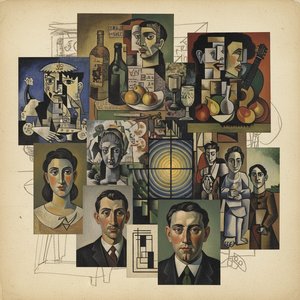
Man in Blue: A Window into Picasso’s Soul
The
Man in Blue, a captivating oil on canvas painting created by the renowned artist
Pablo Picasso in 1902, is a cornerstone of his early Expressionist period. This piece, measuring 90 x 78 cm, currently resides within the walls of the
Von Der Heydt Museum in Wuppertal, Germany—a testament to Picasso’s enduring legacy and a poignant glimpse into the artist's inner world.
The Artistic Context: Modernism’s Embrace
Picasso’s artistic journey during this formative decade unfolded against the backdrop of burgeoning Modernist movements. Impressionism’s fleeting light and Post-Impressionism’s emotive color palettes served as crucial precursors to his groundbreaking stylistic innovations. However, it was arguably the pervasive influence of Symbolism—particularly its exploration of psychological depth and emotional resonance—that truly propelled Picasso toward Expressionism. Moreover, deeply affected by personal tragedies – notably the untimely demise of a cherished friend – Picasso channeled these experiences into his art, forging a visual language characterized by raw emotion and unflinching honesty.
Composition and Symbolism: Lines That Speak Volumes
The painting’s composition is deliberately austere yet profoundly expressive. Picasso depicts an elderly man seated before a stark white wall, conveying a palpable sense of solitude and contemplation. The dark background serves as a dramatic counterpoint to the figure's pale complexion, intensifying his gaze and drawing the viewer’s eye inward—a technique that anticipates Cubism’s fragmentation of perspective. Notice the careful arrangement of chairs; one positioned behind the man adds spatial complexity and reinforces the feeling of confinement. Each element contributes to an overarching narrative of melancholy and introspection, mirroring Picasso's preoccupation with themes of loss and vulnerability during this period.
Artistic Influences: Echoes of El Greco
Picasso’s artistic sensibilities were undeniably shaped by the stylistic vision of El Greco—specifically his elongated figures and somber color palettes. Like El Greco, Picasso sought to transcend realism, prioritizing emotional impact over precise representation. This influence is evident in the painting's expressive handling of form and color, mirroring El Greco’s masterful manipulation of visual language to convey spiritual intensity. Furthermore, Picasso’s exploration of psychological states aligns seamlessly with Symbolist ideals—a stylistic hallmark that would solidify his position as a pioneer of Expressionism.
Relevance to Art Movements: The Genesis of Cubism
The
Man in Blue stands as a pivotal precursor to the revolutionary movement that Picasso spearheaded alongside Georges Braque: Cubism. The painting’s innovative use of multiple viewpoints and fractured geometric shapes—a radical departure from traditional artistic conventions—anticipates the visual vocabulary that would define Cubist art for decades to come. It represents not merely an aesthetic experiment but a fundamental rethinking of how artists perceive and depict reality, cementing Picasso's place as one of the most influential figures in 20th-century art history.
To delve deeper into the world of Cubism and its influence on modern art, refer to the Wikipedia article on Cubism.



 Preview
 Acquista stampa
 Invia
Invia Condividi
 Dettagli opera

 Scarica
 Simili
 Radiografia
 Slideshow


 Scopri di più






































 L'opzione vetro è disponibile solo per dimensioni inferiori a 110 cm