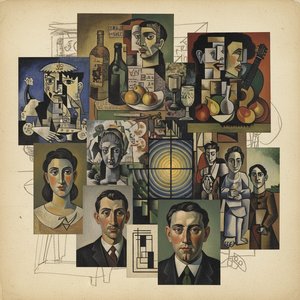
Musketeer with a Dove – A Cubist Meditation on Peace
The
Musketeer with a Dove is more than just a portrait; it’s a profound exploration of form and emotion executed in Pablo Picasso's signature Cubist style. Painted around 1906-1907 during his Rose Period, this artwork embodies the artist’s fascination with capturing fleeting moments and conveying complex psychological states through fragmented perspectives—a hallmark of the movement that revolutionized artistic representation.
A Fragmented Vision – The Essence of Cubism
Picasso's approach to depicting reality wasn’t about faithfully reproducing it; rather, he sought to distill its essence into geometric shapes and planes. As exemplified in this piece, the figure of the musketeer is dissected into multiple viewpoints simultaneously presented on a single canvas. Notice how the torso appears as if viewed from several angles at once—a technique central to Analytic Cubism. The drapery folds are rendered as intersecting planes, disrupting traditional notions of depth and creating an unsettling yet captivating visual experience. This deliberate distortion isn’t merely stylistic; it reflects Picasso's desire to represent not just what is seen but also how it *feels*.
Symbolism Beneath the Surface
Beyond its formal innovation lies a rich tapestry of symbolism. The dove perched on the musketeer’s shoulder serves as a powerful emblem of peace and reconciliation—a theme recurrent throughout Picasso’s oeuvre, particularly during this period marked by political upheaval and social unrest. Its placement is deliberate, suggesting an aspiration for serenity amidst turbulent circumstances. The muted palette – predominantly reds, browns, and ochres – contributes to the painting's solemn mood, reinforcing its contemplative character. These colors are not merely decorative; they evoke associations with warmth, earthiness, and resilience—qualities that resonate deeply within the artwork’s narrative.
Historical Context: Picasso’s Rose Period
The Rose Period represents a transitional phase in Picasso’s artistic journey following the intense emotional turmoil of his Blue Period. Influenced by Henri Rousseau's landscapes and Spanish bullfighting traditions, Picasso adopted a warmer tonal range and incorporated softer contours. This shift mirrors a newfound optimism—albeit tempered with melancholy—as he navigated personal relationships and explored themes of compassion and human dignity. The painting’s creation coincided with a time when Picasso was grappling with questions of identity and artistic expression, cementing his place as one of the most influential figures in modern art.
A Legacy of Innovation
The
Musketeer with a Dove stands as a testament to Picasso’s unwavering commitment to experimentation and his ability to transform visual perception. Its enduring appeal lies in its masterful manipulation of form and color—elements that combine to create an unforgettable image brimming with emotional depth. It continues to inspire artists and collectors alike, reminding us that true beauty resides not in imitation but in the courageous pursuit of artistic innovation.
- Artist: Pablo Picasso
- Born Year: 1881
- Death Year: 1973
- Birth City: Málaga
- Birth Country: Spain
Further Exploration: Discover more about Picasso’s artistic evolution and his profound impact on the art world at
https://TopImpressionists.com/@/Pablo-Picasso or
https://en.wikipedia.org/wiki/Pablo_Picasso. Admire the artistic heritage of Musée Quartier Des Héronnières in Fontainebleau, France, on
/art/list/?Filter=A@D3AEH5-The-Museum-Quartier-Des-Heronnieres-(Fontainebleau-France).



 Acquista stampa
 Invia
Invia Condividi
 Dettagli opera

 Scarica
 Simili
 Radiografia
 Slideshow

 Scopri di più






































 L'opzione vetro è disponibile solo per dimensioni inferiori a 110 cm