Atelier — Spedizione gratuita in tutto il mondo — Consegna in 2–6 settimane
Da foto a dipinto Lista dei desideri Carrello
Anteprima in scala realeAnteprima in scala reale Anteprima in ARAnteprima in AR Ordina la riproduzione dipinta a mano Ordina la riproduzione dipinta a manoAcquista download Acquista download CondividiCondividi
DettagliDettagli Aggiungi ai preferiti Aggiungi ai preferiti Scarica immagineScarica immagine Articoli similiArticoli simili RadiografiaRadiografia SlideshowSlideshow

Testa di un uomo 16

Esplora 'Testa di un uomo 16' di Pablo Picasso, un ritratto cubista fondamentale. Forme geometriche e influenza africana definiscono questa affascinante opera giovanile – imperdibile per gli appassionati d'arte.

Scopri Pablo Picasso: il genio del Cubismo e delle avanguardie! Esplora i periodi Blu e Rosa, Guernica e l'impatto rivoluzionario sulla storia dell'arte moderna.

Giclée / Stampe d'arte

Stampa giclée o su tela di qualità museale, con produzione rapida e diverse opzioni di finitura. (Ordina la riproduzione dipinta a mano Ordina la riproduzione dipinta a manoAcquista download Acquista download)

P118B $10
P118H $10
P118W $10
P438Z $10
P508JH $12
P508YH $12
P805H $10
P805Z $10
P919BZ $10
P919G $10
P919XJ $10
P959ZH $10
P968JZ $12
W106C $8
W218G $10
W218JH $8
W218Y $10
W307PJ $10
W316G $10
W316PJ $8
W316Y $10
W398PJ $8
W4111J $10
W500HY $15
W500JH $15
W692G $12
W849H $8
W940BG $15
W953PJ $8

Standard
custom
CM
INCH

Scegli tra le nostre dimensioni predefinite, che rispettano le proporzioni originali dell'opera d'arte.

larghezza
altezza

È possibile inserire dimensioni personalizzate per adattare l'opera a una cornice o a uno spazio specifico. Se la dimensione selezionata non corrisponde alle proporzioni dell'immagine originale, procederemo al ritaglio dell'opera o all'estensione dell'immagine con un bordo specchiato o a tinta unita. Un mockup digitale ti verrà inviato per approvazione prima dell'inizio della produzione.
Si prega di notare che l'anteprima a schermo non riflette il ritaglio o l'estensione effettivi. Solo il mockup mostrerà accuratamente la composizione finale.
Sebbene siano disponibili dimensioni personalizzate, si raccomanda di selezionare una dimensione dall'elenco predefinito per preservare le proporzioni originali.

Consegna in tutto il mondo () in 2 settimane invece delle normali 4/5 settimane. (18 Agosto)

why_choose_icon
Spedizione espressa gratuita in tutto il mondo
why_choose_icon
Tela in lino di alta qualità
why_choose_icon
Assicurazione completa sulla spedizione
why_choose_icon
Garanzia di rimborso dei dazi doganali
why_choose_icon
Garanzia di fedeltà cromatica dell'originale
why_choose_icon
Politica di reso entro 60 giorni (solo per difetti di fabbricazione)
why_choose_icon
Garanzia di rimborso al 100%
why_choose_icon
Sconto per acquisti multipli

Prezzo totale

$ 69

reproduction

Testa di un uomo 16

Giclée / Stampe d'arte

Dimensioni della riproduzione

-

Prezzo totale

$ 69

Dettagli rapidi

  • style: Early Cubism
  • notable elements: Geometric shapes, fragmented forms
  • movement: Cubism
  • artist: Pablo Picasso
  • year: 1908
  • subject: Portrait

Quiz d'arte

Per ogni domanda è presente una sola risposta corretta.

Domanda 1:
To which art movement does 'Head of a Man 16' belong?
Domanda 2:
What significant artistic influence is noted in the description of this artwork?
Domanda 3:
How does Picasso challenge traditional representation in 'Head of a Man 16'?
Domanda 4:
Approximately when was this artwork created?
Domanda 5:
What is a key characteristic of the style used in 'Head of a Man 16', as described in the image description?

Descrizione del pezzo

Deconstructing Reality: An Exploration of Picasso’s *Head of a Man 16*

Pablo Picasso's *Head of a Man 16*, created in 1908, stands as a pivotal work marking the burgeoning stages of Cubism – a revolution in artistic representation. This isn’t simply a portrait; it’s an intellectual and visual dismantling of traditional form, presenting a fragmented visage that challenges our very perception of reality. The painting depicts a male head, but not as a seamless whole. Instead, it's constructed from geometric planes and angles, offering multiple perspectives simultaneously – a radical departure from the single viewpoint that had dominated Western art for centuries. It’s a daring assertion of artistic freedom against established conventions, reflecting Picasso’s profound engagement with groundbreaking ideas circulating within the European avant-garde.

The Dawn of Cubism & Artistic Influences

This piece emerged during a period of intense experimentation for Picasso alongside Georges Braque, as they sought to break free from representational constraints. *Head of a Man 16* is a direct precursor to Analytic Cubism, where objects are broken down into their constituent parts and reassembled in an abstract form. However, it’s crucial to understand the broader context: Picasso wasn't working in isolation. He was profoundly impacted by non-Western art, particularly African masks and sculpture. The influence of these forms is palpable—the simplified facial features, the emphasis on form over naturalistic detail, and even the muted color palette all echo the aesthetic principles found in traditional African art. Picasso wasn’t appropriating; he was engaging in a dialogue with different visual languages, seeking new ways to express emotion and meaning. This deliberate stylistic choice signaled a decisive move away from academic realism toward a more conceptual approach to painting.

Technique & Materiality

The painting showcases Picasso’s evolving technique. Oil on canvas remains his medium, but the application is far from smooth or blended. Instead, he employs a fractured brushstroke, building up layers of paint to create a textured surface that reinforces the fragmented nature of the subject. The deliberate flattening of perspective further emphasizes the two-dimensionality of the canvas, rejecting illusionistic depth. This technique—characterized by thick impasto—was revolutionary for its time and contributed significantly to the painting’s somber mood and intellectual seriousness. Picasso meticulously crafted each plane and angle, striving to capture not just what he saw but also how he *felt* about what he was depicting.

Symbolism & Emotional Resonance

What does this fragmented head *mean*? While Picasso rarely offered definitive interpretations of his work, several readings are possible. The deconstruction of the face can be seen as a metaphor for the complexities of human identity – how we present different facets of ourselves to the world and how our sense of self is constantly shifting. The angularity and distortion might also convey a sense of unease or psychological tension. It’s not merely an image; it's an invitation to contemplate the nature of perception and representation itself. Picasso’s intention was to unsettle the viewer, prompting them to question assumptions about how we understand visual experience. It’s important to note that this isn’t necessarily a portrait of a specific individual, but rather an exploration of universal themes related to emotion, consciousness, and the human condition—a cornerstone of Picasso's artistic legacy.

A Legacy of Innovation

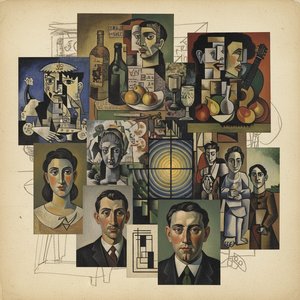
*Head of a Man 16* is more than just a painting; it’s a landmark in art history. It paved the way for countless subsequent movements – Futurism, Suprematism, Dada, Constructivism, and beyond – all of which built upon Picasso's radical innovations. Today, this work resides in prestigious collections like the Kunstmuseum Bern, Switzerland, solidifying its place as an essential piece for any serious art enthusiast or collector. Its influence continues to resonate with contemporary artists and designers alike, inspiring new approaches to form, space, and representation. The painting’s enduring power lies in its ability to challenge our assumptions about what a portrait can be and to invite us to see the world in a fundamentally different way—a testament to Picasso's genius and his unwavering commitment to artistic experimentation. Photo Description: --Overall Impression-- The artwork is a close-up portrait of a man wearing a hat and sunglasses, rendered in the style of Pablo Picasso’s Cubist approach. It presents a fragmented and distorted representation of the subject's face, emphasizing geometric shapes and multiple perspectives simultaneously. The composition is tightly cropped, focusing entirely on the head and upper torso, creating an intimate yet unsettling effect. Lines are angular and broken, contributing to the fractured appearance. Shapes are predominantly rectangular and triangular, with areas of smooth color juxtaposed against textured brushstrokes. The texture is heavily impastoed, particularly in the facial features, adding a tactile quality to the image. Lighting appears to be diffused and even, though it highlights the sharp edges and contrasts within the composition. Perspective is deliberately flattened, eliminating traditional depth cues. The subject matter is a portrait, but its emotional impact stems from the deconstruction of form and the expression of intense emotion through color and line. Symbolically, the fragmented face could represent psychological distress or the breakdown of identity. The style is unmistakably Cubist, characterized by geometric abstraction, multiple viewpoints, and a rejection of realistic representation. The technique involves layering paint in thick strokes, creating a textured surface and emphasizing the flatness of the image. Materials used appear to be oil paints on canvas. Size: Unknown Date: Unknown

Biografia dell'artista

Pablo Picasso: Un Artista Rivoluzionario

Primi Anni di Vita e Formazione (1881-1904)

  • Nato il 25 ottobre 1881 a Málaga, in Spagna, Pablo Ruiz y Picasso dimostrò un talento artistico fin da piccolissimo.
  • Suo padre, José Ruiz y Blasco, era un insegnante d'arte che gli fornì una formazione precoce. Si dice che le prime parole di Picasso fossero “piz, piz” – cercando di dire ‘matita’.
  • Picasso superò rapidamente le capacità del suo padre, mostrando un’abilità notevole nelle rappresentazioni naturalistiche.
  • La famiglia si trasferì a A Coruña e successivamente a Barcellona dopo la tragica perdita della sorella di Picasso.
  • A Barcellona, frequentò la Scuola d'Arti Visive ma spesso entrò in conflitto con le istruzioni accademiche tradizionali. Studiò brevemente alla Royal Academy of San Fernando a Madrid, trovandola soffocante e preferendo studiare i maestri come Velázquez e Goya in modo indipendente.

Il Periodo Blu e Rosa (1901-1906)

  • Il Periodo Blu (circa 1901-1904) è caratterizzato da dipinti malinconici dominati da sfumature di blu e verde acqua.
  • Questi lavori raffigurano spesso figure emarginate – mendicanti, ciechi, prostitute – riflettendo malinconia e commento sociale. Esempi chiave includono La Vie (1903) e L'Oldista (1903-1904).
  • Successivamente, il Periodo Rosa (1904-1906) emerse con tonalità più calde – rosa, arancione e rosso.
  • Questo periodo riflette una prospettiva più ottimista, spesso ritraendo artisti di circo, harlequini e acrobati. Famiglia dei Saltimbanchi (1905) ne è un esempio.

Gli Anni Rivoluzionari: Cubismo e Oltre (1907-1919)

  • Il 1907 ha segnato un momento cruciale con Les Demoiselles d'Avignon, influenzato dalla scultura iberica e dalle maschere africane. Questo dipinto infranse la prospettiva tradizionale, aprendo la strada al Cubismo.
  • Lavorando a stretto contatto con Georges Braque, Picasso co-fondò il Cubismo, trasformando radicalmente il modo in cui gli artisti rappresentavano la realtà.
  • Cubismo Analitico (1909-1912) presentava forme frammentate, colori tenui e una dissezione degli oggetti in forme geometriche.
  • Cubismo Sintetico (1912-1919) incorporava elementi di collage – ritagli di giornale, stracci – per creare superfici testurizzate e nuovi livelli visivi.

Neoclassicismo e Surrealismo (Anni '20 - Anni '30)

  • Gli anni '20 hanno visto Picasso esplorare stili neoclassici con figure monumentali che enfatizzavano le forme classiche.
  • Ha anche interagito con il movimento surrealista, pur non allineandosi pienamente ai suoi principi. La sua opera ha combinato stili precedenti con immagini surrealiste e prospettive distorte.

Anni Successivi e Eredità (1940-1973)

  • Durante la Seconda Guerra Mondiale, Picasso è rimasto in Francia, producendo dichiarazioni anti-guerra potenti come Guernica (1937), una risposta viscera al bombardamento di Guernica durante la guerra civile spagnola.
  • Guernica è diventata un simbolo duraturo degli orrori della guerra e rimane uno dei suoi lavori più celebrati.
  • Nel corso degli anni '50 e '60, Picasso ha continuato a sperimentare con vari mezzi – ceramiche, sculture, stampe – dimostrando una versatilità notevole.
  • Si è sposato con Jacqueline Roque nel 1961. È morto il 8 aprile 1973 a Mougins, in Francia.

Influenze e Significato Storico

  • Lo sviluppo artistico di Picasso fu plasmato da maestri spagnoli come Velázquez e Goya, dalla scultura iberica, dall'arte africana e da Henri Matisse.
  • Il suo impatto sull'arte del XX secolo è incommensurabile. Ha co-fondato il Cubismo, ha pionieristicamente utilizzato collage e sculture costruite e ha costantemente sfidato le convenzioni artistiche.
  • L'incessante sperimentazione di Picasso ha ridefinito l'arte moderna e continua a ispirare gli artisti oggi.
  • La sua produzione prolifica – stimata in oltre 50.000 opere – consolida la sua posizione come uno degli artisti più importanti e influenti della storia.
Pablo Picasso

Pablo Picasso

1881 - 1973 , Spagna

Informazioni rapide

  • Artisti Che Hanno Influenzato Questo Artista:
    • Velázquez
    • Goya
    • Henri Matisse
  • Data Di Morte: 8 aprile 1973
  • Data Di Nascita: 25 ottobre 1881
  • Luogo Di Nascita: Malaga, Spagna
  • Movimento Artistico: Cubismo, Surrealismo
  • Nazionalità: Spagnola
  • Nome Completo: Pablo Ruiz y Picasso
  • Opere Notevoli:
    • Les Demoiselles d'Avignon
    • Guernica
    • La Vie
    • L'Oldista
    • Famiglia dei Saltimbanchi
Esplora le opere d'arte organizzate per temi, stili e caratteristiche.
© TopImpressionists.com — Tutti i diritti riservati  ·  100% Dipinto a mano · Soddisfazione garantita · Spedizione gratuita in tutto il mondo

VISA MASTERCARD