A Moment of Tranquility: Cézanne’s ‘At Jas de Bouffan’
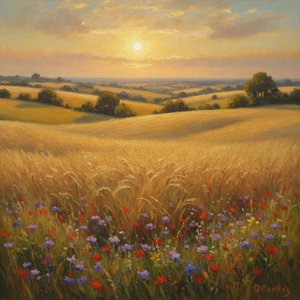
Paul Cézanne's “At Jas de Bouffan,” a captivating landscape rendered with the artist’s signature approach, offers a profound meditation on perception and the very nature of seeing. Painted at his beloved estate in Aix-en-Provence – a place he referred to simply as ‘Jas’ – this work embodies Cézanne’s revolutionary shift away from traditional representational art towards a more subjective and internalized vision. The scene unfolds with a quiet dignity, depicting a field punctuated by the sturdy presence of trees, their forms subtly distorted yet undeniably recognizable. Two figures, small in scale against the vastness of the landscape, add an element of human connection to this otherwise solitary tableau, inviting the viewer to contemplate the relationship between humanity and nature.
The Dawn of Modernity: Cézanne’s Artistic Revolution
- A Bridge Between Movements: Cézanne's work occupies a pivotal position in art history. He anticipated many of the tenets of Cubism, employing fragmented forms and multiple perspectives within a single composition – techniques that would later be championed by Picasso and Braque.
- Breaking with Tradition: Unlike the Impressionists who sought to capture fleeting moments of light and color, Cézanne was more concerned with defining form through solid, geometric shapes. He meticulously built up layers of paint, creating a palpable sense of volume and weight within his landscapes.
- Influence and Legacy: Cézanne’s influence extended far beyond his own time. His innovative approach profoundly impacted the development of 20th-century art, paving the way for movements like Cubism, Futurism, and Abstract Expressionism.
Technique and Composition – A Masterclass in Observation
Cézanne’s technique is characterized by a deliberate layering of paint—a process he termed “alla prima,” meaning "at first go." He built up the forms through numerous thin glazes, creating an astonishingly rich texture and depth. The brushstrokes are visible, yet carefully controlled, contributing to the painting's overall solidity. Notice how Cézanne doesn’t simply depict the trees; he constructs them from a series of interlocking planes, each rendered with meticulous attention to light and shadow. The composition itself is deceptively simple – a central tree dominates the view, drawing the eye inward while the distant figures provide a sense of scale and human presence. This careful balance between foreground and background creates a powerful illusion of depth, inviting the viewer to step into the scene.
Symbolism and Emotional Resonance – A Place of Reflection
"At Jas de Bouffan" is more than just a landscape; it’s a reflection on Cézanne's own emotional connection to his beloved estate. The serene atmosphere, the carefully constructed forms, and the solitary figures all contribute to a sense of quiet contemplation. The tree itself can be interpreted as a symbol of strength, resilience, and enduring beauty – qualities that resonated deeply with Cézanne. The distant figures suggest a moment of respite, an opportunity for reflection amidst the natural world. This painting evokes a feeling of peace and tranquility, inviting viewers to escape the pressures of modern life and reconnect with the simple pleasures of nature.



 Anteprima in scala reale
 Ordina stampa
 Condividi
 Condividi
 Dettagli

 Scarica immagine
 Articoli simili
 Radiografia
 Slideshow

 Leggi tutto






































 L'opzione vetro è disponibile solo per dimensioni inferiori a 110 cm