

 Anteprima in scala reale
 Invia
Invia Condividi
 Dettagli opera
 Guida
Guida

 Scarica
 Simili
 Radiografia
 Slideshow
 Q&A
Q&A Statistiche
The bay


Experience the vibrant tranquility of Paul Signac's 1906 Pointillist masterpiece The Bay featuring colorful sailboats on a serene seascape and inviting you to bring this Neo-Impressionist gem into your collection.
 Espandi i dettagli
Scopri Paul Signac (1863-1935), maestro del Neoimpressionismo! Esplora la tecnica puntinista, le scene costiere e l'influenza sul Fauvismo. Opere d'arte su TopImpressionists!
Giclée / Stampe d'arte
Stampa giclée o su tela di qualità museale, con produzione rapida e diverse opzioni di finitura. ( Acquista il dipinto realizzato a mano Passa all'immagine digitale)




P118B €10

P118H €10

P118W €10

P438Z €10

P508JH €12

P508YH €12

P805H €10

P805Z €10

P919BZ €10

P919G €10

P919XJ €10

P959ZH €10

P968JZ €12

W106C €8

W218G €10

W218JH €8

W218Y €10

W307PJ €10

W316G €10

W316PJ €8

W316Y €10

W398PJ €8

W4111J €10

W500HY €15

W500JH €15

W692G €12

W849H €8

W940BG €15

W953PJ €8




Formato standard
su misura
CM
INCH
Scegli tra le nostre dimensioni predefinite, che rispettano le proporzioni originali dell'opera d'arte.
Loading sizes...

larghezza
altezza
Inserisci la larghezza e l'altezza desiderate, per adattarle alla tua cornice o alla tua parete. Una stampa può essere solo ritagliata, mai resa più grande dell'immagine originale; pertanto, un formato con una forma differente comporterà la perdita di una parte dell'opera. Ti invieremo un mockup digitale da approvare prima di procedere con la stampa. L'immagine mostrata in questa pagina non rappresenta il ritaglio reale — solo il mockup lo mostra.
Consegna in tutto il mondo () in 2 settimane invece delle normali 4/5 settimane. (1 Novembre)

Spedizione espressa gratuita in tutto il mondo

Tela in lino di alta qualità

Assicurazione completa sulla spedizione

Garanzia di rimborso dei dazi doganali

Garanzia di fedeltà cromatica assoluta

Politica di reso entro 100 giorni (solo per difetti di fabbricazione)

Garanzia di rimborso al 100%

Offerta per acquisti multipli
 L'opzione vetro è disponibile solo per dimensioni inferiori a 110 cm

The bay
Giclée / Stampe d'arte
Dimensioni riproduzione
-


Prezzo finale calcolato
€ 61
A Symphony of Light and Color
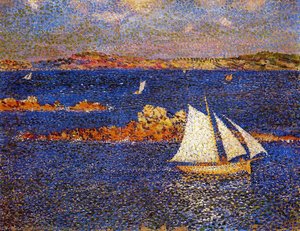
In the tranquil embrace of Paul Signac’s 1906 masterpiece, "The Bay," the viewer is invited into a world where light does not merely illuminate a scene but becomes the very fabric of its existence. This breathtaking work captures a serene coastal moment, where two sailboats with vibrant red and white sails drift lazily upon a shimmering expanse of water. The composition is anchored by a rugged, rocky shoreline in the foreground, where textured trees reach toward a sky filled with soft, drifting clouds. Beyond the gentle movement of the boats, a distant cliff rises with a sense of quiet grandeur, providing a structural weight that balances the ethereal lightness of the sea and sky. It is a scene that transcends mere landscape painting, offering instead a meditative window into the harmony of the natural world.
The true soul of this painting lies in its meticulous execution through the Pointillist technique, a method perfected by Signac to achieve a scientific yet deeply emotional resonance. Rather than blending pigments on a palette, Signac applied tiny, distinct dots of pure, unadulterated color directly onto the canvas. From a distance, these rhythmic pulsations of pigment dance and merge within the viewer's eye, creating an optical fusion that mimics the flickering quality of sunlight on water. This technique lends "The Bay" a unique, vibrating texture; the colors do not sit static upon the surface but seem to breathe and shimmer, capturing the fleeting essence of a summer afternoon with unparalleled vitality.
The Legacy of Neo-Impressionism
To understand the profound impact of "The Bay," one must look to the historical currents that shaped Paul Signac’s vision. As a pioneer of Neo-Impressionism, Signac sought to move beyond the spontaneous, often fleeting impressions of his predecessors toward a more structured and systematic approach to art. Influenced heavily by the scientific theories of color and light prevalent in late 19th-century France, he transformed the canvas into a laboratory of perception. In this work, we see the culmination of years of experimentation—a transition from the soft edges of Impressionism to a disciplined, mosaic-like precision that celebrates the mathematical beauty of light.
For the discerning collector or interior designer, "The Bay" offers much more than aesthetic beauty; it provides a focal point of sophisticated tranquility. The striking contrast between the deep, saturated tones of the rocky coast and the brilliant pops of crimson in the sails creates a dynamic visual energy that can anchor a room with elegance. Whether placed in a contemporary gallery setting or a classic study, this reproduction serves as a testament to the enduring power of Pointillism. It is an invitation to slow down, to observe the minute details, and to rediscover the profound peace found in the rhythmic dance of color and light.
Domande e risposte
Posso usare la realtà aumentata per vedere "The bay" di Paul Signac nella mia stanza?
"The bay" dispone di un'anteprima in realtà aumentata: la pagina Anteprima in AR dell'opera ti permette di visualizzarla nel tuo spazio tramite un dispositivo compatibile.
"The bay" di Paul Signac è un ritratto, un paesaggio o una composizione quadrata?
"The bay" di Paul Signac è una composizione in Landscape. Le proporzioni meritano di essere verificate prima di scegliere la dimensione della stampa.
A quale fase della carriera di Paul Signac appartiene "The bay" (1906)?
La data del 1906 colloca "The bay" nel Mature Period della carriera di Paul Signac.
Opere simili





Biografia dell'artista
Primi anni e formazione
Paul Victor Jules Signac, pittore neo-impressionista francese, nacque l'11 novembre 1863 a Parigi. Inizialmente intraprese un corso di architettura prima di decidere di diventare pittore all'età di 18 anni. Questa decisione fu influenzata da una mostra delle opere di Claude Monet.Stile artistico e influenze
Lo stile di Signac era caratterizzato dall'uso di piccoli punti di colore puro, che accostava per creare un senso di profondità e luce. Questa tecnica, nota come puntinismo, fu sviluppata in collaborazione con Georges Seurat. Il lavoro di Signac fu anche influenzato dai suoi viaggi lungo la costa europea, dove catturò la bellezza delle città portuali in acquerelli.Opere notevoli e associazioni
- Boulevard de Clichy (1886), un'opera post-impressionista che mette in mostra lo stile meticoloso di Signac.
- Il Boetta Rossa, Saint-Tropez (1895), una vibrante pittura marina con un boetta rosso-arancio su uno sfondo blu intenso.
- Membro fondatore della Société des Artistes Indépendants, che organizzò mostre annuali che stabilirono tendenze nell'arte del primo XX secolo.
Eredità e influenza
Il lavoro di Signac ebbe un profondo impatto sullo sviluppo del fauvismo, influenzando artisti come Henri Matisse e André Derain. In qualità di presidente della Société des Artistes Indépendants, Signac sostenne gli artisti più giovani ed espose opere controverse dei Fauves e dei Cubisti.- Visualizza altre opere di Paul Signac su https://TopImpressionists.com/@/paul-signac
- Esplora la tecnica del puntinismo e la sua influenza sul neoimpressionismo su https://en.wikipedia.org/wiki/pointillism
- Scopri il movimento artistico del simbolismo, emerso come reazione al realismo nel campo della cultura nel XIX secolo, su https://en.wikipedia.org/wiki/symbolist_painting
Date chiave
- 11 novembre 1863: nato a Parigi
- 1884: ha co-fondato la Société des Artistes Indépendants
- 15 agosto 1935: è deceduto all'età di 71 anni

Paul Signac
1863 - 1935 , Francia
Dettagli rapidi
- Artisti Influenti:
- Claude Monet
- Georges Seurat
- Artisti Influenzati:
- Henri Matisse
- André Derain
- Data Di Nascita: 11 novembre 1863
- Luogo Di Nascita: Parigi, Francia
- Movimento Artistico: Neo-Impressionismo
- Nazionalità: Francese
- Nome Completo: Paul Signac
- Opere Notevoli:
- Boulevard de Clichy (1886)
- Il Boia Rosso, Saint-Tropez (1895)
Articoli correlati

I 25 Capolavori di Paul Cézanne: L'Architetto della Forma
Scopri i 25 capolavori di Paul Cézanne e la rivoluzione post-impressionista. Esplora la collezione su TopImpressionists.com.

I 25 capolavori di Paul Klee: un viaggio tra astrazione e musica
Scopri i 25 capolavori di Paul Klee tra astrazione e Bauhaus. Esplora la collezione su TopImpressionists.com.

The Science of Light: Decoding the Optical Precision of Neo-Impressionism
Explore the scientific brilliance of Neo-Impressionism. Discover how masters like Georges Seurat revolutionized art through optical mixing, color theory, and the precision of Pointillism to capture the true essence of light.

Paul Signac: Puntinismo, Politica e la Ricerca dell'Armonia nell'Arte Moderna
Esplora il puntinismo e il divisionismo con TopImpressionists. Scopri la rivoluzione tecnica di Seurat, l'impegno politico di Signac e la ricerca dell'armonia nell'arte moderna. Approfondimenti storici e analisi approfondite.

La Scienza della Luce: Come l'Ottica ha Guidato la Tecnica di Seurat e Signac nel Puntinismo
Scopri come la scienza dell'ottica ha rivoluzionato il puntinismo di Seurat e Signac. Approfondisci la tecnica del colore ora.
Esplora le opere d'arte organizzate per temi, stili e caratteristiche.


