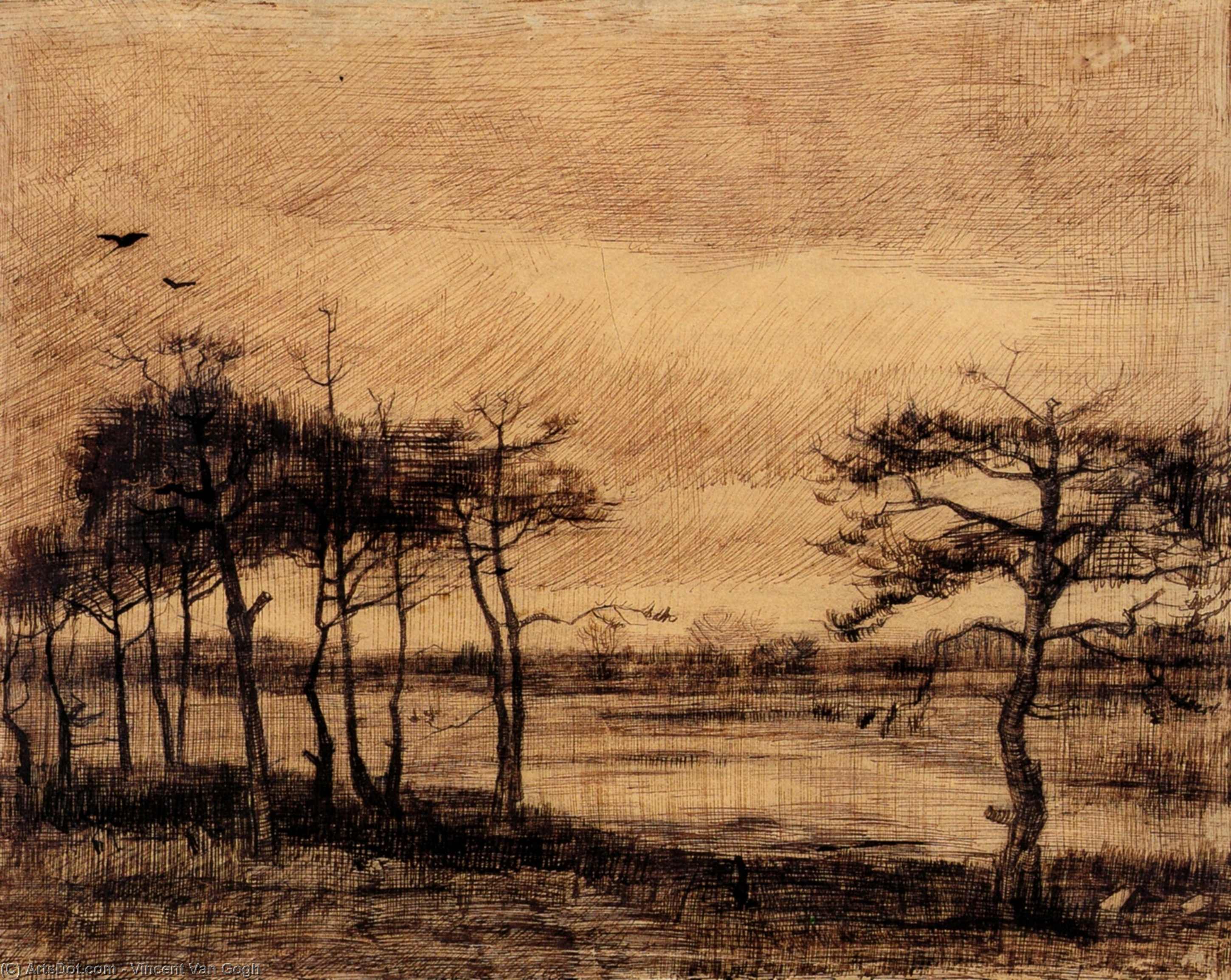
Pine Trees in the Fen
Vincent van Gogh, a renowned artist known for his captivating and emotive works, created "Pine Trees in the Fen" in 1884. This pencil drawing is a testament to his ability to capture the essence of nature with simplicity and elegance. It’s a piece that speaks volumes about Van Gogh's profound connection to the natural world—a connection he sought to express through meticulous observation and expressive technique.
Composition and Style
The painting features several pine trees standing alone or grouped together, set against a serene backdrop of water. The presence of birds adds a sense of life and movement to the scene. A birdhouse is also visible, adding an interesting detail to the composition. The black and white nature of the drawing gives it a classic and timeless feel, while the water adds depth and tranquility. Van Gogh’s masterful use of pencil allows for incredible textural detail—the rough bark of the pines contrasts beautifully with the smooth surface of the water, creating a visual harmony that embodies the artist's signature style: Realism blended with an undeniable emotional resonance. This approach wasn’t merely about accurately depicting what he saw; it was about conveying his feelings about being immersed in nature.
Artistic Significance
“Pine Trees in the Fen” showcases Van Gogh’s skill in realism, a style he often employed in his works. This piece is particularly notable for its use of pencil, which allows for intricate details and textures. The drawing is a reflection of Van Gogh's fascination with nature and his ability to find beauty in everyday scenes. Consider how the artist captures the subtle nuances of light and shadow—a technique that elevates the simple depiction of pine trees into something far more profound. It’s a demonstration of Van Gogh’s belief that art could illuminate the human spirit, mirroring the quiet contemplation evoked by observing the natural world.
Context and Influence
Van Gogh was influenced by various art movements during his time, including realism. His work often featured landscapes and still-life compositions that highlighted the beauty of the natural world. “Pine Trees in the Fen” is a prime example of this influence, demonstrating his ability to capture the essence of nature with precision and emotion. He drew inspiration from Japanese woodblock prints—
Ukiyo-e—which encouraged him to explore flattened perspectives and bold compositional arrangements. This stylistic fusion reflects the broader artistic currents of the era, signaling Van Gogh’s commitment to pushing boundaries while remaining rooted in observation.
Collection and Exhibition
“Pine Trees in the Fen” is part of an impressive collection at
The Museum Galleria d’Arte Moderna (Brescia, Italy), which houses over 5,000 paintings and sculptures by renowned artists. This museum is a significant cultural institution, showcasing modern and contemporary art. It's a place where visitors can experience Van Gogh’s artistic legacy firsthand—a testament to his enduring impact on the history of art.
Other Works by Van Gogh
Van Gogh's other notable works include:
These works, like “Pine Trees in the Fen,” demonstrate his mastery of realism and his ability to capture the essence of life through art.
Conclusion
“Pine Trees in the Fen” is a captivating piece that showcases Van Gogh’s skill in capturing the serenity of nature. This pencil drawing is a testament to his artistic genius and his ability to find beauty in everyday scenes. For those interested in exploring more of Van Gogh's works,
Pine Trees in the Fen and other pieces can be found at TopImpressionists.com.
For more information on Van Gogh's life and works, visit
Vincent van Gogh.


 Acquista stampa
 Invia
Invia Condividi
 Dettagli opera

 Scarica
 Simili
 Radiografia
 Slideshow

 Scopri di più






































 L'opzione vetro è disponibile solo per dimensioni inferiori a 110 cm



