

展示内容: · 額縁を含むサイズ:
 設置イメージを表示
 シェアする
シェアする シェアする
シェアする
 詳細を見る
詳細を見る ガイドを表示

 ダウンロード
 似ている作品
 X線調査
X線調査 スライドショーを表示
 Q&A
Q&A 統計情報
統計情報


¥ 42579
手描き油彩複製画
当社のアーティストが、ご希望のサイズと額縁に合わせてキャンバスに手描きで制作する、オーダーメイドの油彩画です。 ( プリント版に切り替え デジタル画像販売へ切り替え)
本作品の著作権について
このページに掲載されている作品は著作権法によって保護されており、当社の許可なく同一の複製物を制作または販売することは法律で禁じられています。この保護は、以下のような国際条約に基づき執行されます。 ベルヌ条約 および、以下の条項に定められたものを含む各国の法律により、 米国著作権法 第17編。
敬意を払った法的な代替手段として、私たちはオリジナルにインスピレーションを与えられた、カスタムの手描きアートワークを提供しています。私たちの熟練したプロのアーティストは、元の作品が持つスタイル、情緒、そして芸術的なエッセンスを注意深く研究し、独自の創作物でありながら、同じ感性を呼び起こすような、新しくユニークな作品を作り上げます。
この手法は、著作権で保護された作品の複製や複写を伴わないため、著作権法に完全に準拠しています。これは単なる模倣ではなく、創造的な再解釈です。元の作品からインスピレーションを受けつつも、それとは異なる、全く新しい絵画を生み出すものです。
 詳しく読む
詳しく読むサイズ
·標準サイズ
オーダーメイド
CM
INCH
作品のオリジナル比率に合わせた、当店の規定サイズからお選びください。
サイズを読み込み中...

横幅
高さ
フレームや壁のスペースに合わせて、ご希望の幅と高さを入力してください。本作品は手描きのため、異なる比率のサイズをご希望の場合、絵画の周囲を少し広げて描くか、あるいは端を少しカットして調整することが可能です。お客様のご要望に合わせます。制作を開始する前に、仕上がりを確認するためのデジタルモックアップをお送りいたします。このページに表示されている画像は完成品の実物ではなく、あくまでモックアップによるイメージです。
仕上げ
·
白の側面仕上げ ¥1

エッジぼかし仕上げ ¥1

回り込み仕上げ ¥1

P118B ¥10

P118H ¥10

P118W ¥10

P438Z ¥10

P508JH ¥12

P508YH ¥12

P805H ¥10

P805Z ¥10

P919BZ ¥10

P919G ¥10

P919XJ ¥10

P959ZH ¥10

P968JZ ¥12

W106C ¥8

W218G ¥10

W218JH ¥8

W218Y ¥10

W307PJ ¥10

W316G ¥10

W316PJ ¥8

W316Y ¥10

W398PJ ¥8

W4111J ¥10

W500HY ¥15

W500JH ¥15

W692G ¥12

W849H ¥8

W940BG ¥15

W953PJ ¥8

H24-GOLD ¥30

H24-SILVER ¥30

H36-GOLD ¥45

H36-SILVER ¥45
保護用の筒に入れてお届けしますので、お客様ご自身でフレーム(額縁)をご用意いただく形となります。
オプションサービス
任意特典の内容について
変更可能な例:顔をお客様の写真に差し替え、ペットの変更(例:猫を犬に変更)、背景に隠しメッセージを追加、背景の風景や要素の変更。
ご注文後、TopImpressionists.com のチームより詳細な手順についてメールをお送りし、仕上がりイメージ(モックアップ)をご提示いたします。
ご注文後、TopImpressionists.com のチームより詳細な手順についてメールをお送りし、仕上がりイメージ(モックアップ)をご提示いたします。
世界中への配送()は、通常の5週間ではなく、3〜4週間でお届けいたします。(9 11月)。品質には一切妥協いたしません。
保護用ワニス
キャプション
刻印入りブロンズプレートの詳細
This elegant plaque features the artist's name and the title of the artwork, finely engraved for a timeless presentation.
It is made from bronze with a refined, elegant finish. The text is precisely laser-engraved for a sharp and permanent result. Measuring 9x2 cm, the plaque is compact yet easy to read. It's built to be durable and scratch-resistant, offering a professional, museum-quality look. Mounting is simple thanks to the included adhesive backing.
透明アクリル銘板の詳細
The plaque includes essential engraved details such as the artist's name, the title of the artwork, the date it was created, the type of media used-like oil on canvas or watercolor-a brief description of the piece, and a QR code that links to the complete artwork information.
It is crafted from clear acrylic, offering a sleek, modern appearance. The text is UV-engraved in black to ensure strong visual contrast. With a size of 10x15 cm, it ensures optimal readability. It comes equipped with two metal hooks for secure wall mounting. The plaque is designed to be weather-resistant, making it suitable for various environments, and it includes interactive features that work seamlessly with smartphone scanning.
黒アクリル製銘板の詳細
This elegant plaque includes engraved information such as the artist's name, the title of the artwork, the date it was created, the type of media used (like oil on canvas or watercolor), a short description of the artwork, and a QR code for quick access to more information.
The plaque itself is made from refined black acrylic with a premium finish. The text is laser-engraved in white for high contrast and readability. Its size is 10x15 cm, designed to be easy to read. It comes with two metal hooks for professional mounting. The design is sleek and fits any interior style. It is also weather-resistant and durable, with built-in digital integration for mobile compatibility.
ガラスオプションは、110cm未満のサイズでのみご利用いただけます。
 ガラスオプションは、110cm未満のサイズでのみご利用いただけます。
- 世界中へ無料エクスプレス配送
- 高品質なリネンキャンバス
- 配送時完全保険付
- 関税・輸入税の払い戻し保証
- 真の色彩再現に関する保証
- 100日間返品保証(製造上の欠陥がある場合のみ)
- 100% 全額返金保証
- まとめ買い割引のご案内


作品解説
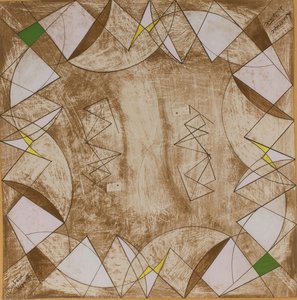
Barbara Hepworth's "Proof for Landscape Sculpture" is a captivating abstract screenprint featuring dynamic triangles and circles—a testament to her modernist vision.
アーティストの略歴
バーバラ・ヘップワース(1903-1975)のモダニズム彫刻を探索しましょう。抽象芸術の先駆者である彼女の作品は、「Oval Form」や「Two Forms」など、シュルレアリスムと抽象を融合させています。ヘップワース・ウェイクフィールドで彼女の遺産を見つけましょう。
作品について
The Genesis of a Geometric Dream
Barbara Hepworth's "Proof for 'Landscape Sculpture' Ascher scarf design," created in 1947, isn’t merely a decorative print; it’s a distilled essence of the artist’s profound engagement with form and space. Born in Wakefield, Yorkshire, Hepworth’s journey into abstraction began amidst the burgeoning artistic movements of the early 20th century, influenced by her time in Italy and her close relationships with figures like Ben Nicholson. This particular work represents a pivotal moment – a bridge between her sculptural explorations and a more accessible visual language. The design itself feels almost embryonic, a preliminary sketch for a larger concept, yet it possesses an undeniable maturity and a captivating internal logic. It’s as if Hepworth is inviting us to witness the birth of an idea, a geometric meditation on the relationship between solid form and negative space.
- Key Materials: The print utilizes a limited palette – primarily shades of grey and black – emphasizing the interplay of light and shadow. This restraint amplifies the impact of each shape, creating a sense of quiet intensity.
- Technique: Executed as a screenprint, the work showcases Hepworth’s masterful control over texture and layering. The subtle variations in ink density produce a delicate, almost velvety surface, adding depth to the otherwise flat design.
Deconstructing the Landscape – A Symphony of Triangles
At first glance, the composition appears deceptively simple: a network of interlocking triangles and circles arranged within a central circular void. However, closer inspection reveals a complex system of relationships. The triangles aren’t randomly placed; they seem to be striving for equilibrium, pushing against each other in a dynamic tension. They evoke the fractured planes of a landscape viewed through shifting light, mirroring Hepworth's own sculptural explorations of natural forms – rocks, water, and earth. The circles, acting as anchors, provide stability and suggest the cyclical nature of existence. The deliberate absence of a definitive ‘foreground’ or ‘background’ further enhances this sense of spatial ambiguity, inviting the viewer to actively participate in constructing their own interpretation.
Symbolism Note:Hepworth was deeply influenced by Surrealist ideas and sought to capture the subconscious through her art. The fragmented forms can be interpreted as representing the brokenness of experience, while the circular void suggests a yearning for wholeness or perhaps an acceptance of incompleteness.
A Legacy of Modernism – Hepworth’s Sculptural Roots
Understanding “Proof for ‘Landscape Sculpture’ Ascher scarf design” requires acknowledging Barbara Hepworth's broader artistic context. She was a key figure in the Unit One movement, alongside Ben Nicholson and Paul Nash, which aimed to synthesize Surrealist and abstract principles within British art. Her sculptural work, characterized by its clean lines, biomorphic forms, and exploration of negative space, profoundly influenced her printmaking. The design’s geometric precision reflects this commitment to reductive abstraction – stripping away extraneous detail to reveal the essential form. Her sculptures often sought to capture a sense of movement and dynamism, qualities that are subtly echoed in the arrangement of shapes within the print.
Emotional Resonance - A Quiet Contemplation
Despite its intellectual rigor, “Proof for ‘Landscape Sculpture’ Ascher scarf design” possesses a remarkable emotional resonance. The muted colors and carefully considered composition evoke a sense of quiet contemplation – an invitation to slow down and observe the subtle beauty of form. It's not a work that demands immediate attention; rather, it rewards patient viewing with a growing appreciation for its intricate details and underlying harmony. The design’s inherent ambiguity allows it to resonate differently with each viewer, making it a timeless piece that continues to provoke thought and inspire reflection. Its understated elegance makes it an ideal addition to any space seeking a touch of sophisticated serenity.
Q&A
「Proof for」の詳細を確認することはできますか?
バーバラ・ヘップワース作「Proof for」のX線解析ページは、X線写真のような表示を含む、作品画像の11層にわたる光学レイヤーをスライドして閲覧できるインタラクティブ・ビューアです。
「Proof for」における明暗のバランスは、どのように表現されていますか?
バーバラ・ヘップワース作「Proof for」の明るさはbrilliant、輝度はGentle Luminanceと記録されています。
バーバラ・ヘップワース作「Proof for」のデジタルデータを入手するには、どうすればよいですか?
バーバラ・ヘップワース作「Proof for」のデジタルイメージは、こちらの高解像度デジタル画像ページにてご購入いただけます:高解像度デジタル画像のダウンロード
作品の豆知識とアートクイズ
バーバラ・ヘップワースについて

バーバラ・ヘップワース
1903 - 1975, イギリス
作家プロフィール
生い立ちと教育
バーバラ・ヘプワース卿は、イギリスの彫刻家および芸術家としてその名を馳せた人物であり、1903年1月10日、ヨークシャーのウェイクフィールドに生を受けました。彼女の芸術への道は、1920年にリーズ・スクール・オブ・アートに入学したことから始まり、その後、郡の奨学金を得てロンドンのロイヤル・カレッジ・オブ・アート(RCA)へと進みました。1921年から学びを深め、1924年には見事にディプロマを授与されました。芸術的キャリア
- バーバラ・ヘプワース卿の作品は、モダニズム、とりわけ近代彫刻の真髄を体現しています。彼女は、国際的な名声を手にした数少ない女性芸術家の一人でした。
- 1933年、彼女はベン・ニッコールやポール・ナッシュらと共に「ユニット・ワン」という芸術運動を共同設立しました。これは、イギリスの芸術界においてシュルレアリスムと抽象表現を融合させることを目的とした挑戦的な試みでした。
- ヘプワースの初期の作品は、抽象的な性質を特徴としており、パリを拠点とする芸術運動「アブストラクション・クレアシオン」への関わりも、彼女の作風形成に大きな影響を与えました。
代表作と展覧会
- ブロンズ彫刻である「Oval Form (Trezion)」は、アメリカ合衆国フォートワースにあるキンベル美術館のコレクションとして収蔵されています。(TopImpressionistsで詳細を見る)
- 彫刻作品である「Two Forms」は、イギリスのウェイクフィールドにあるヘプワース・ウェイクフィールドにて展示されています。(TopImpressionistsで詳細を見る)
- 大理石の彫刻である「Totem」もまた、ヘプワース・ウェイクフィールドのコレクションの一部を構成しています。(TopImpressionistsで詳細を見る)
遺産と美術館コレクション
バーバラ・ヘプワースの作品は世界的に高く評価されており、彼女の彫刻や絵画は、世界各地の様々な美術館のコレクションに組み込まれています。彼女の名を冠したヘプワース・ウェイクフィールドには、ヘプワース自身の傑作をはじめ、著名な芸術家たちによる数多くの名品が収蔵されています。(ヘプワース・ウェイクフィールドについて詳しくはこちら(TopImpressionists))結び
バーバラ・ヘプワース卿が近代イギリス彫刻において切り拓いた先駆的な業績は、美術史に消えることのない足跡を残しました。彼女の遺志は、今なお多くの芸術家や愛好家たちにインスピレーションを与え続けており、その作品群は、彼女の革新的な精神と芸術的才能を物語る不朽の証として輝き続けています。 バーバラ・ヘプワースの詳細(Wikipedia)バーバラ・ヘップワースについてのクイック・ファクト
- Artistic Movement Or Style: モダニズム、抽象主義
- Artists Or Movements Influenced By This Artist:
- アブストラクション・クレアシオン
- ユニット・ワン
- Artists Who Influenced This Artist:
- ヘンリー・ムーア
- ベン・ニッコール
- Date Of Birth: 1903-01-10
- Date Of Death: 1975-05-20
- Full Name: バーバラ・ヘップワース
- Nationality: イギリス
- Notable Artworks:
- オーバル・フォーム (トレジオン)
- トゥー・フォームズ
- トーテム
- Place Of Birth: イギリス、ウェイクフィールド


バーバラ・ヘップワース
Proof for
() ·
額縁を含むサイズ: · リネンに油彩で手描き
合計