作品詳細説明
A Symphony of Faces: Unpacking Fernand Léger’s “Untitled (6005)”
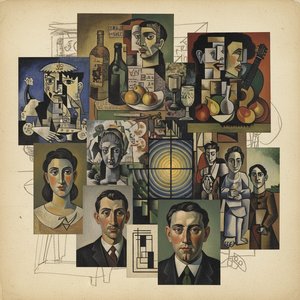
Fernand Léger's "Untitled (6005)" isn’t merely a painting; it’s a visceral exploration of the modern condition, a fragmented portrait of humanity grappling with the burgeoning complexities of the 20th century. Created in 1926, during his most prolific and influential period, this work embodies Léger's signature style – a bold synthesis of Cubism, Tubism, and a fascination with industrial forms. The image immediately commands attention: a dense field of black ink faces stacked upon one another, creating an unsettling yet compelling grid above a simpler, more abstract lower section. It’s a scene that simultaneously evokes the anonymity of urban life and the inherent human desire for connection, a duality that lies at the heart of Léger's artistic vision.
The Language of Tubism and Modernity
Léger developed his distinctive “Tubism” – a contraction of "tube," referring to the cylindrical forms he favored – as a way to represent the dynamism and geometric precision of machines and modern life. This approach moved beyond traditional Cubist fragmentation, seeking to capture not just the *appearance* of objects but their underlying structure and movement. In "Untitled (6005)," this is evident in the simplified, almost schematic rendering of each face – eyes, noses, mouths reduced to essential lines and angles. The repetition of these basic forms creates a rhythmic effect, mirroring the relentless pace of industrial progress. The stark black and white palette further emphasizes this mechanical quality, stripping away any superfluous detail and focusing solely on form and line. It’s a deliberate rejection of Romantic notions of beauty in favor of an honest depiction of the world as it was rapidly changing.
A Visual Commentary on Conformity and Anonymity
The sheer number of faces within the composition is profoundly significant. Léger himself described his work as reflecting “the face of the crowd,” suggesting a commentary on the increasing anonymity of modern urban life. The overlapping, almost suffocating arrangement speaks to the pressures of conformity – the feeling of being lost in a sea of similar individuals. Each face, though simplified, retains a subtle individuality, hinting at the unique experiences and emotions beneath the surface. Yet, collectively they form a homogenous mass, suggesting a loss of identity within the larger societal structure. The chaotic arrangement isn’t random; it's carefully constructed to convey a sense of unease and disorientation – a visual representation of the anxieties associated with rapid social change.
Technique and Historical Context
Léger executed "Untitled (6005)" using direct ink drawing, applying pigment directly to the paper with a brush or pen. This technique lends the work a raw, immediate quality, emphasizing the artist’s hand and process. The bold lines are deliberately thick and assertive, creating a strong visual impact that dominates the composition. The painting emerged during a period of immense social and technological upheaval – the aftermath of World War I, the rise of mass production, and the increasing urbanization of Europe. Léger's work reflects this turbulent era, grappling with themes of modernity, industrialization, and the human condition in the face of unprecedented change. It’s important to note that Léger was not simply documenting these changes; he was actively engaging with them through his art, seeking to find a new visual language for the modern age.
Symbolism and Emotional Resonance
Beyond its formal qualities, "Untitled (6005)" resonates with a powerful emotional depth. The repetition of faces evokes feelings of both alienation and connection – a recognition of our shared humanity amidst the anonymity of the crowd. The abstract lower section, comprised of geometric shapes reminiscent of machinery or architectural elements, provides a counterpoint to the densely populated upper portion, suggesting a potential escape from the pressures of urban life. Ultimately, the painting invites viewers to contemplate their own place within the modern world – to consider the challenges and opportunities presented by progress, and to reflect on the enduring importance of individual identity in an increasingly complex society. It’s a work that continues to provoke thought and inspire dialogue nearly a century after its creation.



 手描き複製画を注文する
 シェアする
シェアする シェアする
シェアする
 詳細を見る
詳細を見る

 ダウンロード
 似ている作品
 X線調査
X線調査 スライドショー

 詳細を見る
詳細を見る






































 ガラスオプションは、110cm未満のサイズでのみご利用いただけます。