作品詳細説明
A Symphony of Form and Color: Exploring Matisse’s ‘Cut Outs’
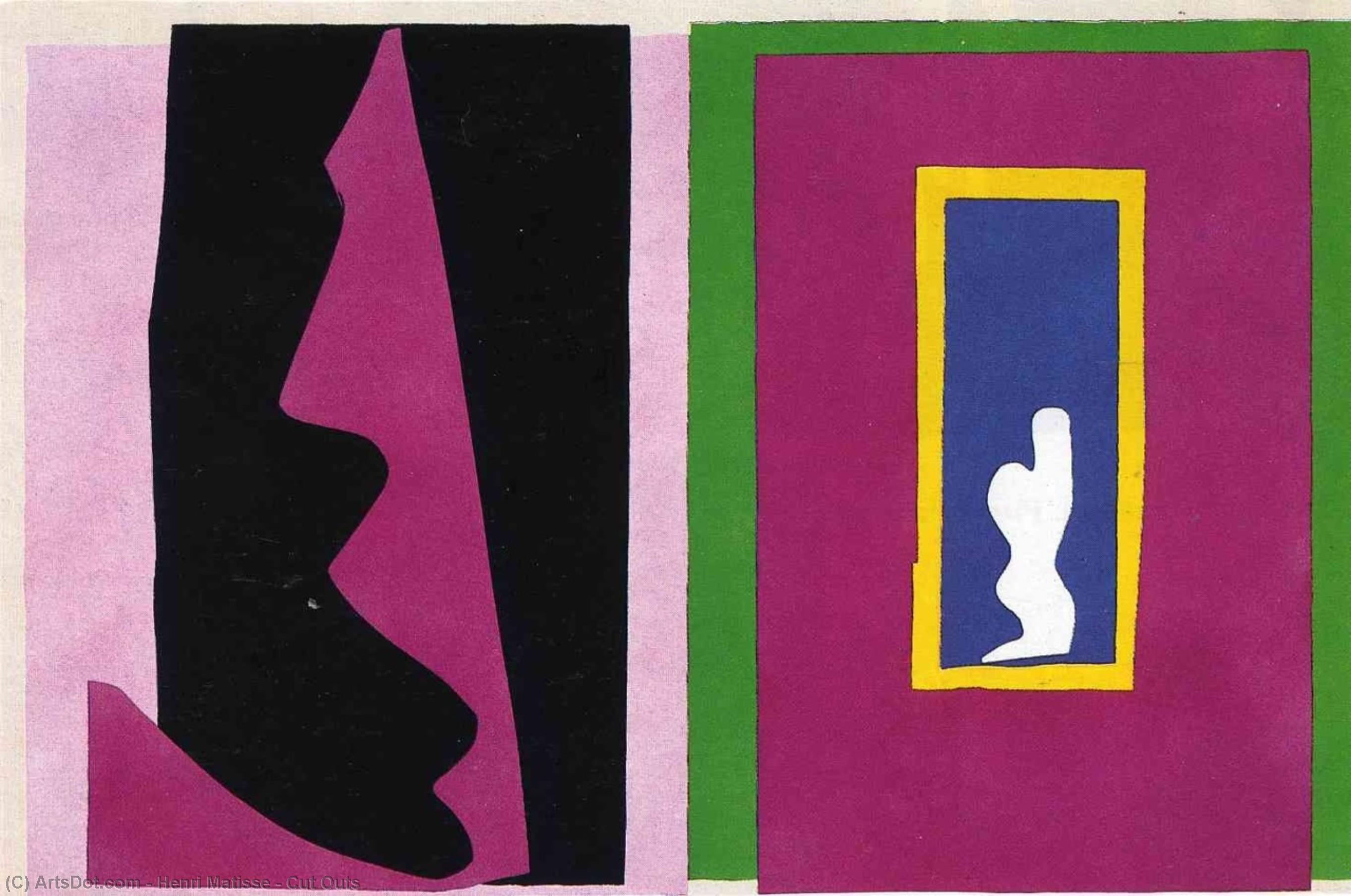
This captivating artwork embodies the revolutionary spirit of Henri Matisse's late career – his celebrated *cut-outs*. A prime example of modernist abstraction, this piece showcases Matisse’s mastery of color, shape, and negative space. The composition is boldly divided into two distinct rectangular fields separated by a grounding band of dark tone, creating an immediate visual impact.
Deconstructing the Composition
On the left, we encounter an abstracted human head rendered in nuanced shades of pink and black. Though simplified to its essential forms, the head retains a powerful presence, hinting at introspection and perhaps even vulnerability. To the right, a vibrant blue rectangle houses a flowing white figure – evocative of a dancer mid-leap or the graceful undulation of waves. This dynamic contrast between the static head and the fluid form establishes a compelling dialogue within the artwork. The shapes themselves are primarily geometric—rectangles, curves, and angular forms—yet possess an organic quality due to their arrangement and color choices.
The Revolutionary Technique
Matisse’s *cut-outs* weren't born from youthful experimentation but rather from necessity. Confined to a wheelchair in his later years following surgery, he found painting increasingly difficult. He turned instead to paper collage – or *papier découpé* as it is known in French – and discovered an entirely new artistic language. This technique involved precisely cutting shapes from vividly colored paper and arranging them into compositions. It’s a process that allowed him to synthesize color and form with unprecedented freedom, bypassing the traditional constraints of brushwork and perspective. The resulting aesthetic is strikingly clean and graphic, emphasizing the interplay between positive and negative space.
Historical Context & Artistic Lineage
Henri Matisse (1869-1954) was a pivotal figure in the development of modern art. Initially trained in academic painting, he became a leader of the *Fauvist* movement – known for its bold, non-naturalistic use of color. While this work leans towards abstract expressionism, it retains echoes of Fauvism’s vibrant palette and simplified forms. The *cut-outs*, created primarily between 1936 and 1954, represent a culmination of his lifelong exploration of color and form. They stand as a testament to his innovative spirit and ability to reinvent his artistic practice even in the face of physical limitations.
Symbolism & Emotional Resonance
While abstract, this artwork is rich with symbolic potential. The abstracted head can be interpreted as representing humanity itself – a universal symbol of thought, emotion, and existence. The flowing figure embodies movement, freedom, and perhaps even the life force. The deliberate color choices—the warmth of the pinks against the coolness of the blues—evoke specific moods and sensations. Overall, the piece exudes a sense of controlled energy and optimistic vitality.
A Lasting Legacy
Matisse’s *cut-outs* have had a profound influence on subsequent generations of artists, designers, and architects. Their bold simplicity and vibrant color palettes continue to inspire contemporary creativity. This artwork is not merely a visual statement; it's an invitation to experience the power of pure form and color – a testament to Matisse’s enduring genius. It offers a striking focal point for any interior, bringing a touch of modernist elegance and intellectual depth.