


 PaintingContemporary Art
 1997Contemporary
 130.0 x 140.0 cm
 Contemporary Art Platform
作品のオリジナル比率に合わせた、当店の規定サイズからお選びください。

特定のフレームやスペースに合わせて、ご希望のサイズをご入力いただけます。選択されたサイズが元の画像の比率と異なる場合、アートワークをトリミングするか、手描きで要素を追加して絵画を拡張いたします。デジタルモックアップ を制作し、制作開始前にご確認(承認)をいただきます。
画面上のプレビューは、実際のトリミングや拡張を正確に反映しているものではありません。最終的な構図は、モックアップによってのみ正確にご確認いただけます。
カスタムサイズもご利用いただけますが、元の比率を維持するためには、あらかじめ用意されたリストからサイズを選択することをお勧めいたします。

Untitled
複製画のサイズ
In this captivating 1997 masterpiece titled Untitled, the late Lebanese visionary Hussein Madi orchestrates a visual symphony that transcends the boundaries of traditional representation. At first glance, the viewer is struck by the vibrant, pulsating energy of a deep red background, which serves as a dramatic stage for the central protagonists: a violin and a cello. Rather than adhering to strict realism, Madi employs an abstract language to deconstruct these iconic musical instruments, reimagining them through fluid lines and rhythmic shapes. The composition breathes with a sense of movement, as if the very pigments are dancing to an unheard melody, inviting the observer to experience the music through sight alone.
The technique employed in this work reflects Madi’s profound mastery over form and texture. By blending elements of his sculptural background with the delicate precision of engraving, he creates a piece that feels both structurally grounded and ethereally light. The instruments are not merely objects but are transformed into symbols of harmony and resonance. Scattered throughout the canvas, smaller, enigmatic figures emerge from the composition, acting as rhythmic accents that guide the eye across the 130 x 140 cm expanse. These figures add a layer of narrative complexity, suggesting a larger, cosmic dance where every element is interconnected within the grand design of the universe.
To understand the emotional depth of this piece, one must look toward the rich cultural tapestry that informed Madi’s life. Having studied in Rome and deeply researched Egyptian and Arabic iconography, Madi possessed a unique ability to weave ancient symbolism into the fabric of modern abstraction. In Untitled, this manifests as a profound respect for balance and rhythm—concepts central to both Middle Eastern art and classical music. The interplay between the bold, saturated reds and the structured silhouettes of the instruments evokes a sense of passion tempered by discipline, mirroring the duality of the artist's own journey between the Mediterranean traditions and contemporary global movements.
For the discerning collector or interior designer, this artwork offers more than just aesthetic beauty; it provides a focal point of intellectual and emotional sophistication. The painting’s ability to command attention through its intense color palette makes it an ideal centerpiece for luxurious, modern interiors that seek to evoke warmth and cultural depth. Whether placed in a curated gallery setting or a grand residential salon, this reproduction of Madi's work serves as a timeless tribute to the enduring power of art to harmonize the human spirit.
In the vast tapestry of Middle Eastern modernism, few threads are as intricately woven or as profoundly resonant as those left by Hussein Madi. Born in the historic coastal city of Sour, Lebanon, in 1938, Madi emerged not merely as an artist, but as a visual poet capable of translating the ancient echoes of Arabic heritage into the language of contemporary form. His journey was one of constant dialogue between the local and the universal, beginning with his foundational studies at the Lebanese Academy of Fine Arts and expanding through a transformative period in Rome. It was in Italy that Madi’s artistic consciousness truly deepened; by immersing himself in the study of Egyptian cultural heritage, he began to synthesize the classical rigor of Western training with the symbolic richness of his Levantine roots.
The years between 1973 and 1986, spent primarily in Rome, served as a crucible for his creative evolution. During this era, Madi moved beyond mere representation, embarking on a scholarly and artistic quest to uncover the hidden iconography of the Arab world. He sought to capture the essence of identity through a vocabulary of shapes that felt both timeless and modern. Upon his return to Lebanon in 1986, he did not merely settle into a studio practice but became a vital pillar of the academic community, teaching sculpture and engraving at the Lebanese University and the Institute of Fine Arts. Through this mentorship, Madi ensured that his dedication to craftsmanship and cultural storytelling would ripple through future generations of Levantine artists.
Madi’s artistic output was characterized by a remarkable duality, masterfully navigating the tactile weight of sculpture and the delicate precision of printmaking. In his sculptural works, often rendered in bronze and stone, he possessed an uncanny ability to freeze motion within stillness. His figures frequently embody ritualistic gestures, capturing a sense of sacred movement that suggests archetypal narratives from Arabic tradition. These works are not static objects; they are breathing entities that invite the viewer into a state of spiritual contemplation, where the heavy permanence of stone meets the ephemeral grace of a human gesture.
Parallel to his sculptural mastery was his profound command of the graphic arts. As an engraver and printmaker, Madi utilized etching techniques to create monochrome worlds of striking contrast. His prints are celebrated for their ability to convey complex emotional landscapes through minimalist lines. A recurring motif in his oeuvre is the stylized bird—a symbol that transcends mere decoration to represent freedom, resilience, and transcendence. These avian forms, soaring across the paper with rhythmic elegance, serve as a visual metaphor for the human spirit’s ability to rise above historical turbulence and find liberty within the constraints of form.
The impact of Hussein Madi’s work extends far beyond the borders of Lebanon, reaching the global stage through prestigious exhibitions and international acclaim. His participation in the Venice Biennale in 2003 stands as a testament to his standing among the world's elite contemporary artists. This recognition was further solidified by receiving the Order of Merit, an honor reflecting his profound contribution to the cultural fabric of the Mediterranean region. His ability to bridge the gap between the historical weight of Islamic and Arabic iconography and the sleekness of modern abstraction allowed him to create a universal aesthetic that resonates across cultures.
Ultimately, the significance of Hussein Madi lies in his role as a guardian of memory and a pioneer of form. Through his meticulous engravings and dynamic sculptures, he provided a visual language for an identity that is both deeply rooted in the soil of Lebanon and soaring with the limitless possibilities of modern art. His legacy remains a vital part of the Middle Eastern canon, reminding us that true art does not just depict history—it breathes life into it.

1938 - 2024 , Lebanon

Journey through Wassily Kandinsky's 25 most iconic abstract paintings. Explore his revolutionary use of color, form & spiritual expressionism. Find museum-quality Kandinsky reproductions and elevate your home decor with TopImpressionists.com. Discover all masterpieces on TopImpressionists.com!

抽象表現主義を定義する10の傑作。ポロック、ロスコら巨匠たちの情熱と色彩の世界へ。各作品に込められた物語と技法を紐解き、至高のアート体験を。TopImpressionists.comで、ミュージアムクオリティの複製画や洗練されたインテリアアイデアを発見してください。

マーク・ロスコの傑作25選。抽象表現主義を代表する巨匠、色彩が織りなす深遠な世界を探求します。絵画の背景や技法、感動的なストーリーを紐解き、TopImpressionistsで高品質なアートプリントをお楽しみください。リビングやオフィスにモダンアートを飾るなら!

モンドリアン、マレーヴィチ…幾何学的抽象絵画を代表する傑作10選。各作品の背景や色彩構成、アーティストの情熱に迫ります。美術館品質の複製画はTopImpressionists.comで。オンラインでアートコレクションをご覧ください。
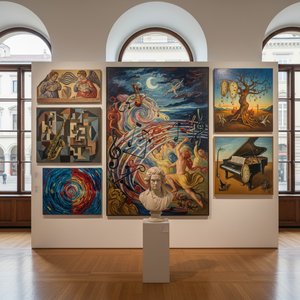
Explore the fascinating history of music's visual representation in art! From ancient symbolism to modern abstraction, discover how artists have captured sound and emotion on canvas. Expert insights & stunning examples.


最新の美術ニュース、限定オファー、そしてインテリアのアイデアをいち早くお届けします。
お客様のプロジェクトについてお聞かせください。当社の美術専門家が、お客様に合わせた3つのパーソナライズされた芸術提案をご提供いたします。
あなたにぴったりの3作品を無料で厳選いたします
 プリントを購入
 シェアする
シェアする シェアする
シェアする
 詳細を見る
詳細を見る

 ダウンロード
 似ている作品
 X線調査
X線調査 スライドショー
 詳細を見る
詳細を見る






































 ガラスオプションは、110cm未満のサイズでのみご利用いただけます。


