

展示内容: · 額縁を含むサイズ:
 設置イメージを表示
 シェアする
シェアする シェアする
シェアする
 詳細を見る
詳細を見る ガイドを表示

 ダウンロード
 似ている作品
 X線調査
X線調査 スライドショーを表示
 Q&A
Q&A 統計情報
統計情報

¥ 42511
手描き油彩複製画
当社のアーティストが、ご希望のサイズと額縁に合わせてキャンバスに手描きで制作する、オーダーメイドの油彩画です。 ( プリント版に切り替え デジタル画像販売へ切り替え)
サイズ
·標準サイズ
オーダーメイド
CM
INCH
作品のオリジナル比率に合わせた、当店の規定サイズからお選びください。
サイズを読み込み中...

横幅
高さ
フレームや壁のスペースに合わせて、ご希望の幅と高さを入力してください。本作品は手描きのため、異なる比率のサイズをご希望の場合、絵画の周囲を少し広げて描くか、あるいは端を少しカットして調整することが可能です。お客様のご要望に合わせます。制作を開始する前に、仕上がりを確認するためのデジタルモックアップをお送りいたします。このページに表示されている画像は完成品の実物ではなく、あくまでモックアップによるイメージです。
 詳しく読む
詳しく読む仕上げ
·
白の側面仕上げ ¥1

エッジぼかし仕上げ ¥1

回り込み仕上げ ¥1

P118B ¥10

P118H ¥10

P118W ¥10

P438Z ¥10

P508JH ¥12

P508YH ¥12

P805H ¥10

P805Z ¥10

P919BZ ¥10

P919G ¥10

P919XJ ¥10

P959ZH ¥10

P968JZ ¥12

W106C ¥8

W218G ¥10

W218JH ¥8

W218Y ¥10

W307PJ ¥10

W316G ¥10

W316PJ ¥8

W316Y ¥10

W398PJ ¥8

W4111J ¥10

W500HY ¥15

W500JH ¥15

W692G ¥12

W849H ¥8

W940BG ¥15

W953PJ ¥8

H24-GOLD ¥30

H24-SILVER ¥30

H36-GOLD ¥45

H36-SILVER ¥45
保護用の筒に入れてお届けしますので、お客様ご自身でフレーム(額縁)をご用意いただく形となります。
オプションサービス
任意特典の内容について
変更可能な例:顔をお客様の写真に差し替え、ペットの変更(例:猫を犬に変更)、背景に隠しメッセージを追加、背景の風景や要素の変更。
ご注文後、TopImpressionists.com のチームより詳細な手順についてメールをお送りし、仕上がりイメージ(モックアップ)をご提示いたします。
ご注文後、TopImpressionists.com のチームより詳細な手順についてメールをお送りし、仕上がりイメージ(モックアップ)をご提示いたします。
世界中への配送()は、通常の5週間ではなく、3〜4週間でお届けいたします。(6 11月)。品質には一切妥協いたしません。
保護用ワニス
キャプション
刻印入りブロンズプレートの詳細
This elegant plaque features the artist's name and the title of the artwork, finely engraved for a timeless presentation.
It is made from bronze with a refined, elegant finish. The text is precisely laser-engraved for a sharp and permanent result. Measuring 9x2 cm, the plaque is compact yet easy to read. It's built to be durable and scratch-resistant, offering a professional, museum-quality look. Mounting is simple thanks to the included adhesive backing.
透明アクリル銘板の詳細
The plaque includes essential engraved details such as the artist's name, the title of the artwork, the date it was created, the type of media used-like oil on canvas or watercolor-a brief description of the piece, and a QR code that links to the complete artwork information.
It is crafted from clear acrylic, offering a sleek, modern appearance. The text is UV-engraved in black to ensure strong visual contrast. With a size of 10x15 cm, it ensures optimal readability. It comes equipped with two metal hooks for secure wall mounting. The plaque is designed to be weather-resistant, making it suitable for various environments, and it includes interactive features that work seamlessly with smartphone scanning.
黒アクリル製銘板の詳細
This elegant plaque includes engraved information such as the artist's name, the title of the artwork, the date it was created, the type of media used (like oil on canvas or watercolor), a short description of the artwork, and a QR code for quick access to more information.
The plaque itself is made from refined black acrylic with a premium finish. The text is laser-engraved in white for high contrast and readability. Its size is 10x15 cm, designed to be easy to read. It comes with two metal hooks for professional mounting. The design is sleek and fits any interior style. It is also weather-resistant and durable, with built-in digital integration for mobile compatibility.
ガラスオプションは、110cm未満のサイズでのみご利用いただけます。
 ガラスオプションは、110cm未満のサイズでのみご利用いただけます。
- 世界中へ無料エクスプレス配送
- 高品質なリネンキャンバス
- 配送時完全保険付
- 関税・輸入税の払い戻し保証
- 真の色彩再現に関する保証
- 100日間返品保証(製造上の欠陥がある場合のみ)
- 100% 全額返金保証
- まとめ買い割引のご案内


作品解説
Explore 'Suprematism (18)' by Kazimir Malevich, a pivotal work of abstract art from 1917. Discover the origins of Suprematism and its revolutionary impact on modern art.
アーティストの略歴
カジミール・マレーヴィチ(1878-1935): Suprematismの創始者であり、抽象芸術の先駆者。黒方や白の中に白といった革新的な作品で知られ、20世紀美術に多大な影響を与えました。
作品について
The Dawn of Feeling: Exploring Kazimir Malevich’s Suprematism (18)
Kazimir Malevich's Suprematism (18), created in 1917, isn’t merely a painting; it is a portal into a radical new vision of art. Emerging from the tumultuous backdrop of revolutionary Russia, this work embodies the core tenets of Suprematism – an artistic movement founded by Malevich himself that sought to liberate art from any representational obligation to the external world. Instead of depicting objects or scenes, Suprematism (18) presents a carefully orchestrated arrangement of geometric forms and vibrant color fields intended to evoke pure feeling. The composition features a dominant brown form, almost sculptural in its presence, tipped with a stark black point that draws the eye upwards, suggesting an aspiration towards something beyond the material realm. Smaller, contrasting shapes dance around this central element, bathed in hues of blue, red, yellow and pink – colors chosen not for their descriptive qualities but for their inherent emotional resonance.
A Rejection of Representation: The Birth of Pure Artistic Feeling
To understand Suprematism (18), one must grasp Malevich’s philosophical underpinnings. He believed that traditional art was burdened by its commitment to depicting the visible world, a constraint he saw as hindering true artistic expression. His journey began with explorations of Impressionism, Symbolism, and Cubism, but ultimately, none satisfied his desire for an art form that could tap into pure spirituality. Suprematism was his answer – a system where shapes and colors were not *about* something; they *were* something. The painting isn’t intended to be ‘read’ like a traditional narrative; it is meant to be *felt*. The arrangement of forms, the interplay of color, and the stark simplicity all contribute to an experience that bypasses intellectual analysis and speaks directly to the subconscious. This was a revolutionary concept at the time, challenging centuries of artistic convention.
Technique and Context: A Moment in Art History
The technique employed in Suprematism (18) is deceptively simple. Malevich’s brushwork, while precise, avoids any display of virtuosity. The focus isn't on the artist’s skill but on the purity of the idea being expressed. He sought to eliminate all traces of personal expression, striving for a universal language of form and color. This painting emerged during a period of intense artistic experimentation in Russia. Following the 1917 revolution, artists were emboldened to push boundaries and explore new forms of expression, free from the constraints of Tsarist patronage. Malevich’s work resonated with this spirit of innovation, becoming a cornerstone of the Russian avant-garde. It's important to note that while seemingly abstract, these compositions weren’t created randomly; they were meticulously planned and executed based on Malevich’s theoretical framework.
The Enduring Legacy: A Source of Inspiration
Suprematism (18) continues to captivate viewers today not only for its historical significance but also for its enduring aesthetic power. Its influence can be seen in countless works of abstract art that followed, from the geometric abstractions of the Bauhaus school to the minimalist paintings of the 20th century. For interior designers, a reproduction of this artwork offers a bold statement piece – a focal point that adds sophistication and intellectual depth to any space. The interplay of warm and cool colors makes it surprisingly versatile, complementing both modern and traditional settings. More than just decoration, owning a reproduction of Suprematism (18) is an invitation to engage with a pivotal moment in art history and to contemplate the power of pure artistic feeling.
Q&A
カジミール・マレーヴィチ作「Suprematism (18)」の色使いは、どのような感情を呼び起こしますか?
カジミール・マレーヴィチ作「Suprematism (18)」のNeutralsなパレットは、そのSpiritualな情緒的トーンと見事に調和しています。色彩は、作品が感情を伝えるための重要な要素の一つです。
カジミール・マレーヴィチ作「Suprematism (18)」 の全体を貫く基調となる色は何ですか?
「Suprematism (18)」はWarm Sunset Tonesの色調が際立っています。
カジミール・マレーヴィチ作「Suprematism (18)」は、Kazimir Malevichにおいてどのような情緒を表現していますか?
Kazimir Malevichのムーブメントにおいて、「Suprematism (18)」はSpiritualなトーンで描かれています。
作品の豆知識とアートクイズ
カジミール・マレーヴィチについて

カジミール・マレーヴィチ
1878 - 1935, ウクライナ
作家プロフィール
カジミール・マレーヴィチ:抽象芸術の先駆者
カジミール・セヴェリーノヴィチ・マレーヴィチは、1878年にウクライナのキエフ地方で生まれ、20世紀美術に革命をもたらした画家であり理論家です。彼の作品は、具象表現を完全に放棄し、純粋な感情と幾何学的な形のみを追求することで、抽象芸術の新たな地平を開きました。「至高主義(Suprematism)」という独自の芸術運動を創始し、その思想は美術の世界に深い影響を与え続けています。マレーヴィチの人生は、伝統からの脱却、芸術における精神性の探求、そして政治的な抑圧との闘いによって彩られています。幼少期と初期の影響
ウクライナの農村地帯で育ったマレーヴィチは、その風景や民俗文化に深く影響を受けました。幼少期から芸術への関心を抱き、キエフで美術を学びますが、すぐにモスクワへと進み、ヨーロッパのアバンギャルド運動に触れる機会を得ます。印象派、象徴主義、フォーヴィスム、そしてキュビスムなど、様々なスタイルを試しながらも、彼は常に伝統的な芸術表現からの脱却を目指していました。民俗芸術への愛着と、現代美術への渇望が、彼の独自の芸術的探求の原動力となりました。至高主義の誕生と展開
1915年、マレーヴィチは「至高主義」という画期的な芸術運動を宣言します。これは、対象物の描写を超越し、純粋な感情を表現することを目的としたものでした。彼は、色彩、線、形といった要素が、人間の精神に直接働きかけ、超越的な感覚をもたらすと信じていました。その象徴として生まれたのが、「黒方」です。この作品は、絵画における具象表現の終焉を宣言するものであり、美術史において非常に重要な転換点となりました。「白の中に白」シリーズに見られるように、マレーヴィチは純粋な形と色彩の組み合わせによって、抽象芸術の可能性を極限まで追求しました。主要作品とその意味
「黒方」は、マレーヴィチの至高主義を象徴する最も有名な作品です。真っ黒な四角形が白い背景に浮かび上がり、見る者に強烈な印象を与えます。これは単なる幾何学的な図形ではなく、宇宙の深淵や人間の精神における絶対性を表現しようとした試みでした。「白の中に白」は、さらに抽象化を推し進めた作品群であり、純粋な白色の四角形が白い背景に浮かび上がり、見る者の意識を静寂へと誘います。また、「家づくりの図」は、初期の至高主義作品であり、建築的な要素と幾何学的な形を組み合わせることで、新たな空間認識を提示しています。これらの作品を通して、マレーヴィチは絵画における表現の可能性を拡大し、抽象芸術の概念を再定義しました。美術史上の意義と遺産
マレーヴィチの至高主義は、20世紀の美術に多大な影響を与えました。ミニマリズムや構成主義といった後続の芸術運動にインスピレーションを与え、非客観的芸術の発展に大きく貢献しました。彼の理論的な著作もまた、美術家たちに大きな影響を与え、抽象芸術の概念を深く理解するための基盤となりました。政治的な抑圧の中で、彼の作品は一時的に忘れ去られてしまいましたが、20世紀後半には再評価され、現代美術における重要な存在として確固たる地位を確立しました。マレーヴィチの遺産は、今なお多くのアーティストに影響を与え続け、抽象芸術の可能性を追求する人々にインスピレーションを与えています。カジミール・マレーヴィチについてのクイック・ファクト
- フルネーム: カジミール・マレーヴィチ
- 主な作品:
- 黒い正方形
- 白と白
- 建設中の家
- 出生地: キーウ、ウクライナ
- 国籍: ウクライナ/ロシア
- 影響を与えたアーティスト:
- ミニマリズム
- 構成主義
- エル・リシツキー
- 影響を受けたアーティスト:
- キュビスム
- フォーヴィスム
- 印象派
- 死亡年月日: 1935年5月15日
- 生年月日: 1878年2月23日
- 芸術運動またはスタイル: 構成主義、抽象芸術
テーマ、スタイル、特徴別に分類された作品を探索しましょう。




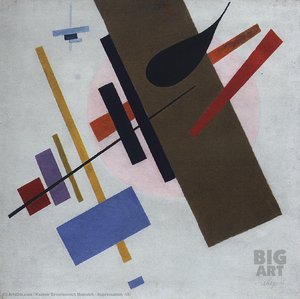
カジミール・マレーヴィチ
Suprematism (18)
() ·
額縁を含むサイズ: · リネンに油彩で手描き
合計