
迅速な制作と多彩な仕上げオプションを備えた、ミュージアムクオリティのジークレーまたはキャンバスプリント。 ( 手描きの絵画を購入 画像を購入)





























作品のオリジナル比率に合わせた、当店の規定サイズからお選びください。

特定のフレームやスペースに合わせて、ご自身でサイズを指定することも可能です。選択されたサイズが元の画像の比率と一致しない場合、作品をトリミングするか、鏡面反射または単色での塗りつぶしによって画像を拡張いたします。制作を開始する前に、ご確認用のデジタルモックアップをお送りいたします。
画面上のプレビューには、実際のトリミングや拡張は反映されませんのでご注意ください。最終的な構図を正確に確認できるのは、モックアップのみとなります。
カスタムサイズも承っておりますが、元の比率を維持するためには、あらかじめ用意されたリストからサイズを選択することをお勧めいたします。

Dos modelos vestidas
複製画のサイズ
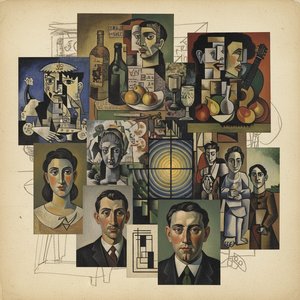
Pablo Picasso's "Dos Modelos Vestidas" (Two Dressed Models), painted in 1933, is not merely a depiction of two women; it’s a profound exploration of form, perspective, and the evolving nature of representation during a pivotal moment in art history. This work, housed within the esteemed Suite Vollard collection, exemplifies Picasso's groundbreaking contributions to Cubism while simultaneously revealing his deep engagement with the human figure – a subject he relentlessly interrogated throughout his prolific career.
The painting immediately commands attention through its fractured composition and deliberate ambiguity. Picasso employs his signature Cubist technique, dissecting each model into a series of interlocking geometric planes—rectangles, triangles, and circles—that simultaneously exist and don’t exist within the same space. The figures themselves are rendered with an almost skeletal quality, their elongated necks and simplified features suggesting a detachment from traditional portraiture. Rather than aiming for realistic representation, Picasso prioritizes the exploration of form itself, presenting multiple viewpoints of each subject at once, challenging the viewer to actively reconstruct the image in their mind’s eye.
Executed in a monochromatic palette—primarily shades of gray—Picasso masterfully utilizes hatching and cross-hatching to create depth and texture. These subtle tonal variations, achieved through meticulous layering of lines, imbue the painting with a remarkable sense of dynamism and movement. The absence of vibrant color forces the viewer to focus on the interplay of shapes and planes, highlighting the structural elements of the composition. Notice how the overlapping forms create an illusion of volume, suggesting the curves of the women’s bodies despite their fragmented presentation. This deliberate manipulation of space is a hallmark of Cubism, pushing beyond traditional notions of perspective and realism.
The background, filled with these geometric abstractions, isn't merely decorative; it actively contributes to the painting’s overall effect. These shapes can be interpreted as architectural elements—windows, doorways, or perhaps even fragments of a stage set—further blurring the boundaries between reality and representation. Picasso seems to be suggesting that the models are not simply posed subjects but rather figures within a constructed environment, reflecting the anxieties and uncertainties of modern life.
"Dos Modelos Vestidas" was created during a period of immense social and political upheaval—the rise of fascism in Europe and the looming threat of World War II. Picasso’s art often reflected these turbulent times, grappling with themes of violence, loss, and displacement. The painting can be viewed as a commentary on the fragmentation of society and the breakdown of traditional values. It's important to note that Picasso was deeply influenced by African masks and Iberian sculpture during this period, which informed his exploration of simplified forms and geometric abstraction.
Furthermore, the Suite Vollard collection itself holds significant historical importance. Commissioned by French collector Louis Vauxcelles, it represented a bold departure from traditional printmaking, embracing innovative techniques such as offset lithography—a process that allowed for greater precision and detail than earlier methods. This experimentation with new technologies reflects Picasso’s willingness to push the boundaries of artistic expression.
Despite its fragmented appearance, “Dos Modelos Vestidas” possesses a powerful emotional resonance. The figures' averted gazes suggest a sense of detachment or perhaps even melancholy. They are not presented as objects of beauty but rather as subjects caught in a moment of introspection. The painting’s ambiguity invites the viewer to project their own emotions and interpretations onto the scene, creating a deeply personal experience.
Ultimately, “Dos Modelos Vestidas” is more than just a portrait; it's a meditation on perception, representation, and the complexities of the human condition. It remains a testament to Picasso’s genius—a work that continues to challenge and inspire viewers decades after its creation. A high-quality reproduction captures not only the visual details but also the spirit of innovation and emotional depth that define this iconic masterpiece.

1881 - 1973 , スペイン

パブロ・ピカソの至高の25選。キュビズム、ゲルニカなど、時代を揺るがした名画の物語と芸術的魅力に迫ります。リビングやオフィスを彩るインテリアアートにも最適。TopImpressionists.comで高品質なピカソ作品をコレクション。
Explore 10 Cubist masterpieces by Picasso, Braque & more! Delve into the history of this revolutionary art movement. Find museum-quality reproductions and elevate your home decor with TopImpressionists. Discover all masterpieces on TopImpressionists.com

キュビスムを代表する10大名作の世界へ。ピカソ、ブラックら巨匠の革新的な技と色彩が織りなす、時代を超越した芸術体験を。TopImpressionists.comで、至高のアートプリントとインテリアアイデアを発見しましょう。

Explore the revolutionary world of Cubism. Discover how Pablo Picasso and Georges Braque dismantled perspective to redefine modern art through geometric innovation and analytical mastery. An essential guide for art students, collectors, and history enthusiasts.

Master the complexities of Cubism with our expert guide. Explore how Picasso and Braque revolutionized modern art through fragmentation, multiple perspectives, and geometric innovation. Perfect for art students and collectors seeking deep historical insight.


最新の美術ニュース、限定オファー、そしてインテリアのアイデアをいち早くお届けします。
お客様のプロジェクトについてお聞かせください。当社の美術専門家が、お客様に合わせた3つのパーソナライズされた芸術提案をご提供いたします。
あなたにぴったりの3作品を無料で厳選いたします


 プレビュー
プレビュー
 シェアする
シェアする シェアする
シェアする
 詳細を見る
詳細を見る

 ダウンロード
 似ている作品
 X線調査
X線調査 スライドショー

 詳細を見る
詳細を見る









 ガラスオプションは、110cm未満のサイズでのみご利用いただけます。


