































作品のオリジナル比率に合わせた、当店の規定サイズからお選びください。

特定のフレームやスペースに合わせて、ご自身でサイズを指定することも可能です。選択されたサイズが元の画像の比率と一致しない場合、作品をトリミングするか、鏡面反射または単色での塗りつぶしによって画像を拡張いたします。制作を開始する前に、ご確認用のデジタルモックアップをお送りいたします。
画面上のプレビューには、実際のトリミングや拡張は反映されませんのでご注意ください。最終的な構図を正確に確認できるのは、モックアップのみとなります。
カスタムサイズも承っておりますが、元の比率を維持するためには、あらかじめ用意されたリストからサイズを選択することをお勧めいたします。

Mandolin
複製画のサイズ
Pablo Picasso’s 1911 drawing, “Mandolin,” isn't merely a depiction of an instrument; it’s a fractured exploration of perception itself. At first glance, the image presents a startling juxtaposition: a bicycle, rendered in the sharp angles and geometric precision characteristic of his early Cubist work, interwoven with a stylized guitar form—a suggestion of musicality emerging from the mechanical. This isn't a straightforward representation; it’s an invitation to question how we see, how we understand, and ultimately, what constitutes reality. The drawing immediately commands attention, pulling the viewer into its dynamic asymmetry and challenging conventional notions of spatial harmony.
The artwork’s monochromatic palette—a carefully orchestrated dance between black, white, and grey—amplifies this sense of disruption. Lines aren't simply delineating shapes; they are actively constructing a new visual language. Angular lines dominate, creating a feeling of restless energy, while meticulous hatching and cross-hatching build up tonal values with remarkable subtlety, suggesting both the solidity of form and the ephemeral nature of light. The visible pencil strokes themselves contribute to an immediate intimacy, as if we’ve stumbled upon a fleeting moment captured on paper – a sketch brimming with intellectual curiosity.
Picasso's masterful manipulation of geometric shapes—triangles, rectangles, and curves—is central to the artwork’s impact. The bicycle frame, composed of sharply defined segments, embodies the Cubist principle of breaking down objects into their constituent parts and reassembling them from multiple viewpoints simultaneously. The guitar element, with its more rounded forms, offers a counterpoint, hinting at organic qualities within this otherwise rigorously constructed composition. This deliberate juxtaposition—the rigid mechanics of the bicycle against the implied warmth of music – speaks to the artist’s desire to dismantle established modes of representation and forge new ways of seeing.
The distortion of perspective is particularly striking. Rather than striving for realistic depth, Picasso flattens the image, creating a two-dimensional effect that emphasizes the interplay between planes and forms. Overlapping shapes contribute to this sense of ambiguity, blurring the boundaries between object and background, foreground and distance. This flattening isn’t simply an aesthetic choice; it mirrors the Cubist exploration of simultaneity – presenting multiple perspectives within a single frame, forcing the viewer to actively engage in the process of interpretation.
Beyond its formal innovations, “Mandolin” carries a potent symbolic weight. The combination of transportation and musical instruments—the bicycle representing movement and the guitar embodying creativity – suggests an exploration of human potential and the relationship between action and expression. The fragmented forms evoke a sense of dynamism and disruption, mirroring the turbulent period in which Picasso was working, grappling with the social and political upheavals of his time. There’s a subtle undercurrent of melancholy, perhaps referencing the loss of his sister Conchita, a recurring theme in his oeuvre.
Ultimately, “Mandolin” is more than just a drawing; it's a meditation on perception, representation, and the very nature of reality. It invites us to reconsider our assumptions about how things ‘should’ look and encourages us to embrace the beauty and complexity of fragmented perspectives. It stands as a testament to Picasso’s revolutionary spirit and his enduring legacy as one of art history’s most influential figures.

1881 - 1973 , スペイン

Explore the captivating world of Art Deco paintings & the Gilded Age's enduring legacy. Discover iconic artists like Tamara de Lempicka & invest in museum-quality reproductions with TopImpressionists.

Explore the revolutionary world of Cubism with TopImpressionists. Discover Picasso & Braque's groundbreaking techniques, its philosophical roots, and lasting impact on modern art. Expert insights for collectors.
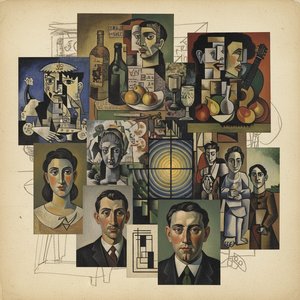
Explore 10 Cubist masterpieces by Picasso, Braque & more! Delve into the history of this revolutionary art movement. Find museum-quality reproductions and elevate your home decor with TopImpressionists. Discover all masterpieces on TopImpressionists.com

Explore the revolutionary world of Cubism with expert insights from TopImpressionists. Discover Picasso & Braque's groundbreaking techniques, its philosophical roots, and lasting impact on modern art. Expert appraisal & custom reproductions available.

キュビスムを代表する10大名作の世界へ。ピカソ、ブラックら巨匠の革新的な技と色彩が織りなす、時代を超越した芸術体験を。TopImpressionists.comで、至高のアートプリントとインテリアアイデアを発見しましょう。


最新の美術ニュース、限定オファー、そしてインテリアのアイデアをいち早くお届けします。
お客様のプロジェクトについてお聞かせください。当社の美術専門家が、お客様に合わせた3つのパーソナライズされた芸術提案をご提供いたします。
あなたにぴったりの3作品を無料で厳選いたします
 手描き複製画を注文する
 シェアする
シェアする シェアする
シェアする
 詳細を見る
詳細を見る

 ダウンロード
 似ている作品
 X線調査
X線調査 スライドショー

 詳細を見る
詳細を見る









 ガラスオプションは、110cm未満のサイズでのみご利用いただけます。


