






























作品のオリジナル比率に合わせた、当店の規定サイズからお選びください。

特定のフレームやスペースに合わせて、ご自身でサイズを指定することも可能です。選択されたサイズが元の画像の比率と一致しない場合、作品をトリミングするか、鏡面反射または単色での塗りつぶしによって画像を拡張いたします。制作を開始する前に、ご確認用のデジタルモックアップをお送りいたします。
画面上のプレビューには、実際のトリミングや拡張は反映されませんのでご注意ください。最終的な構図を正確に確認できるのは、モックアップのみとなります。
カスタムサイズも承っておりますが、元の比率を維持するためには、あらかじめ用意されたリストからサイズを選択することをお勧めいたします。

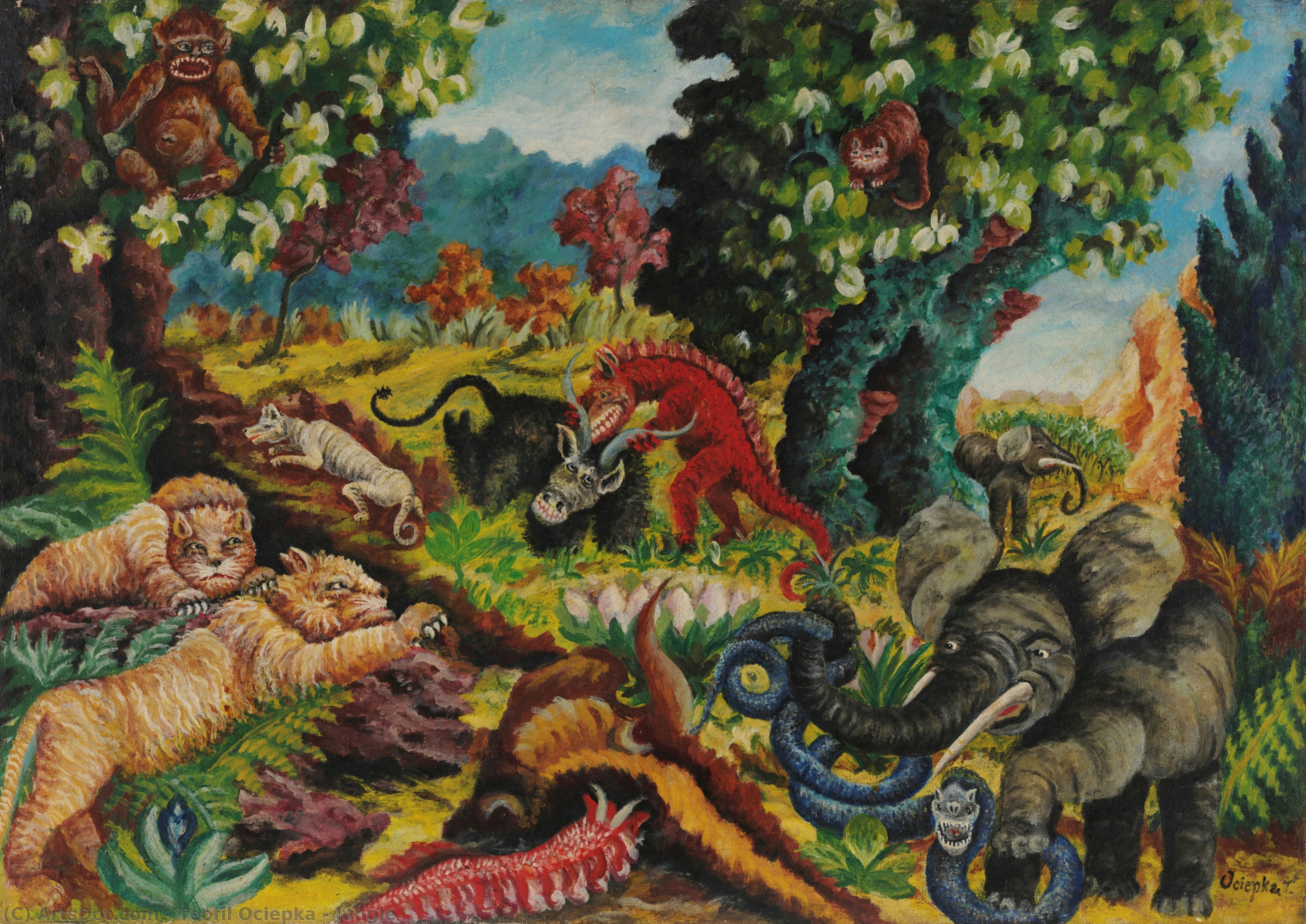
Jungle
複製画のサイズ
In the quiet corners of Polish art history, few figures possess the enigmatic allure of Teofil Ociepka. Born on April 22, 1891, in Janów Śląski, Poland, Ociepka was far more than a mere painter; he was a seeker, an occultist, and a dedicated theosophist whose brush served as a conduit for the unseen realms. As a self-taught primitivist, his work emerged not from formal academic training, but from a profound, internal necessity to translate spiritual truths onto canvas. His life, which spanned until 1978 in Bydgoszcz, was a continuous journey through the layers of the subconscious and the esoteric, leaving behind a body of work that vibrates with a dreamlike, otherworldly energy.
Ociepka’s artistic development was deeply intertwined with his spiritual pursuits. His fascination with the occult and theosophy provided him with a unique visual vocabulary, one where the boundaries between the physical landscape and the metaphysical plane are perpetually blurred. Unlike many of his contemporaries who sought to capture the external reality of the Polish countryside, Ociepka looked inward. His early life in Poland, marked by a deep immersion in folk traditions and mystical philosophies, allowed him to cultivate a style that felt both ancient and deeply personal. This fusion of folk art simplicity and complex esoteric symbolism created a tension in his work that continues to captivate modern viewers.
The aesthetic power of Ociepka’s paintings lies in their striking, unadorned clarity. His technique was characterized by the use of bold, saturated colors and remarkably flat, simplified forms—a hallmark of the Primitivist movement. However, beneath this deceptive simplicity lies a dense web of meaning. Every stroke and every shape often carries a weight of symbolic significance, reflecting his preoccupation with the hidden forces of the universe. His landscapes and still-life compositions are rarely just depictions of nature; they are sacred spaces populated by motifs that whisper of cosmic order and spiritual mystery.
When observing his most celebrated works, such as "The Garden" or "The Mountain," one is struck by the following elements:
Teofil Ociepka stands alongside legendary figures like Nikifor and Henri Rousseau as a master of the Primitivist tradition. While his work shares the raw, intuitive quality found in Rousseau’s jungles, Ociepka’s focus on theosophy gives his oeuvre a distinctively spiritual gravity. He did not merely paint what he saw; he painted what he felt to be true in the higher vibrations of existence. His ability to weave the humble aesthetics of Polish folk art into a grander narrative of universal mysticism has secured his place as one of Poland's most fascinating and enduring artistic voices.
Today, the legacy of Ociepka is preserved through collections in prestigious institutions, including the National Museum in Wrocław and the Museum of Folk Architecture in Sanok. His work remains a vital touchstone for anyone interested in the intersection of art, spirituality, and the human psyche. To encounter an Ociepka painting is to step into a realm where the veil between worlds is thin, offering a glimpse into the profound mysteries that the artist spent his entire life attempting to illuminate.

1891 - 1978 , Poland

クロード・モネの傑作25選。印象派を代表する光の画家、モネの世界を旅しませんか?睡蓮や風景画など、名画の背景にある物語と芸術技法をご紹介。TopImpressionistsで高品質な複製画とインテリアアートを見つけましょう。全コレクションはこちら。

ポール・セザンヌの至高の25選。ポスト印象派を代表する画家、セザンヌの傑作と革新的な技法を紐解きます。TopImpressionistsで高品質な複製画やインテリアアートを見つけ、芸術の世界をご自宅に。今すぐコレクションをご覧ください。

Journey through the vibrant world of Marianne North’s botanical paintings! Explore 25 iconic artworks from this Victorian artist, celebrating exotic flora & travel. Find museum-quality reproductions and curated decor ideas at TopImpressionists.com.

ウィンスロー・ホーマーの傑作25選。アメリカ美術を代表する画家、風景画から海洋画まで、その感動的な絵画の世界を探求。TopImpressionistsで複製画やアートプリントを手に入れ、お部屋に名画の輝きを。コレクションはこちら: TopImpressionists.com

Explore 25 iconic Sir Alfred Munnings paintings! Discover the beauty of British Impressionism, equine art & rural England. Find museum-quality reproductions and elevate your home decor with TopImpressionists. Explore the full collection online.


最新の美術ニュース、限定オファー、そしてインテリアのアイデアをいち早くお届けします。
お客様のプロジェクトについてお聞かせください。当社の美術専門家が、お客様に合わせた3つのパーソナライズされた芸術提案をご提供いたします。
あなたにぴったりの3作品を無料で厳選いたします
 Preview
 手描き複製画を注文する
 シェアする
シェアする シェアする
シェアする
 詳細を見る
詳細を見る

 ダウンロード
 似ている作品
 X線調査
X線調査 スライドショー


 詳細を見る
詳細を見る









 ガラスオプションは、110cm未満のサイズでのみご利用いただけます。


