


 設置イメージを確認
 送る
送る シェア
シェア
 詳細情報
詳細情報 ガイドを表示

 画像をダウンロード
 似ている作品
 X線調査
X線調査 スライドショー
 統計情報
統計情報Clouds and Spitfires
 Impressionism
 1943
1943 51.0 x 61.0 cm
Walter Thomas Monnington’s ‘Clouds & Spitfires’ (1943) captures WWII aerial action in a vibrant oil painting. Explore this evocative piece of aviation history, showcasing realism & impressionism.
Sir Walter Thomas Monnington (1902-1976) was a British painter known for large murals, war art & presidency of the Royal Academy. Explore his diverse works: portraits, landscapes & aerial combat scenes.
 続きを読む
続きを読む
このページに掲載されている作品は著作権法によって保護されており、当社の許可なく同一の複製物を制作または販売することは法律で禁じられています。この保護は、以下のような国際条約に基づき執行されます。 ベルヌ条約 および、以下の条項に定められたものを含む各国の法律により、 米国著作権法 第17編。
この手法は、著作権で保護された作品の複製や複写を伴わないため、著作権法に完全に準拠しています。これは単なる模倣ではなく、創造的な再解釈です。元の作品からインスピレーションを受けつつも、それとは異なる、全く新しい絵画を生み出すものです。
ジークレー/アートプリント
スピーディーな制作と多彩な仕上げオプションが魅力の、ミュージアムクオリティなジークレー・キャンバスプリント。 ( 手描きの複製画を注文する デジタル画像販売へ切り替え)




































標準サイズ
カスタムサイズ
CM
INCH
作品のオリジナル比率に合わせた、当店の規定サイズからお選びください。
Loading sizes...

横幅
高さ
額縁や壁のスペースに合わせて、ご希望の幅と高さを入力してください。プリントはカットすることは可能ですが、元の画像より大きくすることはできないため、異なる比率のサイズを選択された場合は、画像の一部が欠けることになります。印刷を開始する前に、内容を確認していただくためのデジタルモックアップをお送りいたします。このページに表示されている画像は、実際のカット後の状態を示すものではありません。実際の仕上がりはモックアップにてご確認ください。


 ガラスオプションは、110cm未満のサイズでのみご利用いただけます。

Clouds and Spitfires
ジークレー/アートプリント
複製画サイズ一覧
-


合計金額
¥ 10870
アーティストについて
The Visionary Brush of Sir Walter Thomas Monnington
Sir Walter Thomas Monnington (1902–1976) remains a towering figure in the landscape of British art, a painter whose career was defined by an extraordinary ability to navigate between the classical grandeur of the past and the turbulent realities of the twentieth century. Born in Westminster, his early years were deeply influenced by the pastoral serenity of the Sussex countryside. This connection to the natural world provided a foundational layer of observation and craftsmanship that would later inform even his most dynamic wartime compositions. His formal journey began at the Slade School of Fine Art, where he refined a technical prowess that would eventually lead him to the prestigious British School in Rome. It was during this Italian sojourn that Monnington encountered the enduring echoes of the Renaissance, an experience that instilled in him a lifelong fascination with classical ideals, balanced proportions, and the monumental scale of historical narrative.
The emergence of Monnington as a significant voice in modern British art was cemented by his early triumphs in academic competition. His work Allegory, which earned him recognition at the British School of Fine Art, remains a testament to his ability to blend realism with idealized forms. The acquisition of this piece by the Tate Collection served as a definitive milestone, signaling the arrival of an artist capable of translating complex, symbolic concepts into visually arresting oil paintings. As he moved into the professional sphere in London, Monnington’s versatility became his hallmark. He was not merely a painter of canvases but a creator of environments, collaborating on ambitious decorative schemes for institutions such as the Bank of England and St Stephen’s Hall in Westminster Palace. These mural projects demonstrated his capacity to handle large-scale narratives, weaving together history and artistry to serve the public consciousness.
A Legacy Forged in Conflict and Camouflage
The trajectory of Monnington’s life was irrevocably altered by the onset of World War II, a period that transitioned his focus from the serene and the allegorical to the visceral and the urgent. Serving with the Directorate of Camouflage at Leamingly Spa, he applied his keen eye for detail and spatial awareness to the innovative task of designing camouflage for airfields and factories. This period of service was not a departure from his artistry but an evolution of it. The tension of wartime Britain found its way onto his canvases through works that captured the mechanical power and the perilous beauty of aerial combat. In masterpieces such as Fortresses and Southern England Spitfires Attacking Flying Bombs, one can witness the artist’s ability to use bold, expressive brushstrokes to convey motion, energy, and the heavy atmosphere of a world at war.
Beyond the battlefield, Monnington’s repertoire expanded to include evocative landscapes and intimate portraits, proving that his technical mastery could scale from the vastness of a sky filled with aircraft to the quietude of a secluded grove. His work The Orchard exemplifies this softer, impressionistic side, where light and shadow dance across a landscape to evoke a sense of peace and timelessness. This duality—the ability to capture both the roar of engines and the whisper of leaves—is what makes his body of work so profoundly human.
In the later stages of his career, Monnington’s influence reached the highest echelons of the art establishment when he served as President of the Royal Academy. His leadership and dedication to the craft ensured that his commitment to excellence and historical continuity remained central to British artistic identity. To look upon a Monnington painting is to witness a life lived at the intersection of duty and wonder, a career that successfully bridged the gap between the classical traditions of the Old Masters and the modern complexities of a changing world.

Walter Thomas Monnington
1902 - 1976 , United Kingdom
アーティスト情報
- Full Name: Walter Thomas Monnington
- Nationality: British
- Date Of Birth: 1902
- Date Of Death: 1976
- Place Of Birth: Westminster, United Kingdom
- Notable Artworks:
- Allegory
- Southern England Spitfires Attacking Flying Bombs
- The Orchard
- Artistic Movement Or Style: Impressionism
- Artists Who Influenced This Artist:
- George Clausen
- William Rothenstein
関連記事

Echoes of War & Hope: Top 10 Artworks Reflecting the 1940s | TopImpressionists
Journey through a decade of resilience & change with our Top 10 artworks of the 1940s. Explore iconic paintings by Rockwell, Hopper & more—reflecting WWII's impact and post-war hope. Find museum-quality reproductions at TopImpressionists.com

Beyond the Portrait: Félix Nadar & the Psychological Depths of 19th-Century Photography
Explore the revolutionary photography of Félix Nadar – pioneer of portraiture, aerial imaging & psychological depth. Discover his iconic portraits of Baudelaire, Hugo & more. A deep dive into 19th-century art history.
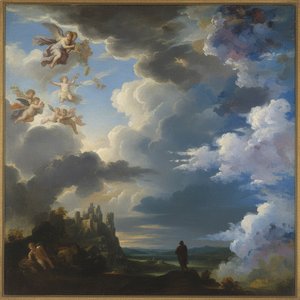
Ephemeral Visions: Clouds as Motif & Metaphor in Western Art History
Explore the captivating history of clouds in Western art! From Romantic masterpieces to Symbolist visions, discover how artists captured atmosphere, emotion & spirituality. A guide for collectors and enthusiasts.

Evoking Mood & Space: A History of Atmospheric Painting Techniques
Explore the history of atmospheric painting techniques – from Renaissance masters to American Tonalism. Learn how artists evoke mood & depth with aerial perspective, light, and color. Discover masterpieces & expert insights at TopImpressionists.