The Evolution of a Figurative Vision
Ernesto Deira was an Argentine artist who played a pivotal role in the Nueva Figuración movement. Alongside Jorge de la Vega, Rómulo Macció, and Luis Felipe Noé, he co-founded the Otra Figuración group in 1961. This collective sought to reintroduce figurative art to Argentinian culture, moving away from both abstraction and traditional representation. Deira’s own artistic journey was marked by a transition from studying law at the Universidad de Buenos Aires to pursuing art under the guidance of Leopoldo Torres Agüero and Leopoldo Presas. His work eventually led him to Paris, where he spent the later part of his life.
Style and Symbolic Expression
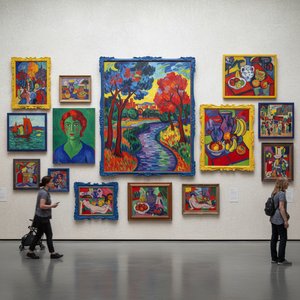
Deira’s aesthetic was characterized by an expressive, linear, and often grotesque style. He utilized a variety of techniques, including free brushwork, drip techniques, and thick, urgent brushstrokes that created a sense of movement. His palette frequently featured bold colors such as red, black, blue, and yellow. His subjects often appeared as distorted, vaguely human figures, sometimes presented in single portraits or as larger groups. In his 1971 series titled Identifications, he created seven paintings mirroring tragic political events in Latin America, Vietnam, and Bangladesh. These works were hidden to preserve them during the military regime in Chile before being returned to Argentina in 2020.
アーティストへのQ&A
Ernesto Deiraの作品は、時とともにどのように進化を遂げてきたのでしょうか?
Ernesto Deiraのアーティスト・クロニクルは、スクロールに合わせて展開するタイムライン形式となっており、アーティストのキャリアを時代ごとに章立てし、その作品群を時系列に沿ってご紹介しています。
Ernesto Deiraが最も頻繁に使用した色は何ですか?
本サイトに掲載されている作品群におけるErnesto Deiraの色彩表現は、アーティストのパレット・ゲノムページで詳しくご覧いただけます。
Ernesto Deiraは、どの時代に活動していましたか?
Ernesto DeiraはModernに活動していました。この時代背景は、その画家の足跡を歴史の中に位置づけるものです。
キーワードでErnesto Deiraの作品を探すことはできますか?
特定のテーマに沿ったErnesto Deiraの作品を探すには、キーワードごとに作品が分類されているアーティストのキーワードから探すページをご活用ください。