A Portrait of Inner Turmoil: Exploring Egon Schiele’s Untitled (9409)
This striking portrait by
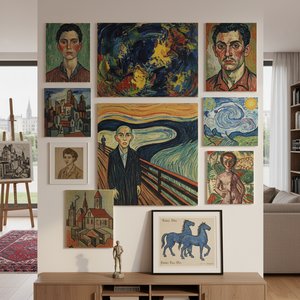
Egon Schiele is a powerful example of early Expressionism, radiating an unsettling yet captivating energy. The work depicts a man in a dark suit, seated and partially obscured, rendered with a boldness that prioritizes emotional impact over strict realism. It’s a piece that doesn't simply *show* a person; it conveys a state of being – one fraught with anxiety and isolation.
Stylistic Characteristics & Technique
Schiele’s signature style is immediately recognizable here. The painting employs several key Expressionist techniques:
- Flattened Perspective: Depth is deliberately distorted, creating an unnatural and claustrophobic space.
- Simplified Forms: The figure is reduced to essential shapes, stripping away detail in favor of raw emotional expression.
- Bold Color Palette: The intense contrast between the dark suit and the aggressively bright yellow background dominates the composition. This isn’t a naturalistic color scheme; it's deliberately jarring.
- Impasto Texture: Thick layers of oil paint are visibly applied, creating a tactile surface that adds to the work’s physicality and emotional intensity.
- Visible Brushwork: Loose, gestural brushstrokes contribute to the sense of urgency and unrest.
The technique itself feels almost frantic, mirroring the internal state it seeks to portray.
Historical Context & Schiele's Oeuvre
Created around 1918 – a tumultuous period marked by the end of World War I and widespread societal upheaval – this work reflects the anxieties and disillusionment prevalent in early 20th-century Vienna. Schiele, alongside Gustav Klimt and Oskar Kokoschka, was at the forefront of Austrian Expressionism, challenging traditional artistic conventions. His work often explored themes of sexuality, death, and psychological distress—subjects considered taboo at the time. He frequently used himself as a model, but also depicted friends and acquaintances with an unflinching honesty that bordered on vulnerability. Schiele’s tragically short life (he died in the Spanish Flu pandemic at age 28) adds another layer of poignancy to his art; it feels like a desperate attempt to capture something essential before time runs out.
Symbolism & Emotional Resonance
The symbolism within *Untitled (9409)* is open to interpretation, but several elements stand out. The obscured face suggests a hidden identity or an internal struggle with self-perception. The dark suit could represent societal constraints or a sense of formality that feels oppressive. The overwhelming yellow background evokes feelings of unease, perhaps even madness or illness.
The overall effect is one of profound isolation and psychological tension. It’s not a comfortable image; it's meant to provoke thought and elicit an emotional response.
Interior Design & Collecting Considerations
This piece, or a high-quality reproduction, would be a striking addition to a modern or contemporary interior. Its bold colors and dramatic composition demand attention, making it a powerful focal point. It pairs well with minimalist décor, allowing the artwork to truly stand out. For collectors, Schiele’s work represents a significant investment in an artist whose influence continues to resonate today. His paintings are held in major museums worldwide, including the Leopold Museum in Vienna and the Österreichische Galerie Belvedere. Owning a piece – or even a faithful reproduction – is owning a fragment of art history that speaks to the complexities of the human condition.
The raw emotional power of this work ensures its enduring appeal for generations to come.