작가 약력
A Life Woven in Lines: The Art of Geta Brătescu
Geta Brătescu, a pivotal figure in Romanian contemporary art, lived a life deeply intertwined with the political and artistic currents of 20th-century Europe. Born Georgina Comanescu on May 4, 1926, in Ploiești, Romania, her journey as an artist was marked by resilience, innovation, and a profound exploration of identity, feminism, and the very essence of creative expression. Brătescu’s early intellectual pursuits led her to the University of Bucharest's Faculty of Letters between 1945 and 1949, where she studied under luminaries like George Călinescu and Tudor Vianu—a foundation that instilled in her a lifelong appreciation for literature and its power to inform artistic vision. Simultaneously, she enrolled at the Academy of Fine Arts, studying under Camil Ressu, but her studies were abruptly halted by the rising tide of communism. Deemed ‘of bad origins’ due to her family's property ownership, she faced expulsion, an early encounter with the censorship and political constraints that would shadow much of her career. This initial setback didn’t extinguish her artistic flame; instead, it fueled a period of self-directed learning and experimentation before returning to formal studies at the Institute of Fine Arts 'Nicolae Grigorescu' from 1969 to 1971.
The Line as Language: A Multidisciplinary Approach
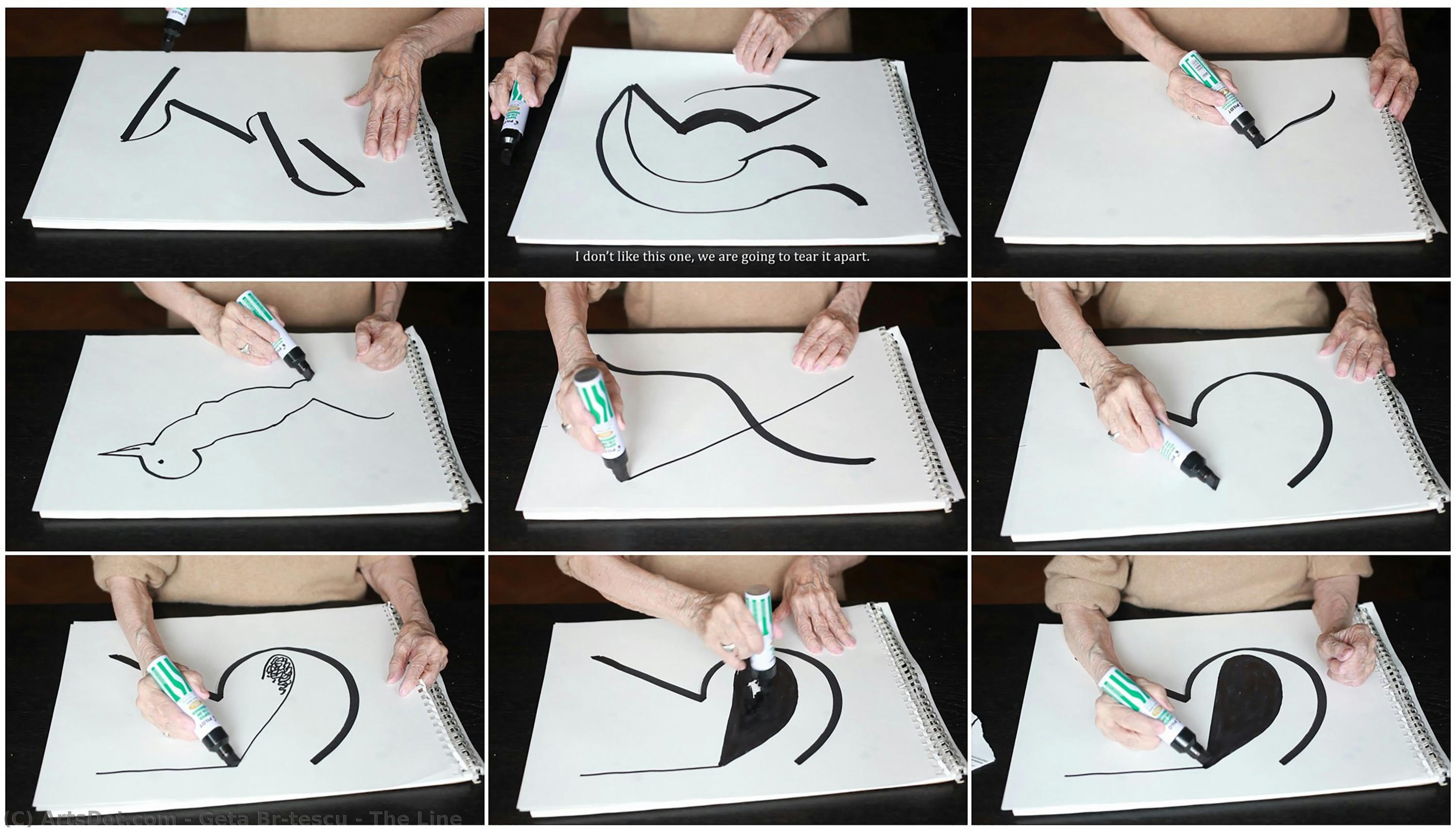
Brătescu’s artistic practice defied easy categorization, embracing a remarkable range of media—drawing, collage, photography, performance, illustration, and film all served as vehicles for her ideas. However, at the heart of this diverse output lay an unwavering fascination with the line. For Brătescu, the line wasn't merely a formal element; it was a fundamental tool for definition, measurement, and conveying movement—a way to map both physical space and inner states. This preoccupation is vividly apparent in her series of detailed hand studies, where the intricate network of lines captures not just anatomical form but also the expressive potential of the human touch. Her exploration extended beyond static representation into performative realms, using the line to delineate space and trace the boundaries of selfhood. This dedication to the line as a core element permeated all her work, becoming a signature that distinguished her unique artistic voice. She wasn’t interested in grand narratives or monumental statements; rather, she focused on the subtle power of gesture, the intimacy of materials, and the quiet revolutions possible within the confines of the studio.
Identity, Feminism, and Resistance
Brătescu's art consistently grappled with complex questions of identity, often through self-portraits and performances that challenged conventional notions of representation. Her work frequently engaged with feminist themes, most notably in her series inspired by the mythological figure of Medea—a character whose story resonated deeply with Brătescu’s own experiences as a woman navigating a patriarchal society. The *Medeic Callisthenic Moves* series, created from scraps of cloth provided by her mother, is particularly poignant, reflecting a complex relationship to femininity and the weight of inherited narratives. Living under a restrictive political regime, Brătescu's art subtly addressed issues of censorship and freedom of expression. Her work often operated within the private sphere as a form of resistance—a quiet rebellion against imposed limitations. *Censored Self Portrait* (1978), a powerful photographic work depicting her mouth and eyes obscured by paper strips, stands as a stark symbol of these constraints, embodying the artist’s struggle to articulate herself in a silenced world. Her studio became a sanctuary, a space for experimentation and self-discovery where she could circumvent official channels and explore forbidden territories.
Major Works and Lasting Legacy
Throughout her career, Brătescu produced a body of work that continues to inspire and challenge audiences. *The Studio* (1978), a seminal film created in collaboration with Ion Grigorescu, is a particularly significant piece, exploring the studio space as a site for self-definition and artistic creation—a microcosm of the artist’s inner world. The *Hands* series (1974–76) showcases her mastery of draughtsmanship and symbolic representation, elevating a seemingly mundane subject to profound metaphorical significance. The *Jeu des Formes (Game of Forms)* collages demonstrate her innovative approach to form and composition, continuing her exploration of lines and shapes in unexpected ways. Brătescu’s achievements were recognized late in life but with increasing acclaim. She served as artistic director of the influential Romanian literature and art magazine *Secolul 21*, and a major retrospective of her work was held at the National Museum of Art of Romania in 1999. In 2015, she had her first UK solo exhibition at Tate Liverpool, bringing her work to an international audience, culminating in representing Romania at the 57th Venice Biennale in 2017—a landmark moment in her career. Geta Brătescu passed away in Bucharest in 2018, leaving behind a legacy as a pioneering figure whose multidisciplinary approach and unwavering commitment to artistic freedom continue to resonate with generations of artists. She remains an essential voice for those seeking to challenge conventions and explore the complexities of human experience through art.






 프린트 구매하기
 공유하기
공유하기 공유하기
공유하기
 상세 정보
상세 정보

 다운로드
다운로드
 유사 작품
유사 작품 X-레이
X-레이 슬라이드 쇼
 더 보기
더 보기






































 유리 옵션은 110cm 미만 크기에서만 선택 가능합니다.


