
 Painting
 1958Modern
 28.0 x 36.0 cm
 스미소니언 국립 우체국 박물관
빠른 제작과 다양한 마감 옵션을 제공하는 박물관 품질의 지클레이 또는 캔버스 프린트. ( 수제 페인팅으로 전환하기 이미지로 전환)





























작품의 원본 비율을 유지하는 미리 설정된 크기 중에서 선택하세요.

특정 프레임이나 공간에 맞춰 직접 치수를 입력하실 수 있습니다. 선택하신 사이즈가 원본 이미지의 비율과 일치하지 않을 경우, 작품을 크롭(자르기)하거나 이미지를 대칭 또는 단색 채우기로 확장하여 제작합니다. 제작 시작 전, 최종 확인을 위해 디지털 목업이 전송됩니다.
화면상의 미리보기는 실제 크롭이나 확장 상태를 반영하지 않으므로, 최종 구도는 오직 목업을 통해서만 정확하게 확인하실 수 있습니다.
맞춤 사이즈 제작도 가능하지만, 원본 비율을 유지하기 위해서는 사전 정의된 목록에서 치수를 선택하시는 것을 권장합니다.

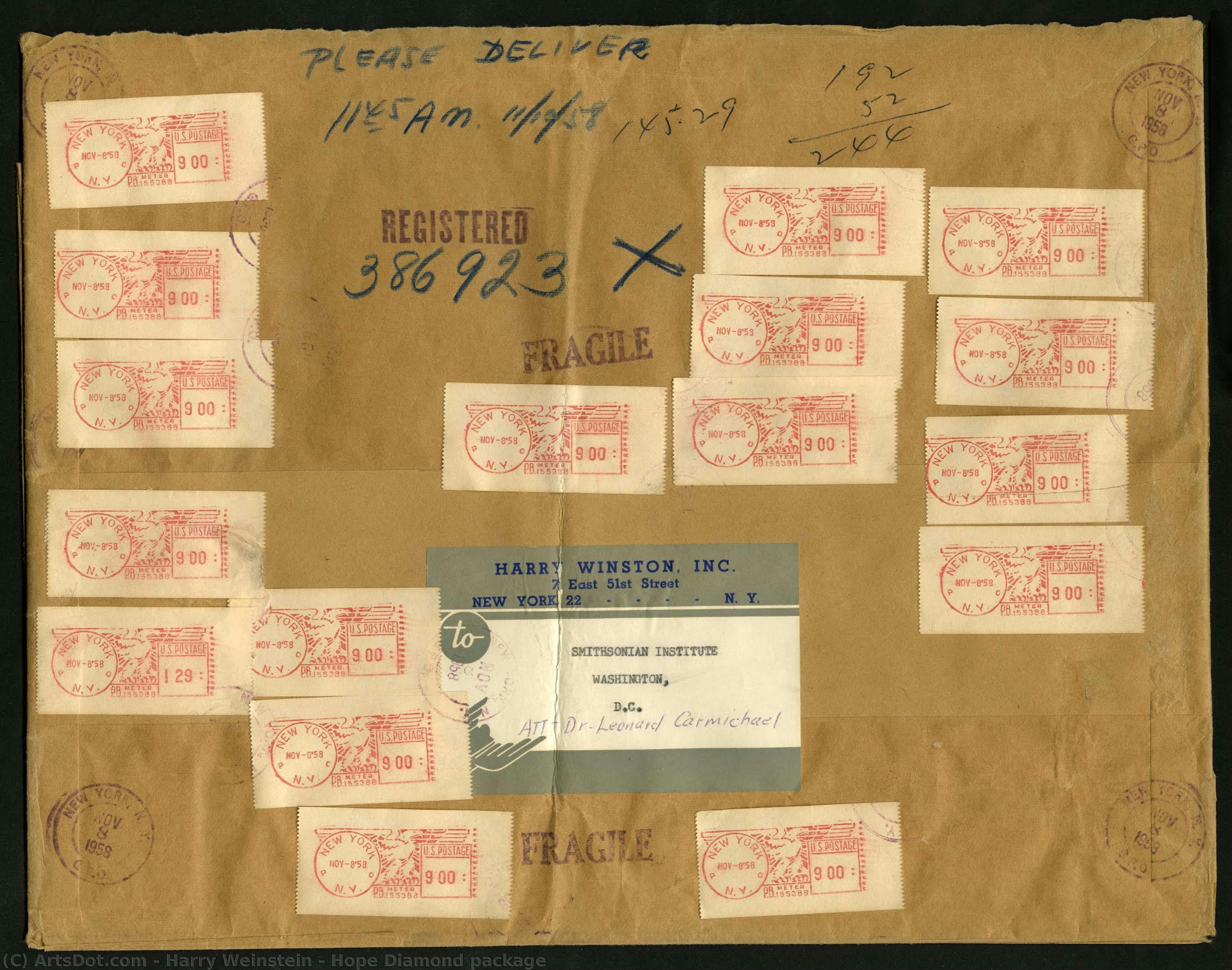
Hope Diamond package
복제본 크기
In the quiet intersection of postal history and fine art lies "Hope Diamond package," a captivating work by Harry Weinstein that invites viewers into a world of international intrigue and historical transit. At first glance, the painting presents us with a humble brown envelope, yet beneath its weathered surface lies a rich tapestry of global connection. This is not merely a depiction of mail; it is a window into a moment in time, captured through the meticulous rendering of a mailing wrapper destined for the Smithsonian's National Postal Museum. The piece breathes life into the mundane, transforming a simple object of logistics into a vessel of storytelling and mystery.
Beyond its visual charm, the painting carries a heavy symbolic resonance. The handwritten note, "Please deliver registered mail," acts as a poignant reminder of the care and gravity associated with precious cargo. It hints at the legendary status of the Hope Diamond itself, suggesting that even in its most transit-oriented form, the object possesses an aura of importance that demands protection. This tension between the fragility of paper and the permanence of historical legend creates a compelling emotional pull for the observer. The artwork serves as a meditation on communication—how ideas, treasures, and histories are packaged, sent, and eventually preserved for posterity.
For the discerning collector or interior designer, this piece offers a unique opportunity to introduce a conversation starter into a curated space. Its aesthetic is both scholarly and soulful, making it an ideal centerpiece for a library, a study, or a sophisticated gallery wall. As a high-quality reproduction, it brings the meticulous craftsmanship of Weinstein’s era into the modern home, offering a touch of academic elegance and a deep connection to the global heritage of the postal arts. To possess this work is to hold a fragment of a world where every stamp told a story and every envelope carried the weight of the world.
Born in Southampton, England, on June 8th, 1829, John Everett Millais was a pivotal figure in the vibrant artistic landscape of Victorian Britain. His life’s work, deeply intertwined with the burgeoning Pre-Raphaelite Brotherhood, marked a significant shift away from established academic traditions and toward a renewed appreciation for nature, medieval legend, and the emotional resonance of storytelling. From humble beginnings – his father a gentleman of considerable means – Millais's artistic journey was one of both prodigious talent and personal complexities, ultimately shaping him into one of the most celebrated painters of his era.
Millais’s early education was remarkably advanced for a boy of his age. He received instruction from various tutors, including a governess who instilled in him a love of literature and art, and later studied at Sass's Art School in London, where he quickly distinguished himself with his technical skill and natural ability. His entry into the Royal Academy Schools at just eleven years old was an unprecedented achievement, demonstrating his exceptional promise. This early success foreshadowed a career defined by both critical acclaim and occasional controversy. The influence of his family’s connections – particularly his mother's association with the poet Julian del Casal – provided him with access to intellectual circles that further nurtured his artistic sensibilities.
In 1848, at the age of nineteen, Millais played a crucial role in the formation of the Pre-Raphaelite Brotherhood alongside William Holman Hunt and Dante Gabriel Rossetti. Dissatisfied with the prevailing artistic conventions of the Royal Academy – characterized by historical painting dominated by grand narratives and idealized figures – the group sought to revive the spirit of the early Renaissance masters, particularly those before Raphael. They believed in returning to a more direct and truthful representation of nature, rejecting the artificiality and sentimentality prevalent in contemporary art.
The Brotherhood’s manifesto, penned by Rossetti, outlined their core principles: a commitment to truth, sincerity, and the study of medieval literature and legend. Millais's early works, such as *Pizarro Seizing the Inca of Peru* (1849), immediately established him as a key member, showcasing his meticulous attention to detail and dramatic compositions. However, this painting also sparked considerable debate within the Academy, with some critics finding its realism unsettling and its subject matter morally questionable.
Millais’s most celebrated works are arguably *Ophelia* (1851-52) and *Christ in the House of His Parents* (also known as *The Carpenter's Shop*) (1850-52). *Ophelia*, depicting the tragic heroine from Shakespeare’s *Hamlet* drowning in a stream, remains one of the most recognizable images in art history. Its vibrant colors, meticulous rendering of foliage and water, and poignant portrayal of sorrow captivated audiences and cemented Millais's reputation as a master of naturalism. The painting’s initial reception was mixed, with some critics objecting to its perceived lack of moralizing sentimentality.
*Christ in the House of His Parents*, however, proved far more controversial. The depiction of Christ as a young boy working alongside his carpenter father challenged conventional religious iconography and sparked outrage among conservative viewers who found it shockingly realistic. Despite this initial backlash, the painting’s powerful emotional impact and technical brilliance eventually secured its place as a cornerstone of Pre-Raphaelite art.
As Millais matured as an artist, his style evolved beyond the strict tenets of the Pre-Raphaelite Brotherhood. He increasingly embraced a more lyrical and atmospheric approach, exploring themes of childhood, beauty, and the changing seasons. His portraits, particularly those of prominent figures like Gladstone and Tennyson, demonstrated his growing mastery of capturing personality and character. He also turned to illustration, producing evocative images for publications such as *Once a Week* and *The Illustrated London News*, further expanding his public profile.
John Everett Millais died in London on August 13th, 1896, at the age of 67. His legacy endures as one of the most influential artists of the Victorian era. His pioneering work with the Pre-Raphaelite Brotherhood helped to reshape British art, paving the way for subsequent movements such as Impressionism and Art Nouveau. Millais’s unwavering commitment to truthfulness, his profound appreciation for nature, and his ability to imbue his paintings with emotional depth continue to resonate with viewers today, ensuring that his work remains a vital part of the artistic canon.

1896 - 1978 , United States of America

Master the complexities of international art acquisition with our expert guide to VAT, customs duties, and global shipping. Discover how we ensure a seamless, worry-free experience for collectors through transparent logistics and our 100% satisfaction guarantee.


최신 미술 뉴스, 특별 혜택 및 인테리어 아이디어를 가장 먼저 만나보세요.
프로젝트에 대해 알려주시면 저희 미술 전문가들이 맞춤형 아트 제안 3가지를 전달해 드립니다.
당신만을 위한 맞춤형 옵션 3가지를 무료로 추천해 드립니다!

 미리보기
미리보기
 공유하기
공유하기 공유하기
공유하기
 상세 정보
상세 정보

 다운로드
다운로드
 유사 작품
유사 작품 X-레이
X-레이 슬라이드 쇼
 더 보기
더 보기









 유리 옵션은 110cm 미만 크기에서만 선택 가능합니다.


