작품 상세 설명
A Symphony of Color: Exploring Henri Matisse’s Untitled (4866)
Henri Matisse, born December 31, 1869, in Le Cateau-Cambrésis, France, wasn't merely a painter; he was an architect of emotion on canvas. Initially drawn to law after secondary school—a path swiftly abandoned following an appendicitis attack—his artistic journey began serendipitously with a gift from his mother: a set of art supplies that ignited within him a passion previously dormant. This convalescence fostered not just recuperation but a profound transformation, propelling him away from legal documents and toward the vibrant realm where color reigned supreme. Growing up in Bohain-en-Vermandois, amidst grain merchants, Matisse’s upbringing seemed incongruous with the bohemian spirit of an artist—yet, the impulse to create had taken root, nurtured by circumstance and blossoming into a lifelong devotion. His enrollment at the Académie Julian solidified his artistic foundation before progressing to the École Nationale des Beaux-Arts, establishing him as a cornerstone of French Impressionism’s evolution.
The Bold Vision of Fauvism
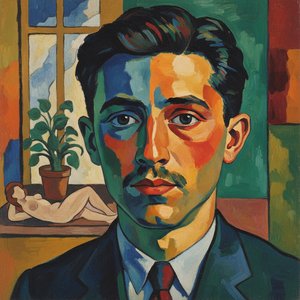
Matisse's artistic breakthrough arrived in 1905 with the emergence of Fauvist art—a movement he spearheaded alongside André Derain and Maurice Denis. Rejecting academic conventions, Fauves championed unrestrained color as expressive force, prioritizing emotional impact over realistic representation. “Untitled (4866)” embodies this ethos perfectly. The painting eschews meticulous detail in favor of simplified forms and a dazzling palette dominated by yellows—a hue that immediately commands attention and conveys warmth, optimism, and perhaps even a hint of melancholy. This deliberate departure from traditional technique speaks volumes about Matisse’s artistic philosophy: to capture the essence of feeling rather than merely mirroring the visual world.
Composition and Symbolism
The artwork's composition is equally striking. A woman sits centrally, her face—the undeniable focal point—illuminated by a radiant yellow hue that contrasts dramatically with the orange background. Two figures flank her, adding depth to the scene without distracting from the primary subject. The vase positioned on the left serves as an anchor for the eye and contributes to the overall harmonious balance. Beyond its visual appeal, “Untitled (4866)” resonates with symbolic significance. Yellow has long been associated with joy, enlightenment, and divine grace—themes that Matisse skillfully conveys through his masterful use of color and form. The woman’s serene posture suggests contemplation and inner peace, inviting viewers to contemplate the beauty and complexity of human experience.
Technique: A Dance Between Color and Line
Matisse's technique is characterized by loose brushstrokes—a hallmark of Fauvist painting—that create a textured surface and imbue the artwork with palpable energy. The artist employs bold, confident lines to define shapes and contours, emphasizing their sculptural quality. Unlike Impressionists who sought to capture fleeting moments of light, Matisse prioritized conveying mood and emotion through color and form. He achieved this remarkable feat by layering pigments directly onto the canvas—a process that allowed him to achieve unparalleled vibrancy and luminosity. This technique underscores Matisse’s unwavering belief in the transformative power of art: to transport viewers beyond mere observation into a realm of feeling and imagination.
Legacy and Influence
Henri Matisse's influence extends far beyond his own lifetime, shaping generations of artists who followed him. His pioneering approach to color revolutionized painting and inspired movements like Abstract Expressionism. “Untitled (4866)” stands as a testament to Matisse’s enduring legacy—a masterpiece that continues to captivate audiences with its boldness, beauty, and profound emotional resonance. It serves as an exemplar of Fauvist art's commitment to expressive color and simplified forms, reminding us that true artistic achievement lies in capturing the intangible essence of human experience.