

Shown: · With its frame:
 실제 크기로 보기
 보내기
보내기 공유하기
공유하기
 상세 보기
상세 보기 가이드 보기

 이미지 다운로드
 유사 작품 더 보기
 X-레이
X-레이 슬라이드 쇼 보기
 Q&A
Q&A 통계 정보
통계 정보

₩ 362276
핸드메이드 유화 복제화
작가가 직접 캔버스에 손으로 그린 유화 작품으로, 원하는 크기와 액자로 맞춤 제작해 드립니다. ( 프린트 판매로 전환 디지털 이미지 판매 채널로 전환)
Size
·표준 규격
맞춤 제작
CM
INCH
작품의 원본 비율을 그대로 유지하는 프리셋 사이즈 중에서 선택해 보세요.
Loading sizes...

가로 너비
높이
액자나 벽면 크기에 맞춰 필요한 가로와 세로 길이를 입력해 주세요. 본 작품은 수작업으로 제작되므로, 요청하신 비율에 따라 작가가 그림의 가장자리를 조금 더 넓게 그리거나 일부를 조정하여 작업할 수 있습니다. 작업 시작 전, 최종 확인을 위해 디지털 목업 이미지를 보내드립니다. 이 페이지에 표시된 이미지는 실제 결과물과 다를 수 있으며, 오직 목업 이미지만이 정확한 결과물을 보여줍니다.
 상세 보기
상세 보기Finish
·
White ₩1

Blurside ₩1

Extended ₩1

P118B ₩10

P118H ₩10

P118W ₩10

P438Z ₩10

P508JH ₩12

P508YH ₩12

P805H ₩10

P805Z ₩10

P919BZ ₩10

P919G ₩10

P919XJ ₩10

P959ZH ₩10

P968JZ ₩12

W106C ₩8

W218G ₩10

W218JH ₩8

W218Y ₩10

W307PJ ₩10

W316G ₩10

W316PJ ₩8

W316Y ₩10

W398PJ ₩8

W4111J ₩10

W500HY ₩15

W500JH ₩15

W692G ₩12

W849H ₩8

W940BG ₩15

W953PJ ₩8

H24-GOLD ₩30

H24-SILVER ₩30

H36-GOLD ₩45

H36-SILVER ₩45
Shipped in a protective tube, ready for your own framer.
Above 105 cm the frame is shipped as a kit for a professional framer — read the details.
Extras
optionalWhat do the extras include?
Examples of what can be changed: Replace face with customer photo; Add pet (e.g., replace cat with dog); Include hidden message in background; Change background landscape or elements.
After order, TopImpressionists.com team will email client for instructions and provide a mockup preview
After order, TopImpressionists.com team will email client for instructions and provide a mockup preview
전 세계 배송()은 표준 5주 대신 3~4주 내에 완료됩니다. (1 11월). 품질에는 어떠한 타협도 하지 않습니다.
보호용 바니시
캡션
동판 각인 상세 정보
This elegant plaque features the artist's name and the title of the artwork, finely engraved for a timeless presentation.
It is made from bronze with a refined, elegant finish. The text is precisely laser-engraved for a sharp and permanent result. Measuring 9x2 cm, the plaque is compact yet easy to read. It's built to be durable and scratch-resistant, offering a professional, museum-quality look. Mounting is simple thanks to the included adhesive backing.
투명 아크릴 명판 상세 정보
The plaque includes essential engraved details such as the artist's name, the title of the artwork, the date it was created, the type of media used-like oil on canvas or watercolor-a brief description of the piece, and a QR code that links to the complete artwork information.
It is crafted from clear acrylic, offering a sleek, modern appearance. The text is UV-engraved in black to ensure strong visual contrast. With a size of 10x15 cm, it ensures optimal readability. It comes equipped with two metal hooks for secure wall mounting. The plaque is designed to be weather-resistant, making it suitable for various environments, and it includes interactive features that work seamlessly with smartphone scanning.
블랙 아크릴 명판 상세 정보
This elegant plaque includes engraved information such as the artist's name, the title of the artwork, the date it was created, the type of media used (like oil on canvas or watercolor), a short description of the artwork, and a QR code for quick access to more information.
The plaque itself is made from refined black acrylic with a premium finish. The text is laser-engraved in white for high contrast and readability. Its size is 10x15 cm, designed to be easy to read. It comes with two metal hooks for professional mounting. The design is sleek and fits any interior style. It is also weather-resistant and durable, with built-in digital integration for mobile compatibility.
유리 옵션은 110cm 미만 크기에서만 선택 가능합니다.
 유리 옵션은 110cm 미만 크기에서만 선택 가능합니다.
- 전 세계 무료 특급 배송
- 고품질 린넨 캔버스
- 배송 전 과정 보험 적용
- 관세 환급 보장 서비스
- 원본 색상 일치 보장
- 제조 결함 발견 시 100일 이내 반품 가능
- 100% 환불 보장
- 다량 구매 할인 혜택


컬렉션 상세 정보
Explore 'Suprematism (18)' by Kazimir Malevich, a pivotal work of abstract art from 1917. Discover the origins of Suprematism and its revolutionary impact on modern art.
작가 소개
카지미르 말레비치 (1878-1935): 초현실주의의 선구자이자 추상 미술의 혁신가. '검은 사각형' 등 기하학적 형태와 순수한 감성을 담은 작품으로 20세기 미술에 큰 영향을 미쳤습니다.
About the painting
The Dawn of Feeling: Exploring Kazimir Malevich’s Suprematism (18)
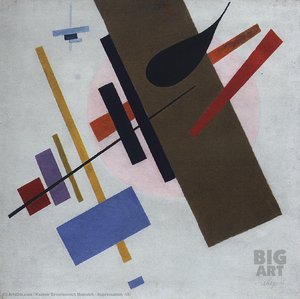
Kazimir Malevich's Suprematism (18), created in 1917, isn’t merely a painting; it is a portal into a radical new vision of art. Emerging from the tumultuous backdrop of revolutionary Russia, this work embodies the core tenets of Suprematism – an artistic movement founded by Malevich himself that sought to liberate art from any representational obligation to the external world. Instead of depicting objects or scenes, Suprematism (18) presents a carefully orchestrated arrangement of geometric forms and vibrant color fields intended to evoke pure feeling. The composition features a dominant brown form, almost sculptural in its presence, tipped with a stark black point that draws the eye upwards, suggesting an aspiration towards something beyond the material realm. Smaller, contrasting shapes dance around this central element, bathed in hues of blue, red, yellow and pink – colors chosen not for their descriptive qualities but for their inherent emotional resonance.
A Rejection of Representation: The Birth of Pure Artistic Feeling
To understand Suprematism (18), one must grasp Malevich’s philosophical underpinnings. He believed that traditional art was burdened by its commitment to depicting the visible world, a constraint he saw as hindering true artistic expression. His journey began with explorations of Impressionism, Symbolism, and Cubism, but ultimately, none satisfied his desire for an art form that could tap into pure spirituality. Suprematism was his answer – a system where shapes and colors were not *about* something; they *were* something. The painting isn’t intended to be ‘read’ like a traditional narrative; it is meant to be *felt*. The arrangement of forms, the interplay of color, and the stark simplicity all contribute to an experience that bypasses intellectual analysis and speaks directly to the subconscious. This was a revolutionary concept at the time, challenging centuries of artistic convention.
Technique and Context: A Moment in Art History
The technique employed in Suprematism (18) is deceptively simple. Malevich’s brushwork, while precise, avoids any display of virtuosity. The focus isn't on the artist’s skill but on the purity of the idea being expressed. He sought to eliminate all traces of personal expression, striving for a universal language of form and color. This painting emerged during a period of intense artistic experimentation in Russia. Following the 1917 revolution, artists were emboldened to push boundaries and explore new forms of expression, free from the constraints of Tsarist patronage. Malevich’s work resonated with this spirit of innovation, becoming a cornerstone of the Russian avant-garde. It's important to note that while seemingly abstract, these compositions weren’t created randomly; they were meticulously planned and executed based on Malevich’s theoretical framework.
The Enduring Legacy: A Source of Inspiration
Suprematism (18) continues to captivate viewers today not only for its historical significance but also for its enduring aesthetic power. Its influence can be seen in countless works of abstract art that followed, from the geometric abstractions of the Bauhaus school to the minimalist paintings of the 20th century. For interior designers, a reproduction of this artwork offers a bold statement piece – a focal point that adds sophistication and intellectual depth to any space. The interplay of warm and cool colors makes it surprisingly versatile, complementing both modern and traditional settings. More than just decoration, owning a reproduction of Suprematism (18) is an invitation to engage with a pivotal moment in art history and to contemplate the power of pure artistic feeling.
질의응답
카지미르 말레비치의 "Suprematism (18)"의 색채는 어떤 감정을 불러일으키나요?
카지미르 말레비치의 "Suprematism (18)"의 Neutrals 색조는 Spiritual 분위기와 조화를 이룹니다. 색채는 작품이 감정을 전달하는 중요한 방식 중 하나입니다.
카지미르 말레비치의 "Suprematism (18)"의 전반적인 색조는 무엇인가요?
"Suprematism (18)"은(는) Warm Sunset Tones 톤에 가깝습니다.
카지미르 말레비치의 "Suprematism (18)"은(는) Kazimir Malevich 내에서 어떤 분위기를 자아내나요?
Kazimir Malevich 사조 안에서, "Suprematism (18)"은(는) Spiritual한 어조로 기록되어 있습니다.
Quick facts and art quiz
About 카지미르 말레비치

카지미르 말레비치
1878 - 1935, 우크라이나
작가 소개
카지미르 말레비치: 절대주의의 선구자, 추상 미술의 혁신가
카지미르 세베리노비치 말레비치는 1878년 우크라이나 키예프 인근에서 태어난 화가이자 미술 이론가로, 20세기 추상 미술 발전에 지대한 영향을 미친 인물입니다. 폴란드계 가정에서 태어나 어린 시절은 우크라이나 시골의 풍경과 그곳의 전통적인 예술 표현에 깊이 뿌리내렸습니다. 이러한 경험은 그의 작품에 은근히 반영되었으며, 이후 그는 더 넓은 예술적 지평을 찾아 모스크바로 이동하여 유럽의 급진적인 전위 운동에 참여했습니다. 초기에는 인상주의, 상징주의, 포비즘, 입체파 등 다양한 스타일을 탐구하며 자신의 예술적 길을 모색했지만, 점차 자연 세계를 묘사하려는 시도를 벗어나 순수한 감정과 형식을 기반으로 하는 독자적인 예술 언어를 구축하고자 했습니다. 말레비치의 예술적 여정은 파리 여행을 통해 결정적인 전환점을 맞이했습니다. 유럽 미술의 최신 흐름에 노출되면서 그는 점차 구체적인 형태에서 멀어져, 기하학적 도형과 색채를 중심으로 하는 순수한 예술적 표현을 추구하게 되었습니다. 이러한 탐색의 결과로 1915년경 절대주의(Suprematism)가 탄생했습니다. 절대주의는 “순수한 감정의 우위”를 강조하며, 눈에 보이는 세계의 객관적인 묘사를 거부하고 기본적인 기하학적 형태만을 사용하여 예술을 구축하는 운동입니다. 그의 작품은 단순한 추상화를 넘어선 정신적이고 철학적인 깊이를 지니고 있으며, 보는 이에게 순수한 감정과 영감을 불러일으키는 것을 목표로 했습니다. 말레비치의 대표작 중 가장 유명한 것은 1915년에 제작된 ‘검은 사각형(Black Square)’입니다. 이 작품은 전통적인 미술의 개념을 완전히 뒤엎는 파격적인 시도로 평가받으며, 추상 회화의 새로운 지평을 열었습니다. 또한 ‘백색 위에 백색(White on White)’ 연작은 형태와 색채의 순수성을 탐구하는 실험으로, 추상을 극단까지 밀어붙인 작품입니다. 이 외에도 ‘건축 중인 집(House under Construction)’은 우크라이나 문화에 대한 그의 독특한 시각을 반영하며 절대주의적 형식을 통해 표현되었습니다. 말레비치는 예술 이론가로서도 활발하게 활동하며, 자신의 예술 철학을 담은 저술들을 발표했습니다. 말레비치의 절대주의는 러시아 전위 미술의 중요한 흐름으로 자리 잡았으며, 이후 미니멀리즘과 구성주의 등 다양한 현대 미술 운동에 영향을 미쳤습니다. 그의 작품은 단순한 기하학적 형태를 통해 인간의 감정과 정신 세계를 탐구하며, 예술의 본질에 대한 근본적인 질문을 던졌습니다. 1917년 러시아 혁명 이후에는 교육자로서 활동하며 젊은 화가들을 양성하는 데 힘썼지만, 스탈린 정권 하에서 그의 작품은 탄압받고 그는 표현주의적 스타일로 회귀해야 했습니다. 그럼에도 불구하고 말레비치는 예술에 대한 열정을 잃지 않고 창작 활동을 이어갔으며, 1935년 레닌그라드(현재 상트페테르부르크)에서 세상을 떠났습니다. 그의 작품은 오랜 기간 상대적으로 잊혀졌지만, 20세기 후반부터 재평가받기 시작하여 현대 미술사에서 빼놓을 수 없는 중요한 위치를 차지하게 되었습니다.말레비치의 유산과 현대적 의미
카지미르 말레비치는 단순한 기하학적 형태를 통해 추상 미술의 새로운 가능성을 제시하고, 예술의 본질에 대한 근본적인 질문을 던진 선구자였습니다. 그의 절대주의는 20세기 미술에 지대한 영향을 미쳤으며, 오늘날에도 여전히 많은 예술가들에게 영감을 주고 있습니다. 말레비치의 작품은 단순함 속에 담긴 깊이 있는 철학적 사유와 순수한 감정의 표현을 통해 보는 이에게 끊임없는 영감과 질문을 던지며, 현대 미술의 지평을 넓히는 데 기여하고 있습니다. 그의 예술적 실험 정신과 혁신적인 시도는 앞으로도 오랫동안 기억될 것입니다.Quick facts about 카지미르 말레비치
- 국적: 우크라이나/러시아
- 대표 작품:
- 검은 사각형
- 흰 바탕에 흰색
- 건축 중인 집
- 사망일: 1935년 5월 15일
- 영향을 받은 예술가:
- 미니멀리즘
- 구성주의
- 엘 리시츠키
- 영향을 준 예술가:
- 쿠비즘
- 포비슴
- 인상주의
- 예술 사조: 초현실주의, 추상 미술
- 전체 이름: 카지미르 말레비치
- 출생일: 1878년 2월 23일
- 출생지: 키예프, 우크라이나
테마, 스타일, 특징별로 큐레이션된 작품들을 만나보세요.




카지미르 말레비치
Suprematism (18)
() ·
With its frame: · Hand-painted in oil on linen
Total