

Shown: · With its frame:
 실제 크기로 보기
 보내기
보내기 공유하기
공유하기
 상세 보기
상세 보기 가이드 보기

 이미지 다운로드
 유사 작품 더 보기
 X-레이
X-레이 슬라이드 쇼 보기
 Q&A
Q&A 통계 정보
통계 정보


₩ 365765
핸드메이드 유화 복제화
작가가 직접 캔버스에 손으로 그린 유화 작품으로, 원하는 크기와 액자로 맞춤 제작해 드립니다. ( 프린트 판매로 전환 디지털 이미지 판매 채널로 전환)
Size
·표준 규격
맞춤 제작
CM
INCH
작품의 원본 비율을 그대로 유지하는 프리셋 사이즈 중에서 선택해 보세요.
Loading sizes...

가로 너비
높이
액자나 벽면 크기에 맞춰 필요한 가로와 세로 길이를 입력해 주세요. 본 작품은 수작업으로 제작되므로, 요청하신 비율에 따라 작가가 그림의 가장자리를 조금 더 넓게 그리거나 일부를 조정하여 작업할 수 있습니다. 작업 시작 전, 최종 확인을 위해 디지털 목업 이미지를 보내드립니다. 이 페이지에 표시된 이미지는 실제 결과물과 다를 수 있으며, 오직 목업 이미지만이 정확한 결과물을 보여줍니다.
 상세 보기
상세 보기Finish
·
White ₩1

Blurside ₩1

Extended ₩1

P118B ₩10

P118H ₩10

P118W ₩10

P438Z ₩10

P508JH ₩12

P508YH ₩12

P805H ₩10

P805Z ₩10

P919BZ ₩10

P919G ₩10

P919XJ ₩10

P959ZH ₩10

P968JZ ₩12

W106C ₩8

W218G ₩10

W218JH ₩8

W218Y ₩10

W307PJ ₩10

W316G ₩10

W316PJ ₩8

W316Y ₩10

W398PJ ₩8

W4111J ₩10

W500HY ₩15

W500JH ₩15

W692G ₩12

W849H ₩8

W940BG ₩15

W953PJ ₩8

H24-GOLD ₩30

H24-SILVER ₩30

H36-GOLD ₩45

H36-SILVER ₩45
Shipped in a protective tube, ready for your own framer.
Above 105 cm the frame is shipped as a kit for a professional framer — read the details.
Extras
optionalWhat do the extras include?
Examples of what can be changed: Replace face with customer photo; Add pet (e.g., replace cat with dog); Include hidden message in background; Change background landscape or elements.
After order, TopImpressionists.com team will email client for instructions and provide a mockup preview
After order, TopImpressionists.com team will email client for instructions and provide a mockup preview
전 세계 배송()은 표준 5주 대신 3~4주 내에 완료됩니다. (30 10월). 품질에는 어떠한 타협도 하지 않습니다.
보호용 바니시
캡션
동판 각인 상세 정보
This elegant plaque features the artist's name and the title of the artwork, finely engraved for a timeless presentation.
It is made from bronze with a refined, elegant finish. The text is precisely laser-engraved for a sharp and permanent result. Measuring 9x2 cm, the plaque is compact yet easy to read. It's built to be durable and scratch-resistant, offering a professional, museum-quality look. Mounting is simple thanks to the included adhesive backing.
투명 아크릴 명판 상세 정보
The plaque includes essential engraved details such as the artist's name, the title of the artwork, the date it was created, the type of media used-like oil on canvas or watercolor-a brief description of the piece, and a QR code that links to the complete artwork information.
It is crafted from clear acrylic, offering a sleek, modern appearance. The text is UV-engraved in black to ensure strong visual contrast. With a size of 10x15 cm, it ensures optimal readability. It comes equipped with two metal hooks for secure wall mounting. The plaque is designed to be weather-resistant, making it suitable for various environments, and it includes interactive features that work seamlessly with smartphone scanning.
블랙 아크릴 명판 상세 정보
This elegant plaque includes engraved information such as the artist's name, the title of the artwork, the date it was created, the type of media used (like oil on canvas or watercolor), a short description of the artwork, and a QR code for quick access to more information.
The plaque itself is made from refined black acrylic with a premium finish. The text is laser-engraved in white for high contrast and readability. Its size is 10x15 cm, designed to be easy to read. It comes with two metal hooks for professional mounting. The design is sleek and fits any interior style. It is also weather-resistant and durable, with built-in digital integration for mobile compatibility.
유리 옵션은 110cm 미만 크기에서만 선택 가능합니다.
 유리 옵션은 110cm 미만 크기에서만 선택 가능합니다.
- 전 세계 무료 특급 배송
- 고품질 린넨 캔버스
- 배송 전 과정 보험 적용
- 관세 환급 보장 서비스
- 원본 색상 일치 보장
- 제조 결함 발견 시 100일 이내 반품 가능
- 100% 환불 보장
- 다량 구매 할인 혜택


컬렉션 상세 정보
작가 소개
르아블 프랑스 니콜라 푸생 르아블, 앙데리 고대 로마의 영향을 받아 고요하고 균형 잡힌 풍경과 신화 속 이야기를 담은 프랑스 바로크 화가 니콜라 푸생. 그의 작품은 18세기 네오클래식 미술에 큰 영향을 미쳤습니다. 바로크, 고전주의 자크 루이 다비드 라파엘로 1594년 1665년 니콜라 푸생 프랑스 게르마니쿠스의 죽음 프랑스 르아블 파리 3 니콜라 푸생은 주로 어느 도시에서 활동했습니까?
About the painting
A Moment Frozen in Time: Poussin’s ‘Two Silver Birches’
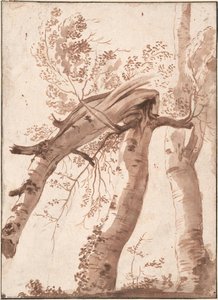
Nicolas Poussin's “Two Silver Birches, the Front One Fallen,” painted circa 1629, isn’t merely a depiction of trees; it’s a carefully constructed meditation on mortality, harmony, and the enduring power of classical ideals. Emerging from his formative years in France and culminating in his profound immersion within the Roman artistic landscape, Poussin sought to synthesize the sensual richness of Venetian painting with the rigorous order and intellectual depth of antiquity. This work, created during a pivotal period of his career, exemplifies this ambition – a quiet yet profoundly resonant scene that speaks volumes about the artist’s evolving philosophy.
The painting immediately draws the eye with its stark simplicity. Two birch trees dominate the composition, their silvery bark rendered with an almost luminous quality. The tree on the right stands tall and proud, branches reaching skyward as if in defiant grace, while its counterpart lies prone at the base of the canvas, a fallen sentinel marking the passage of time. The absence of leaves is deliberate; it strips away the seasonal distractions, focusing instead on the skeletal beauty of the trees themselves – a motif frequently associated with death and remembrance within classical art. This reduction to essential form allows Poussin to explore the underlying structure of nature, mirroring his broader interest in geometric principles and mathematical harmony.
The Language of Line and Light
Poussin’s technique is characterized by an exquisite control of line and light. He employs a meticulous layering of thin washes of paint – a hallmark of his style – to build up the forms with remarkable precision. The branches, particularly those of the upright birch, are delineated with delicate, almost hesitant strokes, creating a sense of movement and vulnerability. The fallen tree is rendered with a slightly heavier touch, suggesting its weight and the inevitability of decay. Light plays a crucial role in shaping the scene; it seems to emanate from an unseen source, bathing the trees in a soft, diffused glow that enhances their silvery sheen. This masterful manipulation of light not only creates visual beauty but also imbues the painting with a sense of spiritual depth.
Noticeably, Poussin includes a human figure – a small, dark silhouette standing near the base of the fallen tree. The identity and purpose of this figure remain deliberately ambiguous, adding another layer of complexity to the work. Some scholars interpret it as representing contemplation or perhaps even mourning, while others see it as a symbol of humanity’s relationship with nature—a witness to its cycles of growth and decline. The figure's presence subtly anchors the scene in the realm of human experience, reminding us that even within the grandeur of the natural world, we are confronted by our own mortality.
Symbolism Rooted in Antiquity
The birch tree itself carries a rich symbolic weight throughout Western art history. Often associated with purity, resilience, and the afterlife, it frequently appears in funerary monuments and depictions of mourning. Its slender form and delicate branches evoke images of fragility and vulnerability, while its ability to withstand harsh winters speaks to an enduring spirit. Poussin’s choice of birch trees aligns perfectly with his engagement with classical themes – particularly those found in Roman mythology and literature, where the tree frequently served as a symbol of transition and renewal.
Furthermore, the fallen tree can be interpreted as a representation of *memento mori*—a reminder of death. This concept was central to Renaissance art, serving as a powerful tool for prompting reflection on the transience of earthly life. Poussin’s painting, therefore, transcends mere botanical observation; it becomes a poignant meditation on the cyclical nature of existence and the inevitability of loss. The composition invites us to contemplate our own place within this grand scheme, fostering a sense of both melancholy and acceptance.
A Timeless Masterpiece for Reproduction
TopImpressionists offers meticulously crafted hand-painted reproductions of “Two Silver Birches, the Front One Fallen,” allowing you to bring this iconic work into your home or office. Our artists replicate Poussin’s delicate brushwork and masterful use of light with unparalleled precision, ensuring that every detail is faithfully reproduced. Whether you are an art enthusiast, a collector seeking to expand your collection, or an interior designer searching for a touch of classical elegance, our reproductions provide a beautiful and authentic representation of this timeless masterpiece. Experience the profound beauty and intellectual depth of Poussin’s vision – a moment frozen in time, brought vividly back to life.
질의응답
니콜라 푸생의 "Two Silver Birches, the Front One Fallen, c. 1629"은 강렬한 대비를 사용하나요, 아니면 부드러운 조화를 이루고 있나요?
"Two Silver Birches, the Front One Fallen, c. 1629"에서는 Gentle 대비와 Unified Palette 조화가 어우러져 있습니다.
니콜라 푸생의 "Two Silver Birches, the Front One Fallen, c. 1629"은(는) 무엇을 묘사하고 있으며, 어떤 분위기를 담고 있나요?
"Two Silver Birches, the Front One Fallen, c. 1629"은(는) birches, trees, fallen tree, tranquility, poussin, landscape, classical, harmony을(를) 보여주며, 기록된 분위기는 Calm입니다.
니콜라 푸생의 "Two Silver Birches, the Front One Fallen, c. 1629"에서 예술 사조와 시대상은 어떻게 맞닿아 있나요?
"Two Silver Birches, the Front One Fallen, c. 1629"은(는) French Baroque Painting 사조에 속하며, 작가는 근세 초기 시대에 활동했습니다.
Quick facts and art quiz
About 니콜라 푸생

니콜라 푸생
1594 - 1665, 프랑스
작가 소개
빛과 이성의 조화: 니콜라 푸생의 삶과 예술
니콜라 푸생은 프랑스 바로크 회화를 대표하는 거장이지만, 그의 영혼은 대부분의 생애를 이탈리아 토양 속에서 키워냈습니다. 1594년 노르망디 레 안들리에서 태어난 그는 어린 시절부터 그림에 재능을 보였고, 지역 화가 퀴탱 바랭에게 기초적인 기법을 익혔습니다. 파리에서 잠시 활동하며 조르주 라레망과 페르디낭 엘레의 영향을 받았지만, 그의 예술적 운명을 결정짓는 것은 1624년 로마로 떠난 여정이었을 것입니다. 로마는 푸생에게 단순한 작업 공간 이상의 의미를 지녔습니다. 고대 문명의 심장부에서 그는 끊임없이 영감을 얻었고, 이는 그의 작품 전반에 걸쳐 나타나는 고전주의적 특징의 근원이 되었습니다. 초기에는 티치아노와 같은 베네치아 화가들의 영향을 받아 감각적인 색채를 탐구했지만, 곧 이성을 중시하고 명확한 구도를 선호하는 자신만의 스타일을 확립해 나갔습니다.로마 시대: 고전적 이상 추구
로마에서 푸생은 카시아노 달 포초와 같은 학자, 고고학자, 그리고 동료 화가들과 교류하며 지적인 토론을 나누었습니다. 특히 카시아노는 고대 유적을 꼼꼼하게 기록하는 데 몰두했는데, 이는 푸생에게 역사적 정확성과 시대를 초월한 아름다움을 작품에 담고자 하는 열망을 심어주었습니다. 그는 라파엘로의 작품들을 깊이 연구하며 조화로운 구성과 우아한 형태를 흡수했으며, 고대 조각상과 오비디우스의 『변신 이야기』와 같은 문학 작품에서도 영감을 얻었습니다. 이 시기 푸생은 점차 화려하고 감정을 격렬하게 드러내는 바로크 양식에서 벗어나 명확성, 균형, 그리고 선명한 구성을 강조하는 스타일을 발전시켰습니다. 그의 그림들은 종교적, 역사적 주제를 다루었지만, 단순한 이야기 전달을 넘어선 철학적 깊이와 상징적인 의미를 담고 있었습니다.역사, 신화, 그리고 신성: 주제의 다양성과 심오함
푸생은 다양한 주제를 탐구했지만, 그의 작품들은 일관되게 고전주의적 원칙에 기반했습니다. 그는 게르마니쿠스의 죽음과 같은 고대 역사를 묘사하며 비장하고 품위 있는 분위기를 연출했고, 신화 속 이야기를 통해 인간 본성을 탐구하며 도덕적인 교훈을 전달하고자 했습니다. 특히 *아르카디아* 시리즈는 그의 철학적 깊이를 보여주는 대표작으로, 죽음과 기억의 힘에 대한 성찰을 담고 있습니다. 또한 그는 *7가지 성사* 연작과 같이 종교적인 주제를 다루면서도 과도한 감정 표현을 자제하고 고요하고 엄숙한 분위기를 유지했습니다. 그의 후기 작품에서는 광활한 풍경이 더욱 중요하게 부각되었는데, 이는 현실과 이상이 조화를 이루는 아름다운 자연 경관을 통해 인간의 내면 세계를 표현하고자 한 시도였습니다.프랑스 예술에 미친 영향: 고전주의의 초석
푸생은 대부분의 생애를 이탈리아에서 보냈지만, 프랑스 예술에 지대한 영향을 미쳤습니다. 1640년 리슐리외 추기경의 요청으로 잠시 프랑스로 돌아가 왕실 화가가 되었으나, 궁중 생활의 부담과 권력 다툼을 견디지 못하고 곧 로마로 귀환했습니다. 그는 프랑스 왕립 회화 및 조각 아카데미에서 중요한 역할을 수행하며 고전주의 예술 교육의 기준을 확립하는 데 기여했습니다. 그의 엄격한 접근 방식과 지적인 깊이는 자크 루이 다비드와 폴 세잔과 같은 후대 화가들에게 영감을 주었으며, 단순한 스타일 모방을 넘어 프랑스 고전주의 미술의 초석을 다지는 역할을 했습니다. 푸생은 예술을 통해 이성과 아름다움을 추구하며 시대를 초월하는 가치를 창조하고자 했던 위대한 예술가였습니다.- 대표작: *게르마니쿠스의 죽음*, *7가지 성사 연작*, *로마의 길*, *맹인 오리온*, *계절*.
- 주요 특징: 고전적 구성, 선명한 윤곽선, 역사 및 신화 주제, 고요한 풍경.
Quick facts about 니콜라 푸생
- 국적: 프랑스
- 영향받은 예술가:
- 자크 루이 다비드
- 폴 세잔
- 영향을 준 예술가:
- 라파엘로
- 티치아노
- 예술 사조: 바로크, 고전주의
- 전체 이름: 니콜라 푸생
- 주요 작품:
- Germanicus의 죽음
- 7가지 성사 연작
- 로마 도로
- 눈먼 오리온
- 계절
- 출생일: 1594년 6월


니콜라 푸생
Two Silver Birches, the Front One Fallen, c. 1629
() ·
With its frame: · Hand-painted in oil on linen
Total