Pablo Picasso’s Studio (1916): A Fragmented Vision of Creativity
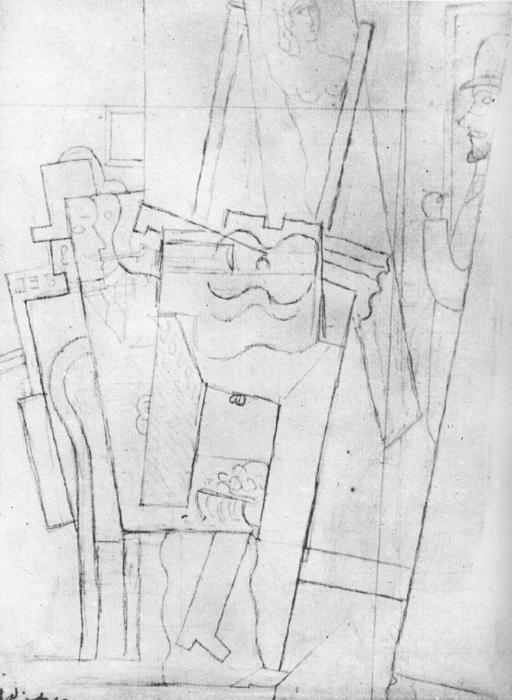
The pencil drawing titled “Artist's studio,” executed by Pablo Picasso in 1916, stands as a pivotal snapshot of the artist’s formative years within Cubism. More than just a depiction of an interior space—a humble atelier bathed in diffused light—it embodies the very essence of Picasso’s revolutionary approach to artistic representation. This piece isn't merely observed; it’s felt – a palpable resonance of intellectual curiosity and artistic experimentation that continues to captivate viewers today.
- Composition & Style: The drawing showcases an asymmetrical composition dominated by a central figure positioned prominently on the right side, contrasted against a background featuring two indistinct figures. Picasso's signature Cubist style is evident in the angular lines and fragmented perspectives—a deliberate rejection of traditional illusionistic techniques favoring geometric shapes and flattened planes.
- Technique & Materials: Executed with meticulous hatching and cross-hatching, the drawing utilizes graphite to achieve tonal variations that convey texture and depth despite the simplified aesthetic. The artist’s direct application of pencil onto paper underscores the immediacy and spontaneity characteristic of his early explorations into Cubism.
- Historical Context: Created during Picasso's immersion in the burgeoning movement of Cubism, alongside Georges Braque, “Artist’s studio” reflects a profound engagement with artistic precedents—particularly Velázquez’s “Las Meninas”—and a desire to dismantle conventional notions of perspective and spatial realism.
- Symbolism & Interpretation: The figure in the foreground, adorned with what appears to be a mask or costume, speaks volumes about Picasso's preoccupation with theatricality and disguise – themes that would recur throughout his oeuvre. This element suggests an exploration of identity and performance within the confines of artistic creation.
- Emotional Impact: Despite its understated palette and simplified forms, “Artist’s studio” possesses a powerful emotional core—a quiet contemplation of artistic endeavor and perhaps a subtle acknowledgement of the artist's solitary pursuit of inspiration. It invites viewers to consider the transformative potential inherent in creative practice.
Echoes of Velázquez: A Dialogue with Tradition
Picasso’s decision to revisit Velázquez’s “Las Meninas” wasn’t simply an aesthetic indulgence; it represented a deliberate challenge to artistic conventions established centuries earlier. As highlighted in the Art Institute article, Picasso meticulously studied Velázquez's masterful use of light and shadow—techniques that he sought to adapt into his own Cubist vocabulary. This intellectual engagement fueled his desire to dissect and reconstruct visual reality, mirroring Velázquez’s groundbreaking approach to portraying a royal court scene.
The Language of Geometry: Embracing Fragmentation
The pervasive use of geometric shapes—squares, rectangles, triangles—is central to Picasso's stylistic vision in “Artist’s studio.” This deliberate fragmentation aligns perfectly with the core tenets of Cubism, which aimed to depict subjects from multiple viewpoints simultaneously. By rejecting illusionistic depth and embracing angularity, Picasso effectively dismantled traditional representations of space, prioritizing conceptual clarity over visual realism.
A Window into Picasso's Soul: The Masked Figure
The enigmatic presence of the masked figure—a recurring motif in Picasso’s work—serves as a potent symbol of artistic identity and performance. As explored in “Woman in the studio,” this element underscores Picasso’s fascination with theatricality and disguise, suggesting an exploration of persona within the creative process. It invites contemplation on how artists present themselves to the world and how they grapple with questions of authenticity and representation.
Beyond Reproduction: Capturing the Essence of Genius
A high-quality reproduction of “Artist’s studio” allows admirers to experience Picasso's groundbreaking vision firsthand—a testament to his enduring legacy as one of the most influential artists of the 20th century. Just like "Studio (Pigeons)" and "Woman in the Studio", this artwork embodies a timeless fascination with artistic exploration and invites viewers to engage with its profound emotional resonance.