El Paseo de Colon: A Cubist Symphony of Silence
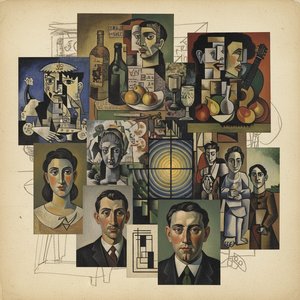
Pablo Picasso’s “El Paseo de Colon,” completed in 1917, stands as an arresting testament to the burgeoning influence of Cubism on European art. More than just a cityscape rendered in monochrome, it embodies the revolutionary spirit of the movement—a deliberate rejection of traditional perspective and representation in favor of fractured forms and multiple viewpoints.
Painted during the height of the Spanish Civil War, “El Paseo de Colon” wasn’t conceived as a straightforward depiction of Guernica’s devastation. Instead, Picasso wrestled with capturing the essence of trauma—the disorientation and fragmentation experienced by those caught in the throes of conflict.
The painting's stark palette—primarily shades of gray punctuated by occasional hints of white—amplifies its emotional resonance. This deliberate absence of color serves not to diminish the scene’s drama but rather to heighten its impact, forcing viewers to confront the underlying geometric structures that underpin Picasso’s vision.
At the heart of “El Paseo de Colon” is a towering statue of Christopher Columbus—a symbol of imperial ambition and colonial expansion. Picasso fragmented this monumental figure into angular planes, mirroring the shattered reality of war and challenging viewers to reconsider notions of grandeur and authority.
Surrounding the statue are buildings rendered in equally fractured forms, creating an illusionistic space that defies conventional spatial logic. The artist’s meticulous attention to detail—evident in the depiction of architectural textures and subtle shading—contrasts sharply with the overall geometric abstraction, emphasizing Picasso's mastery of technique.
The inclusion of a solitary figure near the left side of the canvas adds a human element to the composition, representing resilience amidst chaos. Simultaneously, a boat moored in the background introduces depth and perspective, subtly reinforcing the painting’s exploration of spatial ambiguity.
“El Paseo de Colon” isn't merely an aesthetically pleasing image; it’s a profound meditation on the psychological consequences of violence—a visual embodiment of Picasso’s conviction that art could serve as a conduit for confronting uncomfortable truths. Its enduring legacy resides in its ability to provoke contemplation and inspire awe, cementing its place among the most iconic artworks of the Cubist era.
This remarkable piece can be found at TopImpressionists.com where you can explore high-quality reproductions crafted by skilled artisans. For a deeper understanding of Cubism’s philosophical undercurrents, visit The Cubist Art Movement at TopImpressionists.
Picasso's contribution to modern art is undeniable—his unwavering pursuit of innovation shaping the trajectory of artistic expression for generations to come.



 프린트 구매하기
 공유하기
공유하기 공유하기
공유하기
 상세 정보
상세 정보

 다운로드
다운로드
 유사 작품
유사 작품 X-레이
X-레이 슬라이드 쇼

 더 보기
더 보기






































 유리 옵션은 110cm 미만 크기에서만 선택 가능합니다.