작품 상세 설명
A Fragmented Portrait: Unpacking Picasso’s “Pedestal”
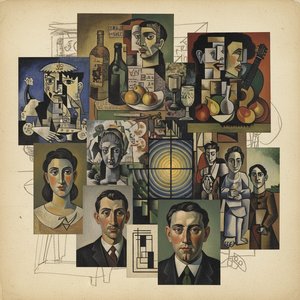
Pablo Picasso's "Pedestal," painted in 1920 during his pivotal Synthetic Cubist period, isn’t merely a depiction of a musician; it’s an invitation to deconstruct reality and rediscover its essence. This small gouache painting—measuring just 26 x 21 centimeters—bursts with a vibrant energy born from the collision of multiple viewpoints and a radical simplification of form. It's a key piece in understanding Picasso’s exploration of abstraction, his embrace of new artistic techniques, and his profound influence on the trajectory of modern art. The work immediately draws the eye to the figure of the musician, positioned slightly off-center yet commanding attention despite his fragmented representation. He holds a guitar, its contours dissolving into geometric planes, while a guitar case rests at his feet—a grounding element amidst the swirling chaos. A prominent hat sits near the center, adding another layer of visual interest and subtly directing the viewer’s gaze.
The Genesis of Synthetic Cubism
“Pedestal” is deeply rooted in the revolutionary movement known as Synthetic Cubism. Emerging between 1915 and 1920, this phase represented a dramatic departure from its Analytical predecessor. While Analytical Cubism focused on dissecting objects into their constituent parts and presenting them simultaneously from multiple angles—often resulting in a muted, almost monochrome palette—Synthetic Cubism embraced a more assertive approach. Artists like Picasso, Juan Gris, and Albert Gleizes sought to create a flatter, more decorative style, prioritizing the surface of the canvas and employing brighter colors and bolder shapes. The goal wasn’t simply to analyze form but to rebuild it in an abstracted, often dreamlike manner. Picasso himself described this period as a “return to order,” a deliberate move away from the perceived complexity of Analytical Cubism towards a more controlled and harmonious composition.
Crystal Cubism: Clarity and Order
Within Synthetic Cubism, Picasso further developed what is known as Crystal Cubism, named by art critic Maurice Raynal. This sub-style emphasized clarity, geometric precision, and a sense of contained energy. “Pedestal” exemplifies these qualities perfectly. The painting’s palette—dominated by striking blues, reds, and touches of green—is carefully considered to create visual harmony despite the fragmented forms. The overlapping planes aren't randomly arranged; they are strategically positioned to guide the viewer’s eye across the canvas, suggesting movement and dynamism. Raynal likened these works to “crystals,” reflecting a desire for order and structure within the abstract realm. The deliberate use of color further enhances this sense of clarity, preventing the composition from feeling overly chaotic or confusing.
Deconstructing Reality: A Symbol of Multiple Perspectives
At its core, "Pedestal" is an exploration of representation itself. Picasso doesn’t aim to create a realistic portrait; instead, he presents us with a series of fractured perspectives—a musician viewed simultaneously from various angles. This technique, central to Cubism, challenges the viewer to actively participate in constructing meaning. We must piece together the fragmented elements—the guitar, the case, the hat—to recognize the subject and understand his posture and activity. The painting becomes a visual puzzle, inviting us to consider how we perceive reality and how art can represent it in innovative ways. It’s a powerful statement about the limitations of single viewpoints and the richness that emerges from multiple perspectives.
Legacy and Influence
“Pedestal” stands as a pivotal work in Picasso's oeuvre and a cornerstone of Synthetic Cubism. Its influence extends far beyond its immediate historical context, shaping subsequent art movements like Surrealism and Expressionism. The techniques pioneered during this period—the use of flattened planes, multiple viewpoints, and bold color palettes—became hallmarks of modern art. Reproductions of “Pedestal,” such as those offered by TopImpressionists.com, allow us to appreciate the intricacies of Picasso’s vision and experience the enduring power of his revolutionary approach to art. It remains a testament to the artist's genius and a captivating example of how abstraction can be both intellectually stimulating and emotionally resonant.