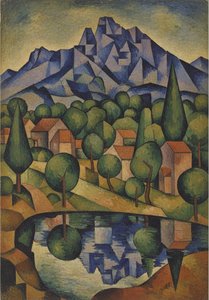
House of the Hanged Man, Auvers-sur-Oise
Paul Cézanne’s “House of the Hanged Man,” painted in 1873 during his formative years as an artist and exhibited at the First Impressionist Exhibition, stands as a cornerstone of Post-Impressionism—a movement that irrevocably altered the course of Western art history. More than just a landscape depiction, it’s a profound meditation on perspective, structure, and the elusive nature of representation itself.
The painting captures a hillside village nestled in Val-d'Oise, France, approximately 27 km north of Paris. Cézanne meticulously observed this location, drawing inspiration from his friend Camille Pissarro’s artistic vision—a shared commitment to capturing the immediacy of natural light and color. However, unlike Impressionists who sought to reproduce fleeting sensations, Cézanne deliberately challenged conventional artistic norms by introducing calculated inaccuracies into perspective.
The composition is dominated by two intersecting paths leading towards a central point, flanked by a bank on the right and branches of trees reaching upwards toward the sky. These axes aren’t merely decorative; they represent Cézanne's deliberate attempt to dissect and rebuild reality—to reveal its underlying geometric framework beneath the surface appearance.
Cézanne employed a distinctive technique characterized by “broken brushstrokes”—small, irregular strokes of pigment applied side-by-side rather than blended together. This method allowed him to capture the texture and luminosity of the landscape with remarkable precision while simultaneously conveying an atmosphere of solitude and contemplation. The palette is muted, favoring cool blues and greens—a stylistic choice that reflects Cézanne’s fascination with tonal harmonies and his desire to evoke a sense of stillness.
The painting's title derives from its symbolic resonance—the hanged man motif representing sacrifice, judgment, and transformation. Cézanne subtly incorporates this imagery into the landscape, suggesting a deeper psychological dimension beyond mere visual observation. It’s a testament to his ability to infuse ordinary subjects with profound emotional significance.
“House of the Hanged Man” cemented Cézanne's reputation as an innovator and profoundly influenced subsequent artists like Henri Matisse and Pablo Picasso—artists who embraced Cézanne’s groundbreaking approach to form and color. Today, housed in the Musée d'Orsay, it continues to inspire awe and provoke contemplation, serving as a timeless emblem of artistic ambition and intellectual rigor.
- Artist: Paul Cézanne
- Year: 1873
- Location: Musée d'Orsay, Paris
- Movement: Post-Impressionism
- Technique: Broken Brushstrokes
For more information on Cézanne and his oeuvre, visit Paul Cézanne at TopImpressionists.



 프린트 구매하기
 공유하기
공유하기 공유하기
공유하기
 상세 정보
상세 정보

 다운로드
다운로드
 유사 작품
유사 작품 X-레이
X-레이 슬라이드 쇼


 더 보기
더 보기






































 유리 옵션은 110cm 미만 크기에서만 선택 가능합니다.