

 미리보기
미리보기
 공유하기
공유하기 공유하기
공유하기
 상세 정보
상세 정보 가이드 보기

 다운로드
다운로드
 유사 작품 더 보기
 X-레이
X-레이 슬라이드 쇼 보기
 질의응답
질의응답 통계 정보
통계 정보Swallow Falls

Discover 'Swallow Falls' by William Payne – a dramatic Romantic landscape painting of a cascading waterfall & figures. Explore its oil technique & evocative beauty.
William Payne (1760-1830) was a pioneering English watercolourist known for inventing Payne's Grey & innovative techniques in sunlight/atmosphere. He revolutionized landscape painting, moving beyond topography to poetic scenery and became London’s mo
 더 보기
더 보기
지클레 / 아트 프린트
빠른 제작과 다양한 마감 옵션을 제공하는 박물관 수준의 지클레이 및 캔버스 프린트. ( 수작업 채색 복제본 주문하기 디지털 이미지로 전환)




































표준 규격
맞춤형
CM
INCH
작품의 원본 비율을 그대로 유지하는 프리셋 사이즈 중에서 선택해 보세요.
Loading sizes...

가로 너비
세로 길이
액자나 벽면 크기에 맞춰 필요한 가로와 세로 길이를 입력해 주세요. 프린트는 원본 이미지보다 크게 제작할 수 없으며 오직 자르는 것만 가능하므로, 비율이 다른 사이즈를 선택할 경우 이미지의 일부가 잘려 나갈 수 있습니다. 인쇄 작업에 들어가기 전, 최종 확인을 위해 디지털 목업을 보내드립니다. 이 페이지에 표시된 이미지는 실제 잘리는 영역을 나타내지 않으며, 오직 목업을 통해서만 정확한 확인이 가능합니다.


 유리 옵션은 110cm 미만 크기에서만 선택 가능합니다.

Swallow Falls
지클레 / 아트 프린트
복제본 크기
-


최종 결제 금액
₩ 93868
작가 정보
The Architect of Atmosphere: The Life and Legacy of William Payne
In the quiet annals of art history, certain names resonate not through the sheer volume of their fame, but through the profound chemical and technical shifts they introduced to the canvas. William Payne (1760–1830) was such a figure—a man whose hands did more than merely guide a brush; they redefined the very vocabulary of watercolor. Born in Devon, England, Payne’s journey began far from the prestigious drawing rooms of London. His early professional life was rooted in the precision of engineering and draughtsmanship, serving as a skilled hand within the Board of Ordnance at the Tower of London. This rigorous training in mathematics and perspective provided him with a structural foundation that would later allow him to master the more ephemeral elements of the natural world.
As he transitioned from the meticulous duties of a draughtsman to the expressive freedom of a landscape painter, Payne sought to move beyond the era's obsession with mere topography. While many of his contemporaries were content to produce literal, almost clinical records of landmarks, Payne looked toward the Picturesque. Influenced by the aesthetic theories of William Gilpin, he began to view the landscape not as a collection of static objects, but as a living, breathing entity shaped by light, moisture, and shadow. His move to London in 1790 marked the beginning of his ascent as the city's most fashionable drawing master, where he taught a new generation how to capture the emotional essence of a scene rather than just its physical boundaries.
The Alchemy of Grey and the Mastery of Light
The true genius of Payne lay in his experimental spirit, particularly his ability to manipulate pigments to mimic the elusive qualities of the English sky. His most enduring contribution to the artist's palette remains the invention of Payne’s Grey. This subtle, neutral tint—a sophisticated marriage of indigo, raw sienna, and lake—offered watercolorists a way to render deep shadows and stormy atmospheres without the muddying effect of traditional blacks. Through this single innovation, he provided a tool that could capture the nuanced transition from twilight to dusk, or the heavy, moisture-laden clouds of a coastal storm.
Beyond his palette, Payne revolutionized the physical application of watercolor. He abandoned the rigid reliance on pen outlines, favoring instead a method of building depth through layers of translucent washes. His techniques were nothing short of revolutionary for the time:
- Splitting the brush to create the delicate, irregular forms of foliage and organic textures.
- Dragging tints across the paper to simulate the ruggedness of foreground terrain.
- The use of bread and rag to lift pigment from a wet surface, effectively "carving" highlights and luminous light out of the darkness.
These methods allowed him to achieve a sense of atmospheric perspective that was previously difficult to sustain in the medium. His work possessed a tactile quality, where the viewer could almost feel the dampness of the Devonshire air or the warmth of sunlight breaking through a canopy.
A Lasting Impression on the Romantic Landscape
Though his name may not carry the immediate weight of a Turner or a Constable in popular consciousness, Payne’s influence was foundational to the development of the Romantic landscape movement. By shifting the focus from the topographical to the poetic, he paved the way for an art form that prioritized feeling and atmosphere over factual accuracy. His success as a teacher ensured that his "tricky" and innovative methods were disseminated throughout the British art scene, influencing notable pupils such as John Glover.
Ultimately, William Payne stands as a bridge between the disciplined draughtsmanship of the eighteenth century and the expressive, emotive watercolor traditions of the nineteenth. He transformed a medium once used for mere documentation into a powerful vehicle for poetic expression. Every time a modern artist reaches for that deep, moody blue-grey to depict a twilight sky, they are participating in a visual legacy that began with the inquisitive mind and steady hand of this Devon-born innovator.

William Payne
1760 - 1830 , United Kingdom
작가 정보 요약
- Full Name: William Payne
- Nationality: English
- Date Of Birth: 1760
- Date Of Death: 1830
- Place Of Birth: Devon, United Kingdom
- Notable Artworks:
- Upon the Yealm, Devon
- View Near Cardigan, South Wales
- Travellers Gossiping At The Wayside
- Artistic Movement Or Style: Romantic Landscape Painting
관련 콘텐츠
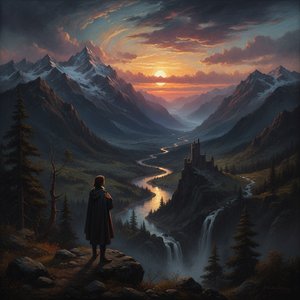
Capturing the Soul: The Emotional Majesty and Sublime Power of Romantic Landscape Painting
Explore the profound emotional depth of Romantic landscape painting. Discover how masters like Turner and Friedrich captured the sublime power of nature through intuition and imagination in this expert art history retrospective.

Capturing the Soul: The Emotional Magic and Sublime Grandeur of Romantic Landscape Painting
Explore the profound emotional depth of Romantic landscape painting. Discover how masters like Friedrich and Turner captured the sublime through light, shadow, and nature's power in this expert art history retrospective for discerning collectors.