Early Life, Family and Training
Albert Bertalan was born on 21 September 1899 in Jászberény, Hungary. He was the son of Ignác Neuberger, a merchant who worked with wood, and Olga Frim. His family roots included his grandfather, Jakab Frim, who spent his life as a teacher for students with special needs. In the years following his birth, the name Albert Bertalan would eventually replace the name Neuberger Albert, a change that occurred after he transitioned to the Lutheran faith in 1921.
His early encounters with art began through the guidance of Jenő Frim, who provided his first lessons. These initial steps led him toward more formal instruction at the Free Art School of Károly Kernstok. The discipline of his training continued as he moved to Szolnok to study under Adolf Fényes. These formative years in Hungary established the technical foundation that would later support his move toward the larger art centers of Europe.
Artistic Training and Early Success
The path toward a professional practice led him from the studios of Hungary to the light of the Académie Julian in Paris in 1924. This period of study was preceded by time spent in the Nagybánya art colony, also known as Baia Mare, where the focus shifted toward the nuances of plein-air painting. His presence in these circles allowed him to absorb the methods of his contemporaries while refining his own approach to the canvas.
Success arrived quickly in the mid-1920s. In 1925, his work was featured in an exhibition at the Galerie Bernheim-Jeune in Paris, a significant moment that signaled his arrival in the French art scene. This momentum continued as he became a member of the Hungarian Association of New Artists. By 1926, his recognition was formalized when he was awarded the Pál Szinyei Merse-Gesellschaft Prize. This period of achievement saw his paintings appearing regularly in the Salon des Indépendants between 1926 and 1930, establishing a consistent presence in the Parisian exhibition circuit.
Style and Artistic Movements
His brushwork carries the quiet weight of the École de Paris. There is a certain stillness in how he approaches a subject, whether it is a woman in a figure study or the light hitting a bowl of fruit. His work leans into post-impressionism, focusing on the way light and form settle into a scene. At times, the edges of his subjects seem to tighten, showing the subtle influence of cubism through a more structured, geometric way of seeing the world.
He spent much of his time looking at the everyday. His compositions often center on interiors, where the arrangement of objects tells a silent story. He found rhythm in still lifes, such as a simple arrangement of fruit, and in the quiet movement of people passing through a street. Landscapes also appear in his repertoire, captured with a focus on the natural environment rather than grand drama. He worked frequently with oil on canvas and oil on cardboard, choosing materials that allowed for a direct, tactile application of color.
Key Works and Collections
His brushwork leaves traces in several institutional collections across Europe. The Institut national d’histoire de l’art in Paris holds his work within the Jacques Doucet Collection. In France, the Musée départemental de l’Oise in Beauvais also maintains pieces from his oeuvre. These works reflect a steady presence in the collections of the regions where he lived and worked.
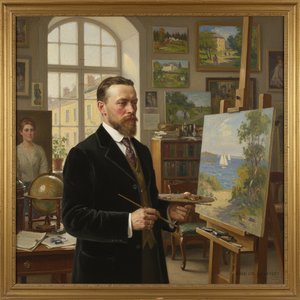
In Hungary, his art is held by the Museum Jászberény and the Janus Pannonius Museum in Pécs. One can find his Self-Portrait, painted about 1930, among the records of the Ernest Zmeták Art Gallery in Nové Zámky. His Parisian Model is an oil on canvas, signed middle right, showing the quiet focus of his studio practice.
Q&A
Albert Bertalan 작가의 작품을 감상할 수 있는 3D 갤러리는 어디인가요?
가상 방문이 가능합니다: Albert Bertalan의 3D 갤러리 페이지에서 3D 갤러리를 통해 작가의 작품들을 만나보실 수 있습니다.
Albert Bertalan의 모든 작품은 어디에서 볼 수 있나요?
이 사이트에 등록된 Albert Bertalan의 모든 작품은 작가의 전체 작품 보기 페이지에서 만나보실 수 있습니다.
Albert Bertalan의 작품을 컬러 팔레트별로 둘러볼 수 있나요?
컬러 팔레트별로 보기 페이지에서는 Albert Bertalan의 작품들을 색상 팔레트별로 모아볼 수 있습니다.
키워드로 Albert Bertalan의 작품을 찾아볼 수 있나요?
Albert Bertalan의 키워드별 탐색 페이지에서는 작가의 작품들을 키워드별로 모아볼 수 있습니다.