The Philadelphia Practitioner
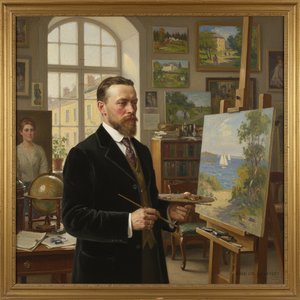
Albert Jean Adolphe was a fixture of the American art scene, a man whose career spanned the transition from the late nineteenth century into the mid-twentieth. Born in Philadelphia, he did not merely inhabit the city; he helped define its visual landscape through a diverse range of professional roles. He was a decorator, a portrait painter, and a landscape artist who moved between the precision of oil and the fluidity of watercolor. His early promise was evident in the life-size portraits of Abraham Lincoln and George Washington he painted on a firehouse fence in Tenth Street, a project that signaled a talent far removed from his father's trade as a shoemaker.
His technical foundation was built through rigorous training at the Pennsylvania Museum School of Art. This local grounding provided the necessary springboard for his departure to Europe, where his development took on a more international character. He was not a solitary dreamer but a disciplined student of the established European tradition, absorbing the methodologies of the era's most significant instructors.
European Training and Technical Breadth
Adolphe’s time in Europe was defined by his proximity to the masters of the day. He sought out specific instruction that shaped his ability to handle both large-scale decorative commissions and intimate portraiture. His education was a deliberate accumulation of skill, moving from the academic rigor of Paris to the specific nuances of the Belgian school.
- Studies at the Ecole des Beaux Artes in Paris under Jean-Léon Gérôme.
- Instruction from James Whistler.
- Training under DeVriendt in Antwerp.
This period of study allowed him to return to the United States with a sophisticated command of composition and light. His work was not confined to the canvas; he applied his training to the physical environment, undertaking decorative commissions for the Marlborough-Blenheim Hotel in Atlantic City, New Jersey, and collaborating with prominent architects like Frank Furness.
Recognition and Academic Influence
The merit of Adolphe's work was validated by several institutional honors. He secured an honorable mention at the Columbian Exposition in Chicago in 1894 and repeated this success with an honorable mention in Paris in 1899. Within his home city, the Philadelphia Art Club awarded him the Stotesbury Prize. These were not mere accolades; they were markers of a professional who could compete on both a domestic and international stage, exhibiting at the Paris Salon between 1898 and 1902, as well as in Munich and Antwerp.
Beyond his own production, Adolphe contributed to the continuity of American art through teaching. He held positions at the Drexel Institute, the School of Industrial Art, and the LaFrance Art Institute. He was a member of the Graphic Sketch Club and the Philadelphia Art Club, maintaining a presence in the professional circles that governed the era's aesthetic standards. His life ended in 1940, leaving behind a body of work that reflects the disciplined, multifaceted approach of a true professional painter.
Q&A
Albert Jean Adolphe의 작품을 기법별로 모아볼 수 있는 곳은 어디인가요?
모든 매체별 페이지에서는 Albert Jean Adolphe의 작품을 기법별로 모아볼 수 있습니다.
Albert Jean Adolphe은(는) 어느 시대의 작품을 남겼나요?
Albert Jean Adolphe은(는) 19th Century 시대에 활동했습니다. 이 시기는 역사적 맥락 속에서 작가의 예술적 위치를 보여줍니다.
Albert Jean Adolphe의 작품을 색상별로 정렬해서 볼 수 있나요?
컬러 인덱스 페이지에서는 Albert Jean Adolphe의 작품들을 색상별로 모아 보실 수 있습니다.
Albert Jean Adolphe의 작품을 연도순으로 어디에서 볼 수 있나요?
Albert Jean Adolphe의 작품은 작품 연대기 페이지에서 연도순으로 확인하실 수 있습니다.