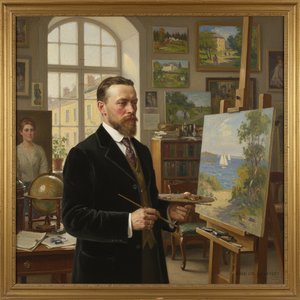
A Philadelphia Renaissance Man: The Life and Art of Alfred Bendiner
Alfred Bendiner, born in Pittsburgh in 1899, was a figure who defied easy categorization—an architect by training, an artist by inclination, and a chronicler of his time through captivating caricature. His journey began within the vibrant cultural landscape of Philadelphia, where his family’s embrace of Orthodox Jewish traditions fostered a deep appreciation for learning and artistic expression. Though initially drawn to the precision of architectural study at the University of Pennsylvania under the tutelage of Paul Philippe Cret, Bendiner possessed an irrepressible urge to capture the fleeting essence of life through drawing. This duality would define his career, leading him down paths that intertwined structural design with spontaneous observation and witty commentary. He wasn’t simply building structures; he was constructing visual narratives about the world around him.From Architectural Draftsmanship to Artistic Voice
Bendiner's early professional life unfolded within the established architectural firms of Stewardson & Page and, more significantly, under Cret—a pivotal figure in American Neoclassical architecture. He contributed to monumental projects like the Detroit Institute of Arts and the Folger Shakespeare Library, honing his technical skills while absorbing the principles of classical design. However, the rigid demands of formal architecture couldn’t fully contain his creative spirit. A master's degree from Penn provided a foundation, but it was the year spent at the American Academy in Rome that truly broadened his artistic horizons. Yet, even these experiences didn’t fully satisfy his desire for immediate expression. The Great Depression presented challenges to establishing a thriving architectural practice, pushing Bendiner toward alternative avenues for his talents. This period saw him taking on smaller commissions—alterations and additions—while simultaneously cultivating his burgeoning skills as a caricaturist.The “Hirschfeld of Philadelphia” and the Power of Spontaneous Portraiture
Bendiner’s true breakthrough came unexpectedly in 1938, when he proposed to the *Philadelphia Evening Bulletin* a unique approach to music criticism: each review would be accompanied by a live caricature of the performer, sketched during the concert itself. This audacious idea proved wildly successful. His ability to distill a musician's personality and performance into a few deft lines—often executed in the dimly lit concert hall—captivated audiences. He quickly earned the moniker “The Hirschfeld of Philadelphia,” a testament to his skill and the immediate recognition he garnered. These weren’t merely likenesses; they were insightful portraits imbued with wit and charm, capturing not just *how* someone looked but *who* they were. He later compiled these works into the 1952 book *Music to My Eyes*, solidifying his reputation as a master of caricature. Beyond music, Bendiner’s illustrations graced publications like *Holiday* and *Scribner's*, showcasing his versatility and broad appeal.Beyond Caricature: Murals, Archaeology, and a Life Fully Lived
While best known for his caricatures, Bendiner’s artistic pursuits extended far beyond the concert hall. He was a prolific muralist, creating works for institutions like Gimbel Brothers Department Store and Fidelity Bank—projects that allowed him to explore larger-scale compositions and engage with public spaces. His adventurous spirit also led him on archaeological expeditions sponsored by the University of Pennsylvania Museum, first to Tepe Gawra and Khafaji in Iraq in 1937, and later to Tikal, Guatemala, in 1960. These journeys weren’t merely opportunities for documentation; they were immersive experiences that fueled his artistic imagination and broadened his understanding of different cultures. He approached these expeditions with the same meticulous attention to detail he brought to his architectural drawings, capturing the essence of ancient sites through precise renderings. He was a member of numerous art societies—the Philadelphia Art Alliance, Franklin Inn Club, and others—demonstrating his commitment to the artistic community.A Lasting Legacy: The Enduring Appeal of Bendiner’s Vision
Alfred Bendiner died in 1964, leaving behind a diverse body of work that reflects a life fully engaged with the world around him. His architectural designs stand as testaments to his formal training, while his caricatures offer a vibrant glimpse into the cultural landscape of mid-century Philadelphia. His murals, though perhaps less widely known today, represent another facet of his artistic talent. Bendiner’s significance lies not just in his technical skill but also in his ability to connect with audiences on an emotional level—to capture the spirit of a moment and translate it into compelling visual form. He was a true Renaissance man, seamlessly blending artistry, architecture, and observation into a unique and enduring legacy. His work continues to resonate today, reminding us of the power of art to illuminate, entertain, and connect us to the past.Q&A
Alfred Bendiner 작가 작품의 컬러 프로필은 어디에서 확인할 수 있나요?
이 사이트에 등록된 작품 전반에 나타나는 Alfred Bendiner의 색채 활용은 작가의 팔레트 지놈 페이지에서 자세히 살펴보실 수 있습니다.
특정 색상 팔레트의 Alfred Bendiner 작품은 어디에서 찾아볼 수 있나요?
Alfred Bendiner의 작품은 작가의 컬러 팔레트별로 보기 페이지에서 컬러 팔레트별로 만나보실 수 있습니다.
Alfred Bendiner의 작품을 색상별로 찾아볼 수 있나요?
컬러 인덱스 페이지에서는 Alfred Bendiner의 작품들을 색상별로 모아 보실 수 있습니다.
Alfred Bendiner의 예술 세계는 시간이 흐름에 따라 어떻게 진화했나요?
Alfred Bendiner의 연대기는 작가의 활동 시기별로 분류된 작품들을 연대순으로 보여주는 스크롤 방식의 타임라인입니다.