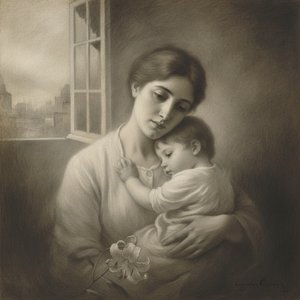
Early Life and Artistic Training
Ethel Carrick Fox (7 February 1872 – 17 June 1952) was an English Impressionist and Post-Impressionist painter, born in Uxbridge, Middlesex, to Emma Filmer Carrick and Albert William Carrick, a wealthy draper. Growing up in Brookfield House alongside nine siblings fostered a rich familial environment that undoubtedly influenced her formative years. Her artistic inclinations began early, nurtured by instruction at the Guildhall School of Music and Art and subsequently at the Slade School of Fine Art under Henry Tonks (ca. 1898-1903), where she honed her skills in capturing fleeting moments of light and color—a cornerstone of Impressionist technique. This foundational training established a trajectory toward exploring broader artistic horizons.Marriage and Parisian Years
In 1905, Ethel Carrick married the Australian Impressionist painter Emanuel Phillips Fox, marking the beginning of a collaborative artistic partnership that would reshape their lives and careers. Together, they relocated to Paris, immersing themselves in the vibrant cultural landscape of the Belle Époque—a period characterized by intellectual ferment and artistic innovation. Their Parisian residence until 1913 proved instrumental in broadening Carrick’s artistic vision, exposing her to influential figures and fostering connections with fellow artists who championed Impressionist ideals. During this time, she undertook extensive travels throughout Europe, North Africa, and the South Pacific—particularly Tahiti—capturing exotic vistas and documenting diverse cultural traditions.World War I Service and Return to Australia
The outbreak of World War I dramatically altered Carrick’s life course, compelling her and Fox to relocate to Melbourne, Australia. Recognizing the urgent need for artistic engagement in supporting the war effort, they actively participated in fundraising initiatives spearheaded by artists and dedicated themselves to bolstering the French Red Cross—demonstrating a commitment to humanitarian values alongside their creative pursuits. Following Fox's untimely death in 1915, Carrick embarked on a protracted journey spanning the Middle East, South Asia (including India), and Europe, continuing her exploration of artistic inspiration and honing her observational skills.Post-War Travels and Artistic Evolution
Carrick’s return to Australia coincided with a resurgence of interest in landscape painting—a genre she embraced wholeheartedly. She established herself as a respected teacher at the Académie de la Grande Chaumière in Paris, attracting students from across Europe and America who sought guidance in mastering still life composition and color harmony. Her artistic style evolved beyond Impressionism's initial focus on capturing atmospheric effects, incorporating bolder brushstrokes and heightened contrasts—reflecting influences from Post-Impressionist movements like Fauvism. Notably, her paintings of the 1920s showcased a more contemplative approach to floral studies, prioritizing formal beauty over mere representation.Legacy and Recognition
Throughout her life, Ethel Carrick Fox remained steadfast in her dedication to artistic expression—producing evocative landscapes, luminous flower paintings, and scenes of urban life that captured the spirit of her era. Her work gained recognition for its distinctive blend of Impressionist technique and Post-Impressionist sensibilities, securing a place among Australia’s most celebrated artists of the Heidelberg School. Furthermore, her contribution to fostering artistic education and promoting cultural exchange cemented her reputation as a visionary artist and influential pedagogue—leaving an indelible mark on the art world and inspiring generations of aspiring painters.Q&A
키워드로 Ethel Carrick의 작품을 찾아볼 수 있나요?
Ethel Carrick의 키워드별 탐색 페이지에서는 작가의 작품들을 키워드별로 모아볼 수 있습니다.
Ethel Carrick가 그린 모든 주제를 한눈에 볼 수 있는 개요가 있나요?
Ethel Carrick의 주제별 작품 모음는 작가의 작품들을 주제별로 찾아볼 수 있는 페이지입니다.
Ethel Carrick의 작품을 기법별로 모아볼 수 있는 곳은 어디인가요?
모든 매체별 페이지에서는 Ethel Carrick의 작품을 기법별로 모아볼 수 있습니다.