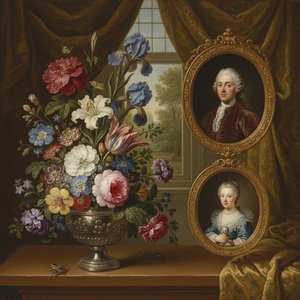
The Quiet Observer of Amsterdam
Born near the Oude Kerk in Amsterdam at Bierkaai, Jan Ekels the Elder grew up in a world defined by the scent of oil and pigment. His father operated a paint shop, a setting that likely steeped the young boy in the practicalities of the artist's craft from his earliest years. Though his family held to the Catholic faith, the specifics of his baptism remain a mystery to history. Life in the city was not always easy; his uncle was known to struggle with alcoholism, a stark contrast to the disciplined life of a craftsman. As he matured, Ekels found himself drawn to the meticulous art of the vedute, seeking to capture the precise likeness of the streets and canals that defined his home.
His talent was nurtured under the guidance of masters, including training with Jan ten Compe and serving as a pupil to Dirk Dalens, the younger. He looked toward the works of Jan van der Heyden for inspiration, learning to manipulate light and shade to bring a sense of depth to his compositions. His paintings were generally small in scale, yet they were executed with a high degree of finish that demanded close inspection. He possessed a keen eye for the way light fell upon the facades of Amsterdam and the quiet corners of Maastricht, attempting to freeze these urban moments in paint.
A Life of Labor and Adaptation
The path of an artist is rarely a straight line, and for Ekels, it was marked by physical hardship. At the age of twenty-eight, a sudden paralysis changed the course of his life. This affliction limited his ability to engage in heavy labor, forcing him to adapt his professional focus. While he continued to paint city views, these works did not always provide a steady livelihood. To sustain himself and his family, he turned to the careful work of an art restorer. This secondary vocation required a steady hand and a deep understanding of the chemistry of paint, skills that complemented his own creative output.
During his years of marriage to Maria Abt, which began in 1756, his domestic life was shaped by the religious landscape of the time. He and his wife saw their three children baptized in the Mozes en Aäronkerk and within a hidden church located in the Kalverstraat. His residence moved through the heart of the city, from the Herengracht near De Krijtberg to his final days at Kerkstraat, opposite the Amstelkerk. His legacy was carried forward by his only pupil, Jan Ekels the Younger, who would go on to find his own success in the art world.
His professional life was defined by several key elements:
- The meticulous depiction of city views in Amsterdam and Maastricht.
- The technical skill required for the restoration of existing paintings.
- A stylistic focus on the interplay of light and shadow in small-scale works.
- The transition from a student of masters to a professional restorer.
The Final Record
When Ekels reached the end of his life, he was a man who had seen the city change through both his eyes and his brush. He was buried in the Nieuwezijds Kapel, leaving behind a body of work that captured the architectural essence of the Dutch Republic. His paintings remain as quiet, highly finished records of a bygone era, offering a glimpse into the light and shadow of the streets he once walked. He lived not as a celebrated figure of grand movements, but as a dedicated craftsman who understood the weight of a single, well-placed shadow.
Q&A
Jan Ekels the Elder의 예술 세계는 시간이 흐름에 따라 어떻게 진화했나요?
Jan Ekels the Elder의 연대기는 작가의 활동 시기별로 분류된 작품들을 연대순으로 보여주는 스크롤 방식의 타임라인입니다.
Jan Ekels the Elder 작품의 연도별 타임라인이 있나요?
Jan Ekels the Elder의 작품 연표를 확인해 보세요: 작품 연대기 페이지에서 작품들을 제작 날짜순으로 보실 수 있습니다.
특정 색상 팔레트의 Jan Ekels the Elder 작품은 어디에서 찾아볼 수 있나요?
특정 색상 팔레트의 Jan Ekels the Elder 작품을 찾으시려면, 작가의 컬러 팔레트별로 보기 페이지를 이용해 보세요.
Jan Ekels the Elder가 그린 모든 주제를 한눈에 볼 수 있는 개요가 있나요?
Jan Ekels the Elder의 주제별 작품 모음는 작가의 작품들을 주제별로 찾아볼 수 있는 페이지입니다.