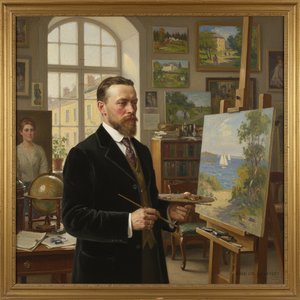
Early Life, Family and Training
Kaljo Polli was born on 30 January 1928 in Raadivere. His early years led him to the Tartu Art School, where he received his formal training. This period of study formed the foundation for a life spent working with color and composition.
Artistry ran through his household. He was married to the painter Ellen Polli. Their children continued this tradition, with his son Heitti Polli becoming an artist and his daughter Helgi Polli working as a textile artist. The lineage extends into the next generation through his grandchildren, the painter Üüli-Heivi (Uuvi) Moran and the watercolorist and graphic artist Eeli-Ethel Polli.
Artistic Periods and Style
The years between 1950 and 1960 marked a significant chapter in his development. During this decade, his focus rested on large figurative compositions. He worked to organize these figures within expansive spaces, building out the weight and presence of the human form. His brushwork during this time was directed toward capturing the structure of his subjects through these substantial arrangements.
As the decades progressed, his interests shifted toward the quietude of the natural world and the arrangement of objects. From 1970 to 1980, he turned his attention to landscapes and still lifes. These later works are characterized by a specific palette, utilizing moody northern colors. He moved away from the large-scale human figures of his earlier years to explore the subtle shifts in light and atmosphere found in the northern landscape.
Notable Works and Subjects
Polli’s brush often turned toward the people who shaped his surroundings. He spent much of his time capturing the likenesses of significant figures from Estonian culture, including Anton Starkopf, Einari Koppel, and Kaarel Karm. In 1959, he completed a portrait of Professor K. Rammul, a work that reflects the careful observation of character through oil on canvas. These portraits were not merely likenesses but studies of presence, capturing the weight of a person's role within their community.
His compositions varied in scale and focus, moving from the intimate to the expansive. He worked on pieces such as Teerada (Tiik), V. Erm, and Vana tisler, each capturing a different facet of life and labor. Some works, like Õhtune Pangodi, suggest a specific sense of place and time, while others focus on the quiet details of a subject's existence. His ability to navigate between large-scale figurative arrangements and more subtle studies allowed him to document a wide range of human and environmental experiences.
- Portrait of Professor K. Rammul (1959)
- Teerada (Tiik)
- V. Erm
- Vana tisler
- Õhtune Pangodi
Where to See the Works Today
Tracing the presence of his work requires looking through several public collections across Estonia. Between 1950 and 1989, ninety-nine works entered Estonian public collections and galleries. You can find his paintings in the Art Museum of Estonia and the Estonian History Museum. His pieces are also held by the Estonian Theatre and Music Museum. Many of his works remain in the care of the Tartu Art Museum and the University of Tartu Art Museum.
The reach of his output extends to various regional sites. The Tallinn City Museum and the Tartu City Museum both hold his art. Other collections include the Saaremaa Museum and the Viljandi Museum. These locations house the various compositions he developed throughout his career, from his early figurative works to his later landscapes and still lifes.
Q&A
특정 색상 팔레트의 Kaljo Polli 작품은 어디에서 찾아볼 수 있나요?
특정 색상 팔레트의 Kaljo Polli 작품을 찾으시려면, 작가의 컬러 팔레트별로 보기 페이지를 이용해 보세요.
Kaljo Polli 작품의 연도별 타임라인이 있나요?
Kaljo Polli의 작품 연표를 확인해 보세요: 작품 연대기 페이지에서 작품들을 제작 날짜순으로 보실 수 있습니다.
특정 매체로 분류된 Kaljo Polli의 모든 작품을 어떻게 찾을 수 있나요?
Kaljo Polli의 작품은 작가 페이지인 모든 매체별에서 매체별로 둘러보실 수 있습니다.
Kaljo Polli의 작품을 색상별로 모아둔 곳은 어디인가요?
Kaljo Polli의 컬러 인덱스에서는 작가의 작품들을 색상별로 모아 보실 수 있습니다.