The Quiet Presence of Amiens
In the streets of Amiens, the name Mathieu Prieur carried the weight of a steady hand and a practiced eye. Born around 1552, he was the son of Jean Prieur, a painter who likely introduced him to the smell of linseed oil and the texture of prepared wood. By February 23, 1579, he had been received as a master painter, a formal recognition that allowed him to take on commissions and navigate the social circles of his city. His life was measured in the steady rhythm of the workshop, moving between the private requests of merchants and the formal duties of the local guilds.
His work often centered on the "Puys," a series of paintings commissioned for specific civic or religious occasions. These pieces, stretching from 1600 to 1618, show a man deeply embedded in the life of his community. He painted for the merchant Louis de Villers, for the draper Jean de Sachy, and for the religious leaders of the Jacobins. Each commission was a contract, a specific task to fulfill for a specific neighbor. His brush moved from the celebratory atmosphere of a jubilee to the more somber, instructional themes required by the church.
The Study of Faces
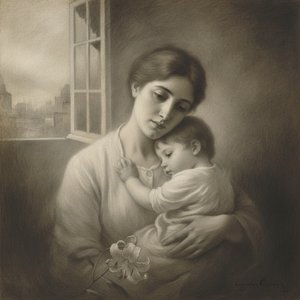
While his public commissions provided his livelihood, the true scale of his practice is found in what he left behind in his studio. An inventory taken after his death in 1619 reveals a massive collection of sketches and drawings. These were not mere practice sheets, but seven hundred portraits of men and women, varying in size and detail. He worked from life, capturing the likenesses of those who sat before him, often working on paper or card. This volume of work suggests a man who spent much of his time observing the subtle shifts in a sitter's expression.
His technical reach extended beyond the brush and into the realm of print. A portrait of Geoffroy de La Marthonie, the Bishop of Amiens, exists as an engraving by A. Dubois, based on a design by Prieur. This single signed work provides a glimpse into how his likenesses were translated for a wider audience. His output can be categorized by the nature of his subjects:
- Civic and Religious Commissions: The Puys, such as the 1600 work for Louis de Villers and the 1617 piece for Brother Firmin Pestel.
- Portraiture: A vast collection of seven hundred sketches and drawings of men and women.
- Engraving Subjects: Likenesses intended for reproduction, such as the portrait of the Bishop of Amiens.
A Legacy in Ink and Oil
The fragments that remain of his career offer a view into a life of consistent labor. Some of his works, like the Puy of 1607, survive only in pieces, yet they still hold the traces of his intent. He was a painter of the local reality, a man who documented the faces and the values of Amiens through the turn of the seventeenth century. His importance lies in this documentation, the way he captured the likeness of a merchant or a priest, preserving the specific character of his era through the simple act of looking.
Q&A
Mathieu Prieur의 작품 중 몇 점을 둘러보실 수 있나요?
전체 작품 보기 페이지에서 Mathieu Prieur의 작품 작품 4점점을 만나보실 수 있습니다.
주제별로 Mathieu Prieur의 작품을 찾아볼 수 있나요?
주제별 작품 모음 페이지에서는 Mathieu Prieur의 작품들을 주제별로 확인하실 수 있습니다.
Mathieu Prieur 작가의 작품을 감상할 수 있는 3D 가상 투어가 있나요?
Mathieu Prieur의 3D 갤러리는 작가의 작품들을 가상 3D 갤러리로 감상할 수 있는 페이지입니다.
특정 색상 팔레트의 Mathieu Prieur 작품은 어디에서 찾아볼 수 있나요?
컬러 팔레트별로 보기 페이지에서는 Mathieu Prieur의 작품들을 색상 팔레트별로 모아볼 수 있습니다.