Jeanne-Marguerite Lecadre in the Garden (also known as Woman in the Garden): Identification, Date, Medium, Dimensions, and Current Location
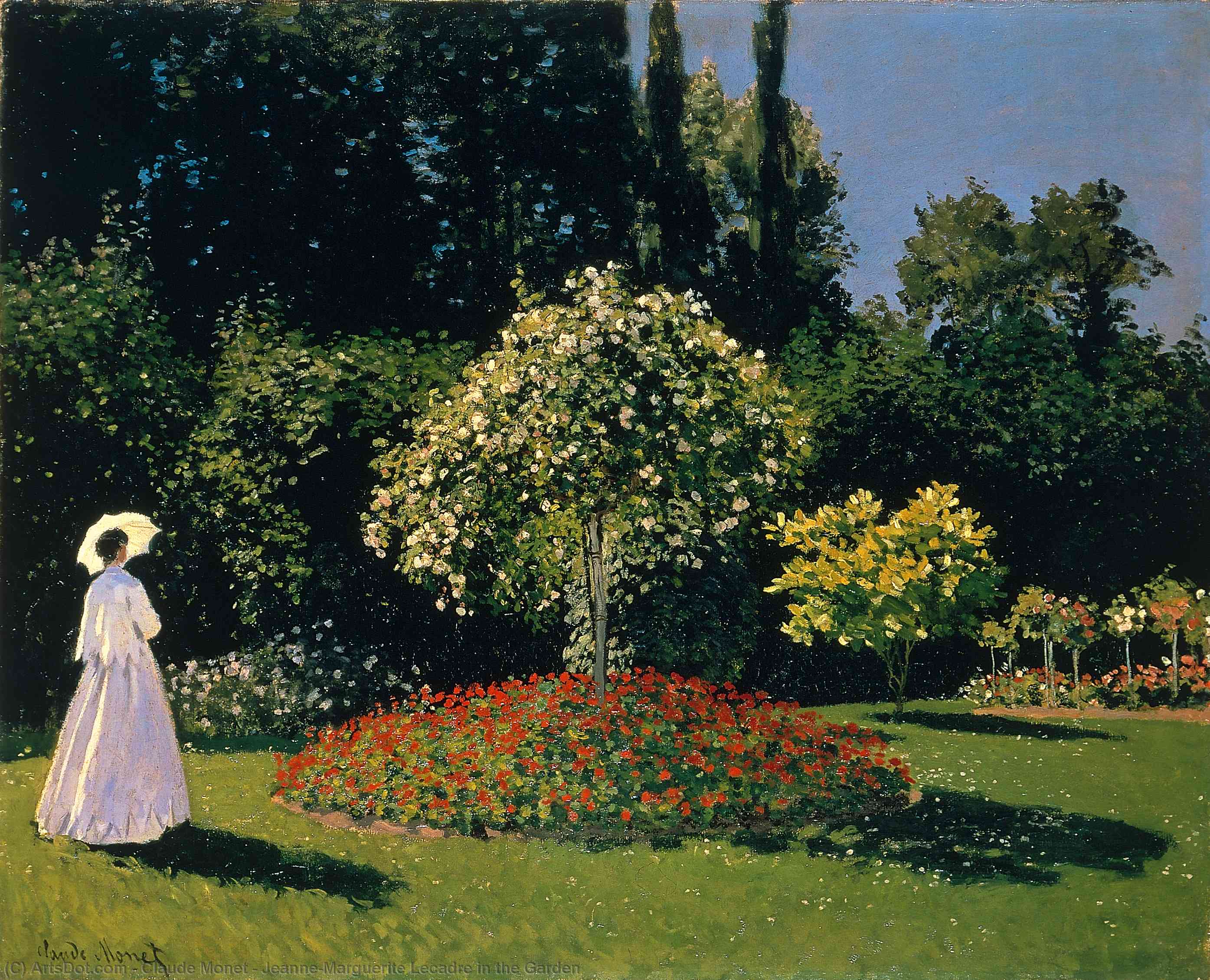
Claude Monet’s Jeanne-Marguerite Lecadre in the Garden (often referred to in catalogues and museum contexts as Woman in the Garden) is an oil painting executed in 1866–1867. The work is in oil on canvas and measures approximately 82 × 101 cm. It is preserved in the collection of the State Hermitage Museum, St. Petersburg, where it is catalogued under the museum’s inventory number ГЭ-6505.
Subject, Sitter Identification, and Site of Execution
The figure represented is identified as Jeanne-Marguerite Lecadre, associated with Monet’s extended family circle through the Lecadre branch. The painting is connected to Monet’s stay and work in Sainte-Adresse (near Le Havre) in the summer of 1867, where he produced multiple canvases exploring the effects of direct sunlight and open-air color relationships. The garden setting is generally linked to the Lecadre family property at Sainte-Adresse, situating the picture within Monet’s early practice of using familiar domestic sites and family members (or family relations) as models for plein-air experimentation.
Historical and Stylistic Context: Monet in the Late 1860s
The canvas belongs to Monet’s formative period in the mid-to-late 1860s, when he was intensively testing outdoor painting strategies while still maintaining a relatively coherent, structured pictorial order inherited from contemporary realist and naturalist practice. In this phase, Monet’s painterly aims increasingly prioritize the analysis of illumination, reflected light, and the chromatic character of shadow—problems that would soon become central to Impressionist method. At the same time, the work retains a degree of finish and compositional stability that distinguishes it from Monet’s later, more radically abbreviated facture.
Composition: Figure Placement, Spatial Organization, and Motif Structure
The composition is organized around a deliberate triadic structure: the standing female figure, the central flowering shrub/rose-tree, and a dense vegetal mass to the right. Jeanne-Marguerite is placed slightly left of center and shown in profile with her back partly turned to the viewer, a device that minimizes narrative psychology and directs attention toward optical phenomena. The silhouette of the figure—especially the luminous white dress—functions as the primary tonal anchor, sharply contrasted against darker foliage. The garden is articulated through layered planes of greenery and flowerbeds; these elements, though descriptive, are subordinated to the pictorial task of registering light across surfaces.
Color and Light: Sunlit Whites, Cool Shadows, and Reflected Illumination
A defining feature of the painting is Monet’s treatment of white in sunlight. The dress is not rendered as a single neutral tone; rather, it is modulated by a spectrum of warm highlights and cool, bluish shadow-notes, consistent with direct observation of outdoor illumination. The parasol introduces a secondary zone of optical complexity: light filtering through the fabric yields subtle warm inflections and localized tonal shifts, integrating the figure within the ambient atmosphere. Across the garden, saturated reds (notably in the flowerbed) and a range of greens are balanced by cooler passages (including a discrete patch of sky), producing a controlled chromatic harmony that supports the painting’s analytical orientation toward natural light.
Brushwork and Handling: Transitional Facture in Monet’s Early Practice
Compared to Monet’s mature Impressionist canvases, the brushwork here remains relatively regulated and descriptive, particularly in the definition of foliage masses and the modeling of forms. Nonetheless, Monet’s handling already signals an interest in surface vibration: foliage and flower passages are constructed with varied strokes and touches that suggest the scattering of light and the textural diversity of the garden. The picture thus occupies a transitional position—maintaining enough structure to satisfy mid-century expectations of legibility while embedding within that structure an increasingly modern insistence on optical truth.
Technical Findings: Revisions Revealed by Radiographic Examination
Technical study has established that the canvas underwent substantive revision during its making. X-radiography (reported in museum and scholarly contexts) indicates the presence of a painted-over male figure at the right side of the composition. This buried element suggests that Monet initially considered (or began) a multi-figure arrangement before simplifying the pictorial situation to foreground the solitary female figure and the light-analytic objectives of the scene. Such revision is consistent with Monet’s working process in the 1860s, in which compositional restructuring could accompany the pursuit of pictorial balance and the concentration on specific optical effects.
Provenance: Ownership History and Transfer to the Hermitage
The painting’s provenance is closely linked to the circulation of Impressionist works through French and Russian collections. After remaining associated with the Lecadre family circle, it entered the orbit of the Paris art trade and was handled by Paul Durand-Ruel, the dealer central to the promotion of Impressionism. In 1899, Durand-Ruel sold the work to the Moscow collector Pyotr Ivanovich Shchukin. In 1912, it passed to Sergei Shchukin, whose collection formed one of the most significant early holdings of modern French painting. Following the nationalization of private collections after 1917, the painting entered Soviet state museums, notably the State Museum of New Western Art in Moscow. After that institution was dissolved in 1948, the canvas was transferred to the State Hermitage Museum, St. Petersburg, where it remains.
Exhibition History: Public Display and Later Retrospective Visibility
The work was not primarily known through the Paris Salon system at the moment of its making. A key early public appearance occurred at the Fourth Impressionist Exhibition in Paris in 1879, where Monet exhibited it under the title Le Jardin (“The Garden”). In the modern era, the painting’s international visibility increased through loans to major retrospectives, including its presentation in the large-scale Monet exhibition at the Grand Palais in Paris (2010) and subsequent venues, which highlighted the canvas as a significant early statement of Monet’s plein-air ambitions and his evolving treatment of natural light.
Scholarly Significance: Early Monet and the Emergence of an Impressionist Optics
For specialist audiences, Jeanne-Marguerite Lecadre in the Garden offers a concentrated case study of Monet’s early negotiation between inherited compositional norms and a newly intensified optical inquiry. The sitter’s averted pose suppresses anecdotal reading and redirects attention to the mechanics of perception: how sunlight fragments across fabric, how shadows acquire color, and how a garden’s chromatic density can be organized into a coherent pictorial field. The radiographic evidence of revision further clarifies Monet’s priorities, suggesting a progressive narrowing of subject matter in favor of heightened control over pictorial emphasis and atmospheric coherence. In this sense, the canvas stands not simply as a family portrait in a garden, but as an early laboratory of Impressionist method.


 Pirkti atspaudą
 Pasidalinti
 Dalintis
 Išsamiau

 Atsisiųsti
 Panašūs eksponatai
 Rentgeno nuotrauka
 Automatinė diorama

 Skaityti daugiau






































 Stiklo variantas prieinamas tik pasirinkus dydį iki 110 cm



