

Shown: · With its frame:
 Peržiūrėti realaus dydžio版
 Pasidalinti
 Dalintis
 Išsamiau
 Vadovas

 Atsisiųsti
 Panašūs eksponatai
 Rentgeno spindulių nuotrauka
 Automatinė diorama
 Q&A
Q&A Statistika

€ 239
Rankų darbo aliejinės reprodukcijos
Rankiniu būdu tapytas aliejus ant droblio jūsų pageidaujamame dydį ir rėmuose – tai mūsų menininkų pagal užsakymą sukurtas darbas. ( Perjungti į spausdinamus版作品 Perejti prie skaitmeninių vaizdų)
Size
·Standartinis dydis
pagal užsakymą
CM
INCH
Pasirinkite iš mūsų nustatytų dydžių, atitinkančių originalaus meno kūrinio proporcijas.
Loading sizes...

plotis
aukštis
Įveskite jums reikiamą plotį ir aukštį, kad paveikslas atitiktų jūsų rėmą ar sieną. Kadangi šis darbas yra rankinio darbo, siekiant išgauti kitokios formos dydį, paveikslas gali būti šiek tiek didesnis (nuo kraštų bus palikta daugiau erdvės) arba mažesnis – pasirinkite jums patogiausią variantą. Prieš pradedant tapyti, atsiųsime jums skaitmeninį maketą patvirtinimui. Šioje puslapio nuotraukoje matomas vaizdas nėra galutinis rezultatas – jį parodys tik sukurtas maketas.
 Skaityti daugiau
Finish
·
White €1

Blurside €1

Extended €1

P118B €10

P118H €10

P118W €10

P438Z €10

P508JH €12

P508YH €12

P805H €10

P805Z €10

P919BZ €10

P919G €10

P919XJ €10

P959ZH €10

P968JZ €12

W106C €8

W218G €10

W218JH €8

W218Y €10

W307PJ €10

W316G €10

W316PJ €8

W316Y €10

W398PJ €8

W4111J €10

W500HY €15

W500JH €15

W692G €12

W849H €8

W940BG €15

W953PJ €8

H24-GOLD €30

H24-SILVER €30

H36-GOLD €45

H36-SILVER €45
Shipped in a protective tube, ready for your own framer.
Above 105 cm the frame is shipped as a kit for a professional framer — read the details.
Extras
optionalWhat do the extras include?
Examples of what can be changed: Replace face with customer photo; Add pet (e.g., replace cat with dog); Include hidden message in background; Change background landscape or elements.
After order, TopImpressionists.com team will email client for instructions and provide a mockup preview
After order, TopImpressionists.com team will email client for instructions and provide a mockup preview
Pristatymas visame pasaulyje () per 3–4 savaites, o ne įprastai – per 5 savaites. (1 lapkritis). Kokybė lieka nepakeičiama.
Apsauginis lakas
Pavadinimo lentelė
Išgraviruotos bronzinės plokštelės detalės
This elegant plaque features the artist's name and the title of the artwork, finely engraved for a timeless presentation.
It is made from bronze with a refined, elegant finish. The text is precisely laser-engraved for a sharp and permanent result. Measuring 9x2 cm, the plaque is compact yet easy to read. It's built to be durable and scratch-resistant, offering a professional, museum-quality look. Mounting is simple thanks to the included adhesive backing.
Skaidrios akrilo plokštelės informacija
The plaque includes essential engraved details such as the artist's name, the title of the artwork, the date it was created, the type of media used-like oil on canvas or watercolor-a brief description of the piece, and a QR code that links to the complete artwork information.
It is crafted from clear acrylic, offering a sleek, modern appearance. The text is UV-engraved in black to ensure strong visual contrast. With a size of 10x15 cm, it ensures optimal readability. It comes equipped with two metal hooks for secure wall mounting. The plaque is designed to be weather-resistant, making it suitable for various environments, and it includes interactive features that work seamlessly with smartphone scanning.
Juodos akrilo plokštelės informacija
This elegant plaque includes engraved information such as the artist's name, the title of the artwork, the date it was created, the type of media used (like oil on canvas or watercolor), a short description of the artwork, and a QR code for quick access to more information.
The plaque itself is made from refined black acrylic with a premium finish. The text is laser-engraved in white for high contrast and readability. Its size is 10x15 cm, designed to be easy to read. It comes with two metal hooks for professional mounting. The design is sleek and fits any interior style. It is also weather-resistant and durable, with built-in digital integration for mobile compatibility.
Stiklo variantas prieinamas tik pasirinkus dydį iki 110 cm
 Stiklo variantas prieinamas tik pasirinkus dydį iki 110 cm
- Nemokamas greitasis pristatymas visame pasaulyje
- Aukštos kokybės lininis drobė
- Pilnas siuntimo draudimas
- Muitinės mokesčių grąžinimo garantija
- Tikro spalvų atitikimo garantija
- 100 dienų grąžinimo politika (tik esant įtaigoms)
- 100% pinigų grąžinimo garantija
- Nuolaida dideliems užsakymams


Kolekcinio objekto aprašas
Inspired by Eugène Boudin's encouragement to paint en plein air, Monet meticulously observed the changing light conditions at Honfleur, resulting in this iconic depiction. Its serene beauty continues to resonate with viewers today.
Autoriaus biografija
Atraskite Klodo Monės pasaulį – impresionizmo meistro, garsaus dėl savo ikoninių peizažų, tokių kaip „Vandens lelijos“ ir „Šienapjūtės“, kuriais jis įamžino laikiną šviesą ir spalvas.
About the painting
The Composition of Honfleur
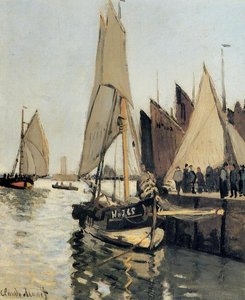
The canvas presents a view of a maritime harbor in Normandy, centered on the movement of several sailing boats upon the water. Near the foreground and along the pier, various figures are positioned, some attending to vessels and others moving along the wooden structure. The water of Étretat Bay occupies much of the lower composition, reflecting shades of blue and green. These colors are interrupted by patches of ochre and lemon yellow that mark the hulls of the boats and the clothing of the people on the shore. The boats themselves vary in scale; some appear close to the viewer near the pier, while others are smaller, situated further out toward the horizon. The sky and water meet in a way that suggests a heavy, moisture-laden atmosphere.
The application of paint relies on impasto, where thick layers of pigment create a physical texture on the surface. This technique allows the light to catch the ridges of the brushstrokes, simulating the way sunlight hits the undulating surface of the bay. Through color modulation, the artist blends different hues to suggest depth and the hazy quality of the air. The strokes are visible and rapid, particularly where the water meets the boats, capturing the immediate visual impression of the scene rather than fine, sharp outlines.
Context and Observation
Painted in 1866, this work emerged from the practice of plein air painting, a method of working outdoors to record shifting light. This approach was learned through the influence of Eugène Boudin, who encouraged observing nature directly. The scene reflects the scientific interest in optics and color perception prevalent during this period. By placing unmixed colors side-by-side, the eye is forced to blend the pigments from a distance, creating an illusion of luminosity.
The subject matter carries specific weight through its depiction of the natural and human elements. The stillness of the bay provides a sense of quietude, while the presence of the boats and people introduces a layer of maritime activity. The interaction between the light on the water and the solid forms of the masts creates a tension between the permanent structures of the harbor and the fleeting, changing qualities of the daylight. This focus on the transient moment defines the technical approach used to render the Normandy coast.
Klausimai ir atsakymai
Ar „Sailing Boats at Honfleur“ yra gera dovanos idėja?
Dovanai siūlome „Sailing Boats at Honfleur“ – Klodas Monet kaip puikų pasirinkimą Anniversary. Šis kūrinys tiktų ir kitiems progoms.
Kaip galiu peržiūrėti „Sailing Boats at Honfleur“ – Klodas Monet reprodukciją?
Norėdami peržiūrėti „Sailing Boats at Honfleur“ – Klodas Monet reprodukciją, atidarykite kūrinio Peržiūra interjere puslapį.
Kokį Klodas Monet kūrybos etapą atitinka „Sailing Boats at Honfleur“ data, nurodyta kaip 1866?
1866 m. data įtraugia „Sailing Boats at Honfleur“ į Klodas Monet kūrybinio plėtojimo Mature Period laikotarpį.
Quick facts and art quiz
About Klodas Monet

Klodas Monet
1840 - 1926, Prancūzija
Autoriaus biografija
Šviesos Įmėnimas: Klodo Monė Pasaulis
Oskar-Klodas Monet, vardas sinonimiškas Impresionizmui, nebuvo tik peizažų dailininkas; jis buvo trumpalaikių akimirkų kronikuotojas, šviesos ir spalvos poetas. Gimė Paryžiuje 1840 m. lapkričio 14 d., jo ankstyvieji metai patyrė nenumatytą posūkį, kai šeima persikėlė į Le Havrę, Normandijoje, penkerių metų amžiaus. Nors iš pradžių skirtas verslo karjerai pagal savo tėvo planus, jaunojo Klodo gimtoji meninė talentas greitai atsiskleidė, pirmiausia pasireiškiant anglies karikatūromis, pardavinėjomomis vietiniams gyventojams – tai bylojo tiek apie jo įgūdžius, tiek apie verslumo dvasią. Tačiau esminiu momentu tapo susitikimas su Ogene Boudinu. Boudinas ne tik mokė Monetę kaip dažyti; jis įskiepijo jam revoliucinę idėją – tiesiogiai iš gamtos, *en plein air* – dažyti, praktiką, kuri apibrėš jo visą meninę kelionę.
Monetės formalus mokymasis prasidėjo Paryžiuje, trumpam Akademijoje Suisse ir vėliau pas Charles Gleyre. Būtent čia jis sukūrė ilgalaikius ryšius su kitais dailininkais, tokiais kaip Ogustas Renoiras, ryšys paremtas bendromis meninėmis nuoskaudomis ir noru praspręsti iš tradicinio akademinio tapybos rėmų. Ankstyvieji jo darbai, nors ir demonstravo techninį įgūdį, neturėjo to skiriamojo balso, kuris vėliau būtų apibūdinęs jo stilių. Po to sekė neramumų laikotarpis – Prancūzijos-Prūsijos karas privertė Monetę ieškoti prieglobsčio Londone, kur jis panėrė į anglų peizažo meistrų, tokių kaip Džonas M. U. Turneris, kūrybą, pasisemdamas atmosferos efektų ir naujoviško spalvų naudojimo.
Estetinės Revoliucijos Gimimas
Grįžęs į Prancūziją Monetė tapo svarbiu buržuazinio meno sukilimo figūra. Nesumontuojant konservatyviems Salono standartams, jis suvienijo jėgas su kitais panašiais požiūriais turinčiais dailininkais, kad organizuotų nepriklausomas parodas. 1874 m. paroda pasirodė esanti lūžis ne tik Monetės, bet ir visos meno pasaulio akimis. Būtent čia buvo parodyta jo drobė „Impression, soleil levant“ (Impresionas, saulėtekis), ir iš jos kilo paniekinis terminas „impresionizmas“. Tačiau pavadinimas įsitvirtino, tapo garbės ženklu judėjui, siekiančiam užfiksuoti tikrą *įspūdį* nuo scenos, o ne jos tikslią atkartojimą.
Šiuo laikotarpiu Monetės savitas stilius sužydėjo: laisvos, matomos teptukų linijos, ryškios ir dažnai nemaišytos spalvos dedamos viena šalia kitos (technika, žinoma kaip „sudaužyta spalva“) ir nepajudinama koncentracija į nuolatinius šviesos aspektus. Jis atkakliai tęsė savo en plein air praktiką, greitai dirbdamas, kad užfiksuotų savo tiesioginę suvokimą, kol besikeičiančios sąlygos pakeistų sceną. Tai nebuvo tik tai, kaip jis *matė*, bet kaip jis *jautėsi* atsakydamas į tai – radikali nuokrypa nuo meninių konvencijų.
Giverny: Šviesos ir Atspindžių Rojus
1883 m. Monetė apsigyveno Givernyje, šiaurės vakaruose nuo Paryžiaus, įkurdindamas namą ir sodą, kurie tapo tiek jo priegloba, tiek didžiausia įkvėpimo šaltiniu. Jis atidžiai pavertė turto teritoriją išskirtine oaze, kurioje buvo egzotinių gėlių, veriančiųjų beržių ir garsiausių vandens lelijų baseino su japoniško pėdos tiltu. Tai nebuvo tik dekoratyvus sodas; tai buvo gyvenimo laboratorija, kur Monetė galėjo studijuoti šviesos efektus ant vandens, lapijos ir atspindžių kontroliuojamomis sąlygomis.
Jo gyvenimo paskutiniojoje dešimtmetyje jis beveik visą laiką skyrė vandens lelijų piešiniams. Jis imasi monumentalios Vandens lelijų (Nymphéas) serijos, sukurdamas dideles drobės, kuriose baseino paviršių vaizduoja kaip nuolat besikeičiančią spalvų ir šviesos tapestiją. Tai nebuvo tik gėlių paveikslai; tai buvo imersiniai patyrimai, skirti apgaubti žiūrovą tylios grožio ir kontempliatyvos pasaulyje. Šių darbų mastas yra kvapą atimantis, peržengiantis tradicinio tapybos ribas ir numatant abstraktaus ekspresionizmo formas.
Palikimas: Nuolatinis Poveikis Meno Istorijai
Klodo Monetės įtaka meno istorijai yra neįvertinama. Jis nebuvo tik Impresionizmo pradininkas; jis fundamentaliai pakeitė, kaip dailininkai suvokė ir atvaizdavo pasaulį aplink save. Jo akcentas į subjektyvią patirtį, jo en plein air tapybos priėmimas ir naujoji technika atidarė kelią modernaus meno abstrakcijos ir ne reprezentacinių formų tyrimams.
Monetė per savo gyvenimą pasiekė didelę komercinę sėkmę – tai retas reiškinys tarp avangardinių dailininkų. Jo darbai ir toliau įkvepia nuostabą ir žavumą visame pasaulyje, tvirtindami jo vietą kaip vieną svarbiausių Vakarų meno figūrų. Jis mirė 1926 m. gruodžio 5 d., palikęs palikimą, kuris rezonuoja per kartas menininkų ir meno entuziastų.
Pagrindinės Meninės Technikos
- Plein Air Tapyba: Centrinis jo vystymuisi, leidžiantis tiesiogiai stebėti šviesą ir atmosferą.
- Sudaužyta Spalva: Taikant mažus gryno spalvos potėpius viena prie kitos optiniam maišymuisi.
- Serijų Tapyba: Vaizduojant tą patį motyvą skirtingomis apšvietimo ir oro sąlygomis – demonstruojant laiko ir šviesos transformacijos galią.
Quick facts about Klodas Monet
- Artistic Movement Or Style: Impresionizmas
- Artists Or Movements Influenced By This Artist: ['Modernus menas']
- Artists Who Influenced This Artist:
- Eugène Boudin
- J.M.W. Turner
- Date Of Birth: 1840 m. lapkričio 14 d.
- Date Of Death: 1926 m. gruodžio 5 d.
- Full Name: Oskar-Klodas Monetė
- Nationality: Prancūzas
- Notable Artworks:
- Impression, Sunrise
- Nymphéas (Water Lilies)
- Haystacks series
- Rouen Cathedral series
- Place Of Birth: Paryžius, Prancūzija
panašūs kūriniai


Tyrinėkite meno kūrinius, suskirstytus pagal temas, stilius ir savybes.


Klodas Monet
Sailing Boats at Honfleur
() ·
With its frame: · Hand-painted in oil on linen
Total